
“You can't learn something just by watching videos”
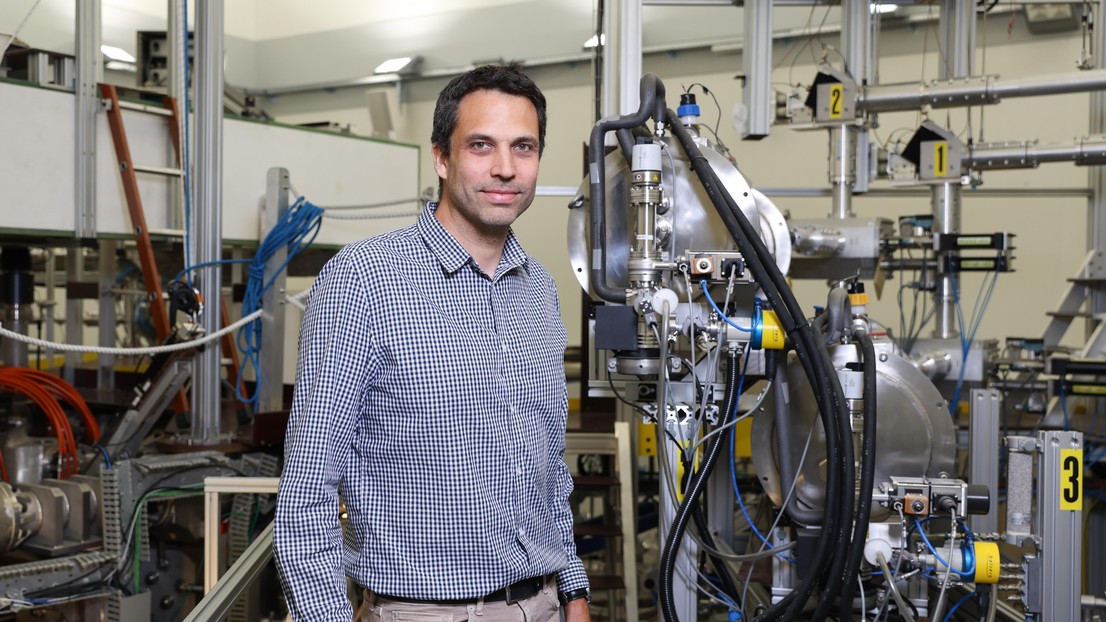
Christian Theiler, winner of the 2025 best teacher award for the physics section - 2026 EPFL/Alain Herzog - CC-BY-SA 4.0
Christian Theiler, winner of the 2025 best teacher award for the physics section, uses equipment, for both his research and teaching, that much of the world can only dream of.
When Christian Theiler played with toy cars as a boy, he imagined them as generating no pollution and even helping in the fight against climate change. This early interest in sustainability “probably came in part from my parents, as they often discussed issues related to energy production and use – and the attendant consequences,” he says.
Theiler went on to make a career out of research on clean energy. Today he’s an associate professor at EPFL’s Swiss Plasma Center (SPC), one of the world’s leading research facilities on plasma physics. The SPC is exploring the use of nuclear fusion to produce safe, abundant and clean energy. To that end, Theiler and his colleagues get to “tinker around” with equipment that’s much more impressive than a toy car: EPFL’s variable configuration tokamak (TCV) reactor. This experimental reactor contains large magnetic coils that can change the shape of plasma. “This lets us examine how plasma behaves in different configurations and study the response.”
The SPC is one of only four sites in Europe with this kind of machine. In Switzerland, EPFL’s TCV reactor plays an important role in energy-transition research. “We’ve already gained an excellent understanding of the mechanism of fusion, which is what creates the energy contained in the Sun and other stars,” says Theiler, who won the 2020 Nuclear Fusion Award. Physicists are now working to develop concrete applications for fusion, which will require overcoming a number of hurdles related to plasma’s instability and how it interacts with the reactor walls, for example. “One of our goals is to improve the reactor design so that it’s more compact and easier to operate,” he says.
“A little scared”
Theiler’s history with the SPC goes back a long way. “I first became interested in plasma and nuclear fusion during my master’s degree in physics at ETH Zurich,” he says. That’s what drew him to EPFL and its advanced plasma facility. He completed the last semester of his master’s degree at EPFL along with his PhD, obtained in 2011. Theiler then worked as a postdoc at the Massachusetts Institute of Technology, conducting research on the university’s Alcator C-Mod tokamak. He returned to EPFL in 2014 on a EUROfusion grant and joined the TCV reactor team. He was given a professorship position two years later.
My students are really motivated, which makes my job easier!
“Teaching had been in the back of my mind for a while,” says Theiler. “Partly because I’ve always enjoyed explaining things to other people, and partly because I believe education is an integral part of successful research. But I have to admit, I was a little scared at first!” While he was already used to speaking in front of hundreds of people at industry conferences, he found that “motivating students to stick with university, helping them realize their potential and, most of all, keeping them engaged is an entirely different matter.”
Cultivating personal interaction
Theiler describes his teaching style as both traditional and dynamic. “I like diving deep into topics and taking the time to explain the theoretical underpinnings with the help of a chalkboard,” he says. He also places a priority on fostering students’ analytical thinking skills. “At the same time, I devote a lot of class time to experiments and design my exercises around concrete applications.” He usually attends the practicals himself “so that I can answer students’ questions directly and, most of all, see what needs to be covered again in class. I generally try to be as available as possible for my students and prompt them to consider problems from different angles.”
Theiler is happy to don his teaching hat. “My students are really motivated, which makes my job easier!” he says. However, he doesn’t consider teaching to be a walk in the park. “It’s hard to find the right balance between not holding back students who learn quickly and assisting those who may be struggling so they don’t fall behind. We shouldn’t forget that everyone has a different way of learning and appropriating new material.” Theiler believes this makes personal interaction even more important. “I don’t think you can learn something just by watching videos. It takes variety and an active approach.”
One advantage of EPFL is that “students can gain experience with cutting-edge machines and equipment early on in their degree programs, while also obtaining a strong theoretical and mathematical foundation for the fundamental concepts,” says Theiler. “Not many universities offer that! It also helps our graduates transition more smoothly and naturally into the working world. It’s actually a win-win situation, because these bright young students play a role in stimulating and sustaining the research carried out at our School.”