
Women in Architecture and the Archives: Alice Biro and Jeanne Bueche
ACM EPFL
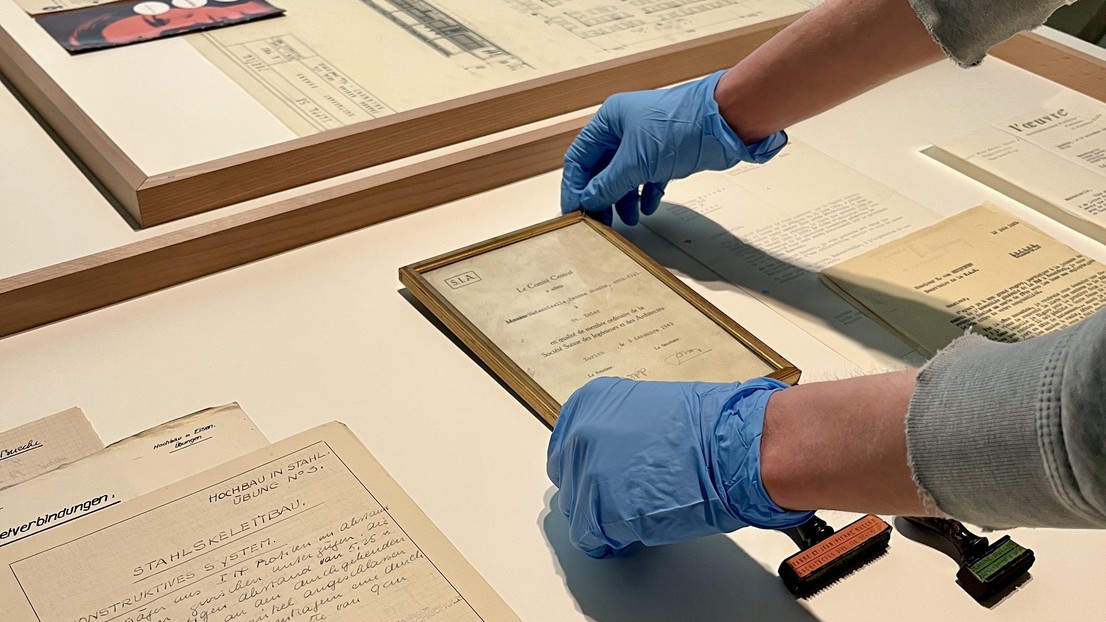
Presented in parallel with the exhibition Crossed Stories: Gae Aulenti, Ada Louise Huxtable, Phyllis Lambert, on Architecture and the City, produced by the Canadian Cultural Centre in Paris with Léa-Catherine Szacka and Catherine Bédard, and presented by Archizoom, the installation 'Unveiling the Archives: Alice Biro & Jeanne Bueche' – developed in collaboration with the Archives de la construction moderne (EPFL) – extends the reflection on the place of women in architectural history. By unveiling two trajectories drawn from the archives preserved by the ENAC Faculty, it broadens the perspective opened by 'Crossed Stories', questioning in turn the conditions of visibility, recognition, and transmission of architects’ work.
Crossed Stories: Gae Aulenti, Ada Louise Huxtable, Phyllis Lambert, on Architecture and the City
Exhibition: from 24.09 to 28.11.2025, Monday to Friday
Archizoom, SG Building, Place Ada Lovelace, EPFL
In architectural archives, the presence of women remains exceptional. This scarcity is not only due to the small number of female students and professionals during the 20th century, but also to the mechanisms of selection, transmission, and preservation that have long favored established figures and dominant networks—mostly male.
The installation Les archives dévoilées sheds light on two trajectories that escape this invisibility: those of Alice Biro (1923–2018) and Jeanne Bueche (1912–2000). Both trained at polytechnic schools (Bueche in Zurich, Biro in Lausanne), they belong to the first generation of women architects to graduate in Switzerland. Their archives, preserved at the Archives de la construction moderne (ACM–EPFL), bear witness to distinct careers animated by a shared commitment to architecture as a field of experimentation and reflection.

Trained in the 1930s under Otto Rudolf Salvisberg, Jeanne Bueche opened her own practice in Delémont in 1944. Her work, deeply rooted in the Jura region, combined houses, schools, industrial buildings, and above all, religious architecture characterized by the interplay of light and the materiality of concrete. Active in several professional associations (SIA, FAS, L’Œuvre) and participant in the Swiss Exhibition of Women’s Work (SAFFA) in 1958, she became a recognized figure in a field still largely closed to women.
A generation younger, Alice Biro left Hungary for Switzerland during the war and graduated in 1948 from the École polytechnique de l’Université de Lausanne (EPUL), the precursor of EPFL. After working at Alvar Aalto’s office in Finland, she took part in various collective projects and international competitions while also carrying out a few personal works, including her own house-studio in Gockhausen (1965). Her path, both intellectual and professional, reflects a rare openness for the time and a continuous reflection on everyday spaces.
Bringing together drawings, photographs, correspondence, and models, the installation reveals the richness and individuality of these two careers. It invites visitors to rediscover their contributions to Swiss architectural history while questioning the place of women in archives and the ways in which their work is—or is not—transmitted and recognized. Through these two figures, Les archives dévoilées encourages us to rethink the history of architecture in light of experiences often kept on the margins, yet essential to its understanding.

The exhibition Crossed Stories: Gae Aulenti, Ada Louise Huxtable, Phyllis Lambert, on Architecture and the City, produced by the Canadian Cultural Centre in Paris
▪ Curator: Léa-Catherine Szacka
▪ Associate Curator: Catherine Bédard
▪ Scenography by the studio Pitis e Associati, Milan
Within the Archizoom–ACM team:
▪ Director: Cyril Veillon
▪ Curatorial and Communication Assistant: Solène Hoffmann
▪ Scenography and Production: Dimitri Kasparian
▪ Administration: Beatrice Raball
▪ Graphic Design: Sophie Wietlisbach
▪ Mediation Workshop: EPFL Science Promotion Service
▪ Archival research and writing for the installation Unveiling the Archives: Barbara Galimberti, Kethsana Muong, and Mathias Narbel