When Paper Fails: Stabilising an Unstable Material on Display
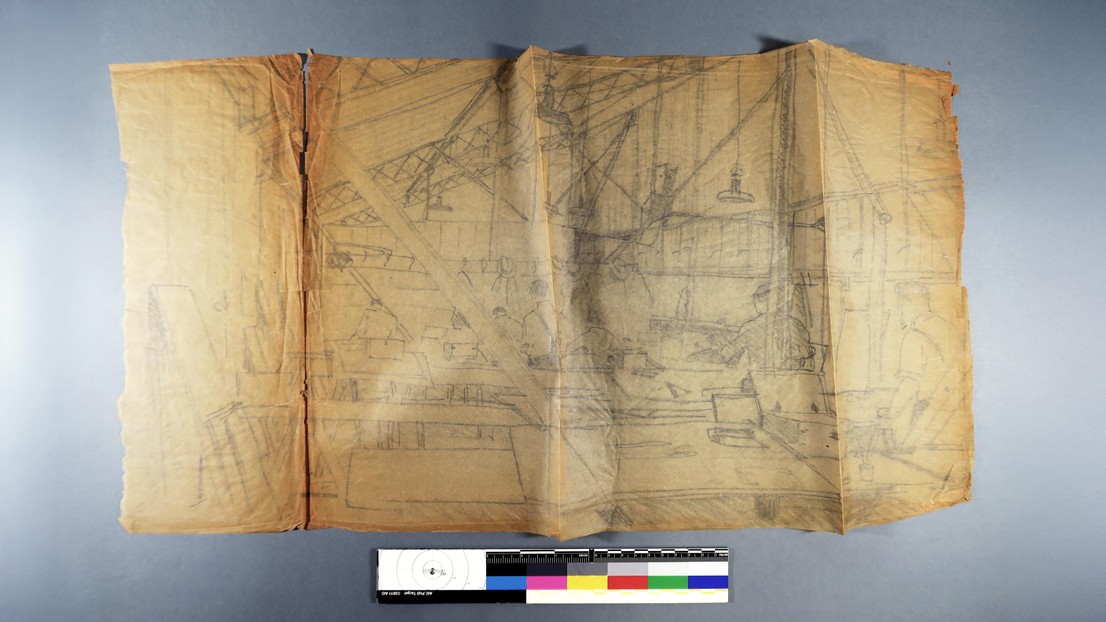
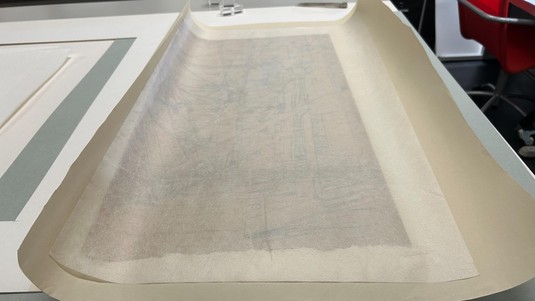
The document before restoration / © 2026 Florane Gindroz Iseli
The exhibition Des Cèdres à Dorigny (EPFL, Archizoom) featured the restoration of a tracing paper drawing by Jean-Pierre Vouga, held in the Archives de la construction moderne. Through this case, it highlighted the material and scientific challenges involved in preserving architectural documents. As materials age and respond to mechanical stresses and environmental conditions, stabilising such fragile supports becomes essential to ensure their long-term transmission and legibility.
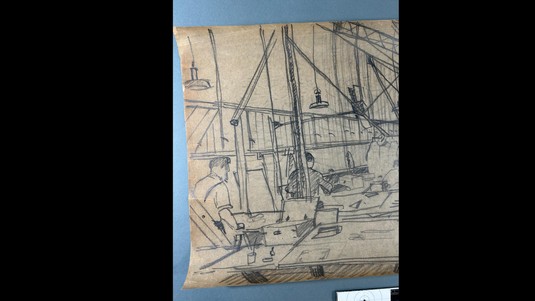
From March 4 to September 29, 2026, the exhibition From Cèdres to Dorigny: Building the School of Architecture, presented at Archizoom on the EPFL campus, traces the origins and development of architectural education in Lausanne through built and unbuilt architectural projects preserved in the collections of the Archives de la construction moderne. Among the works on display is a perspective interior sketch by Jean-Pierre Vouga, identified as depicting the studio of Paul Tournon at the École nationale supérieure des Beaux-Arts in Paris. Undated, but attributable to the 1920s–1930s, this medium-format graphite drawing on tracing paper documents a pedagogical model based on the studio and the project.
Material ageing and structural instability
Tracing paper, widely used for its qualities of translucency and precision, is today one of the main causes of its own vulnerability. This fragility is linked to its composition and manufacturing process, which alters the organisation of cellulose fibres and reduces their ability to absorb and redistribute mechanical and hygrometric stresses. Over time, oxidation and acid hydrolysis further weaken these fibres, leading to a loss of flexibility and an increase in the material’s rigidity. A pronounced yellowing, sometimes turning brown, reflects this chemical ageing of the support. The vertical folds have become rigid and brittle, and numerous tears have developed along these fold lines, some directly threatening the structural cohesion of the whole. The edges show losses, small areas of missing material that interrupt the continuity of the support. These structural alterations are compounded by permanent deformations and general cockling, resulting from the mechanical memory of folds and the loss of flexibility of the tracing paper. The graphic medium remains largely legible, but it also bears the marks of time. The document thus carries its own material history, shaped by use, handling and transformation.
Archives as physical systems in degradation
This case highlights a frequently overlooked reality: archives function as physical objects subject to measurable degradation processes, involving both material chemistry and the mechanics of supports. Architectural drawings, initially conceived as working tools, were not intended for long-term preservation. Their transition to the status of heritage artefacts therefore implies a shift in paradigm, mobilising specific expertise and intervention protocols that combine scientific knowledge with ethical principles.
Stabilising a fragile system: intervention protocol
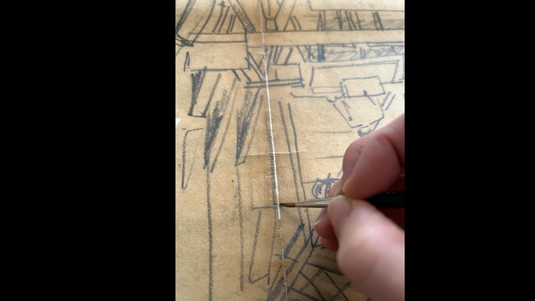
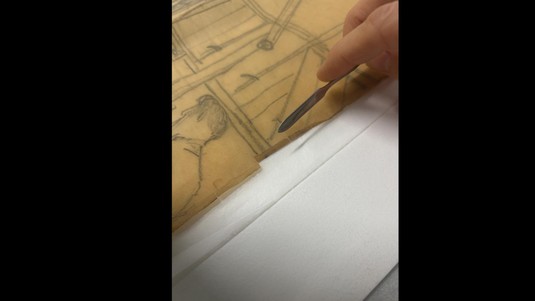
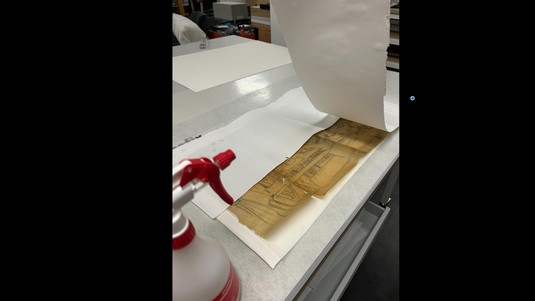
In preparation for the exhibition, it was necessary to intervene, stabilise and restore the document. The treatment was carried out by the paper conservation studio Atelier pour le papier, Florane Gindroz Iseli, Yverdon-les-Bains. Conducted between late January and late February 2026, the intervention consisted of a series of gradual operations aimed at stabilising the work without altering its legibility or erasing the traces of its material history. After surface cleaning, flattening was achieved through controlled humidification of the fold areas, allowing internal stresses to be redistributed and tears to be repositioned. These were then consolidated using a starch-based adhesive and lightweight Japanese papers selected for their mechanical properties and chemical compatibility. Losses were filled, and the whole was reinforced by lining on the verso, increasing the overall strength of the support. Pressing ensured a stable planar condition, while local retouching restored visual continuity. Final mounting in an alkaline-buffered conservation mat board, compliant with preventive conservation standards, provides a physically and chemically controlled environment.
Restoration processes and material science
Restoration thus operates at the intersection of material science and experimental practice. It requires a detailed understanding of the structure and behaviour of cellulose fibres, the mechanisms of oxidation and acid hydrolysis, and the interactions between humidity, temperature and mechanical properties. It also involves continuous consideration of the reversibility of adhesive systems and the long-term evolution of introduced materials. Restoration does not aim to return an object to an original state, but to intervene in a degrading system to slow down its kinetics, stabilise fragile equilibria and ensure its transmission under physically and chemically controlled conditions.

Conservation as environmental infrastructure
Conservation does not end with a single intervention but is part of a broader system of environmental management. Parameters such as temperature, relative humidity, light exposure and air quality directly influence the rate of degradation processes. These issues concern both exhibition spaces and the storage facilities of the Archives de la construction moderne, located on the EPFL campus and in Crissier, where nearly 300 cubic metres of archives are preserved. Conservation thus becomes an infrastructural matter, involving systems of regulation, monitoring and maintenance.
Exhibiting a drawing always involves temporarily removing it from its optimal environment, and each public presentation therefore represents a compromise between accessibility and preservation, between knowledge dissemination and material protection. Behind every displayed document lies a set of operations that ensure its material continuity and legibility.