
When hydrogen locks ice into a quantum dance
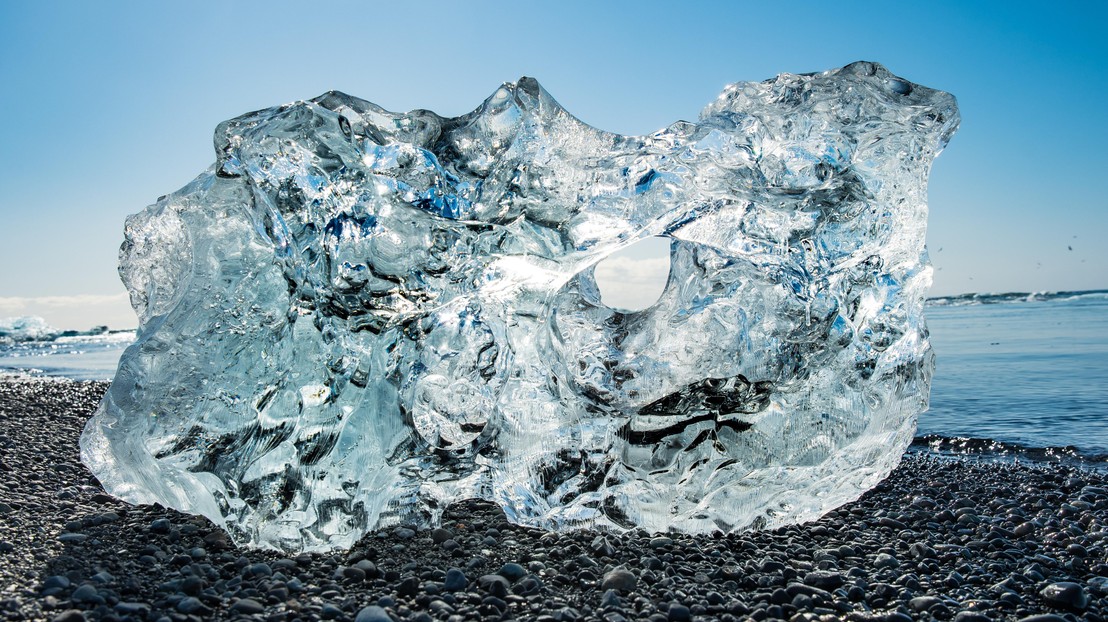
© iStock (Gestur Gislason)
Deep inside giant planets, water and hydrogen are squeezed to enormous pressures. Researchers at EPFL show that under these conditions, ice can trap hydrogen molecules and force them into an unusual quantum dance.
Hydrogen hydrates are solid, ice-like crystalline materials that trap hydrogen molecules within a water molecule lattice. It is a promising, safe, and environmentally friendly method for high-density, large-scale hydrogen storage, but generally requires high pressures (above 300 MPa) or low temperatures (< 140 K) to remain stable. Such compounds are thought to form deep inside giant planets, where water and hydrogen are subjected to crushing pressures.
A dense form known as the “C2 phase”, of hydrogen hydrate contains two interwoven identical crystal networks arranged in a simple cubic structure: one made of water molecules and one made entirely of hydrogen molecules, all packed extremely close together.
Under these conditions, quantum effects become important: Hydrogen molecules can rotate as nearly free quantum rotors but as pressure increases, the proximity of the water molecules begin to restrict this freedom. As a result, the hydrogen molecules and the surrounding water lattice start to respond together as an entangled system.
Earlier studies have detected structural changes in the C2, however, the relationship between rearrangements of the water lattice and the ordering of the trapped hydrogen molecules remains poorly understood. Without this understanding, it is difficult to fully explain how quantum effects arise in confined hydrogen or to accurately model the behavior of hydrogen-rich materials in giant planets and other extreme environments.
A team led by Livia E. Bove at EPFL has now mapped how pressure and temperature drive structural and orientational changes in hydrogen hydrate in the C2 phase. Using challenging high-pressure experiments and quantum simulations, they show that hydrogen molecules and the ice framework undergo a two-stage transformation and evolve together as a coupled quantum system.
The study is published in PNAS.
The team squeezed tiny samples between two diamonds to create extremely high pressures. They then used laser light to probe how the hydrogen molecules vibrate and rotate, while intense synchrotron X-ray beams revealed subtle changes in the crystal structure.
They also ran advanced computer simulations based on quantum physics to model how the atoms behave under pressure. These calculations let them track how the hydrogen molecules’ energy levels split and how their orientation changes as the material is compressed.
The study showed that, at lower pressures and higher temperatures, hydrogen molecules form a “quantum plastic phase”: They sit on fixed lattice sites but rotate almost freely. As pressure rises or temperature drops, this freedom decreases. At around 26 gigapascals at room temperature, hydrogen bonds in the water lattice become symmetric. This proton symmetrization stiffens the framework and reduces its compressibility.
As a consequence, when further compression is applied the hydrogen molecules line up in the same direction to reduce the volume, which makes the hydrogen hydrate crystal change shape. Around 27 to 30 gigapascals, their motion shifts from free spinning to restricted wobbling. In pure hydrogen, the same change requires far greater pressure. As this happens, the allowed energy states of the molecules separate further, showing that their motion is becoming more constrained.
The results show that hydrogen hydrate locks its molecules into ordered states at much lower pressures than pure hydrogen. This makes the material an important model system for studying how light atoms behave under extreme conditions. Beyond fundamental physics, the findings help scientists understand hydrogen-rich materials inside giant planets and may guide future research on hydrogen storage and quantum materials.
Other contributors
- Sapienza Università di Roma
- Sorbonne Université
- Institut Laue-Langevin
European Union–NextGenerationEU
French National Research Agency (ANR)
Swiss National Science Foundation (SNSF)
European High Performance Computing Joint Undertaking (“EU-Japan Alliance in HPC” HANAMI project)
Loan Renaud, Tomasz Poreba, Simone Di Cataldo, Alasdair Nicholls, Léon Andriambariarijaona, Maria Rescigno, Richard Gaal, Michele Casula, A. Marco Saitta, Livia Eleonora Bove. Dual quantum locking: Dynamic coupling of H2 and H2O sublattices in hydrogen-filled ice. PNAS 123 (7) e2526369123, 10 February 2026. DOI: 10.1073/pnas.2526369123