
What are we educating ourselves to notice?
© Cristina Agrigoroae/ 2026 EPFL
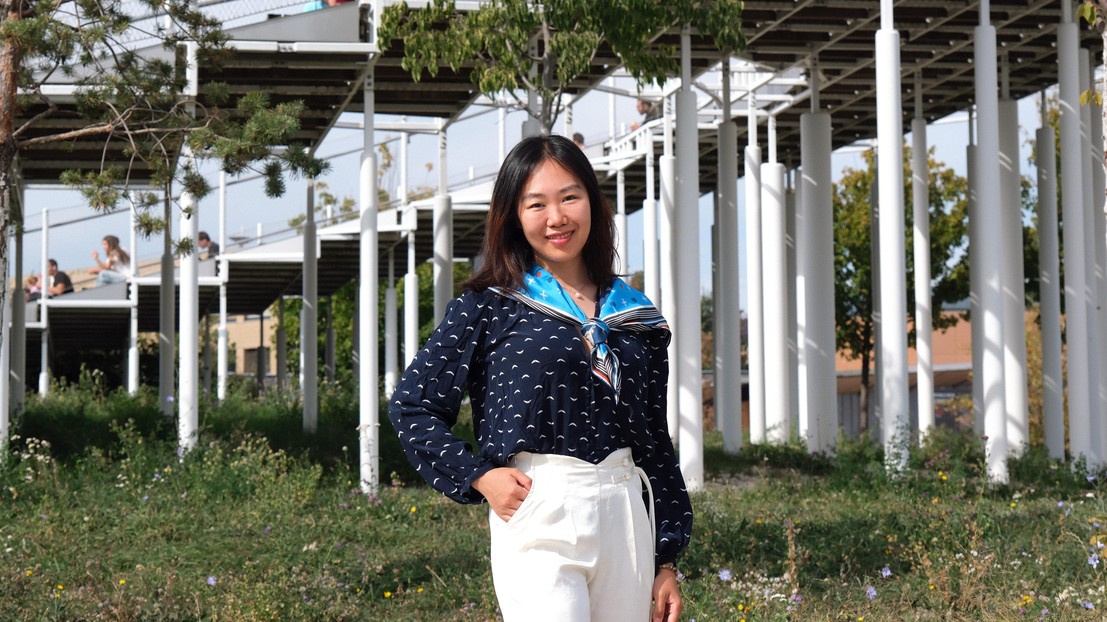
Why sustainability learning needs more than information, and why emotions are not a shortcut to action. An op-ed by Jié Gao, whose transdisciplinary research explores how to design learning spaces, combining role play, dialogue, and reflection, in which emotions and scientific reasoning work together rather than against each other when facing the complex challenges of sustainability.
A student can know a great deal about climate change and still find a climate discussion strangely distant. Another student can enter the same discussion, and suddenly connect it to consumption, inequality, or a decision they have been trying to make in their own life. The difference is not necessarily intelligence, knowledge, or motivation. Sometimes the discussion has found a bridge into one person’s world and not yet into another’s.
That small observation became one of the most important lessons of my PhD.
Sustainability science has become very good at telling us what is happening: emissions are rising, ecosystems are under pressure, technologies create possibilities and harms, and the consequences are distributed unequally. Scientific knowledge is indispensable. But information does not move automatically from a graph, a lecture or a report into how people interpret a situation, relate to others, or decide what to do next.
So what happens in between?
My research has focused on this “in between”: how instructional design can create spaces for people to articulate their thoughts, encounter perspectives different from their own, and remain in inquiry when a problem is uncertain and emotionally charged. I studied this through designing interventions with role-play narratives, dialogic and reflective practices with secondary-school and university students.
I took emotions as my entry-point. One of the risks of talking about emotions in sustainability education is that it can sound as if feelings were another lever to pull: first give people the facts, then make them care, and hopefully produce the desired behavioural change. But, I do not think that, as educators, we should manufacture care, hope or ethical sensitivity on demand.
Across many theories in affective science, emotions are part of how situations become significant to us: they orient our attention, tell us that something matters, and prepare us to respond, while remaining entangled with values, experience, relationships, and the possibilities we can imagine.
Like any form of sense-making, emotions are fallible. So are abstract models, especially when they detach a problem from the people and worlds through which they become consequential. The educational question is therefore not “reason or emotion?”, but how evidence, experience, and values can become available for careful inquiry together.
This matters whenever education asks people to work with complex problems for which there is no purely technical answer: artificial intelligence, climate adaptation, biodiversity loss, migration, public health, and the infrastructures that shape everyday life for decades.
What my studies taught me is that the decisive unit is often not the technique. It is the condition in which the technique is taken up.
Lesson 1: Consider relevance
In one classroom, a student interested in ecology and society could take a question about competition and cooperation in nature and connect it, without prompting, to consumption and capitalism. Another found that the existential questions she discussed with a friend mattered more to her than the climate governance issue discussed that day. It would be easy to call the first student engaged and the second unmotivated. That would miss the point. Both were capable of inquiry; only one had found a bridge into that particular activity.
This changed the first question I now ask about educational design. Not “Which activity should I use?” but “What could make this question genuinely enter the world of these people?” Relevance is one of the conditions under which intellectual work becomes meaningful.
Lesson 2: Emotional permission
A second example concerns emotion itself. Before inviting a group into a difficult discussion, I sometimes used a small mood check: a low-stakes opportunity to notice or name what was already present in the room, with no obligation to explain it. This was not therapy or compulsory disclosure; its function was almost the opposite. By making it legitimate not to arrive as a disembodied reasoning machine, the room could sometimes sustain greater complexity rather than less.
Emotional permission is not the same as emotional performance. One of the students was highly articulate and systemically aware, yet described needing time after a conversation to know what she felt. Immediate response was tiring rather than liberating. Had I treated behaviourally visible participation as the sole measure of engagement, I could have mistaken a different temporal rhythm for absence. The practical implication for facilitating collaborative inquiry is this: build more than one way into an inquiry — speaking, writing, contemplating, pair talk before group discussion, or improvised role-play before returning to reflection later. Otherwise we may create conditions for conformity to the format rather than supporting meaningful participation and capabilities.
Lesson 3: Exploring unfamiliar perspectives
A third lesson was almost embarrassingly simple but easy to miss in the intellectualised environment of higher education. Students sometimes explained that they felt heard because another person turned toward them, made eye contact, nodded, built on previous discussion, or allowed a pause before replying. Nobody needed to announce “I am practising active listening.” Listening was happening through bodily interactions, affordances in the space, rhythm and joint attention.
We often treat capacities as possessions located inside individuals: critical thinking, empathy, emotional regulation, perspective-taking. But whether they become possible in a particular moment depends partly on relations among agents and their environment. A table with one boardgame or many individual screens can invite attention or scatter it. An invitation to role-play a relatable or unrelatable character makes speaking easier or harder. Period one and period seven are not the same learning environment even if the lesson structure is identical.
Role-play is an especially interesting technique often used in climate education. Giving participants designed characters could reduce the personal risk of exploring unfamiliar perspectives. But the richer moments often came when someone moved between the character and themselves or reflected on the distance between them: “I loved my character, but I actually think…” Allowing such movement also creates conditions for reflective dialogue. A stance such as pessimism or optimism about the future held too rigidly can close inquiry down quickly. Good design did not eliminate ambiguity between different stances; it gave participants room to work with it.
A change in what we can teach students to notice
These examples are modest compared with the scale of the polycrisis, and my studies were small and situated: a university pilot, a four-session school implementation, and a workshop with experienced contemplative practitioners. I did not aim to demonstrate that a dialogic inquiry exercise turns students into responsible citizens or produces collective action. What I can say more confidently is that the same design created bounded opportunities for perspective-taking and emotional awareness, and that these opportunities were taken up differently depending on conditions such as topical relevance, peer dynamics, role flexibility, and physical states. The practical lesson is not a recipe. It is a change in what we can learn to notice.
This is also where I think emotional capabilities can be relevant to science and engineering education. Engineering rightly values analytical rigour, precision, and the ability to solve difficult problems. But when a problem is translated mainly into the formats our tools handle well, what recedes into the background?
Take carbon-footprint calculators, which are used in some upper-secondary sustainability and science teaching. They make emissions tangible and allow people to compare activities, but they also make a pedagogical move: By translating emissions mainly through individual or household consumption, they foreground these actors as main sites of responsibility, while backgrounding the infrastructures and political-economic systems that shape our choices. A calculation can be technically correct while its frame still needs questioning: who and what gets counted, what is left out, and when does a tool help us understand responsibility - or obscure how responsibility is organised collectively? Critical pedagogy makes such assumptions open to inquiry, since measurement can make some things comparable while making the hard-to-measure seem less real.
A transdisciplinary approach
Before asking "How can we optimize this?", we should ask: better at what, for whom, and at what cost to those with less power to shape the system? These are not objections to engineering or measuring. They are part of doing them responsibly, especially when designs affect children, marginalized communities, or future generations who cannot sit at today’s decision-making table.
This is where my training in philosophy became a research tool. It taught me to ask what assumptions and normative visions sit inside seemingly neutral goals. The learning sciences then brought those questions into real rooms, with schedules, bodies, institutional constraints, diverse cultures, and prior knowledge. My doctorate thus became an experiment in transdisciplinary work, moving between ethics, design, partnership, and evaluation.
This is also why I think translation across disciplines cannot remain an invisible extra if learning sciences are to support sustainability transitions. Sustainability education is not a one-way transfer of knowledge: different actors hold different knowledge, exposures to harm, and capacities to act. Scientific methods must meet practical knowledge, disagreement, and institutional realities.
Engaged knowing and asking relevant questions
I have started drawing on philosopher Hanne De Jaegher’s notion of “engaged knowing”: knowing that remains answerable to evidence while recognising that knowers are situated, involved, and sometimes transformed through what they come to understand. An engineering student might learn not only to calculate an environmental impact but to ask who bears it and who was missing from the problem definition. A research consortium might budget not only for data collection, analysis and publications, but for building a shared understanding with practitioners and citizens. None of this requires abandoning excellence. It asks us to broaden what excellence is accountable to.
At EPFL, that question feels especially alive. We educate people who will design technologies, infrastructures and organizations with consequences far beyond the campus. Excellent education should ask not only what graduates can solve, but what kind of world their skills help make workable, for whom, and at whose expense.
My thesis does not offer a step-wise solution for doing this. It offers a set of places to look. Is the question relevant to the people in the room? Is there room to experience difficulty without having to perform the “right” value? Are there multiple ways to participate? What assumptions are embedded in the tools already being used? Which institutional conditions expand or constrain people’s agency?
These are questions educators can ask. They are also questions researchers, engineers, managers and citizens can ask.
My public defence in October closes the doctoral project, but I would like it to open a broader conversation with a question that I am carrying beyond the thesis: What does your field, education or profession train you to notice first — and what might it make less visible?
If sustainability transitions require scientific knowledge, technical capacity, democratic deliberation and care for people who are vulnerable now and in futures we will not inhabit ourselves, then perhaps learning begins there: not with certainty, but with the capability of noticing what our own ways of knowing leave at the edge of the frame.