
“We have a fundamental right to make mistakes”
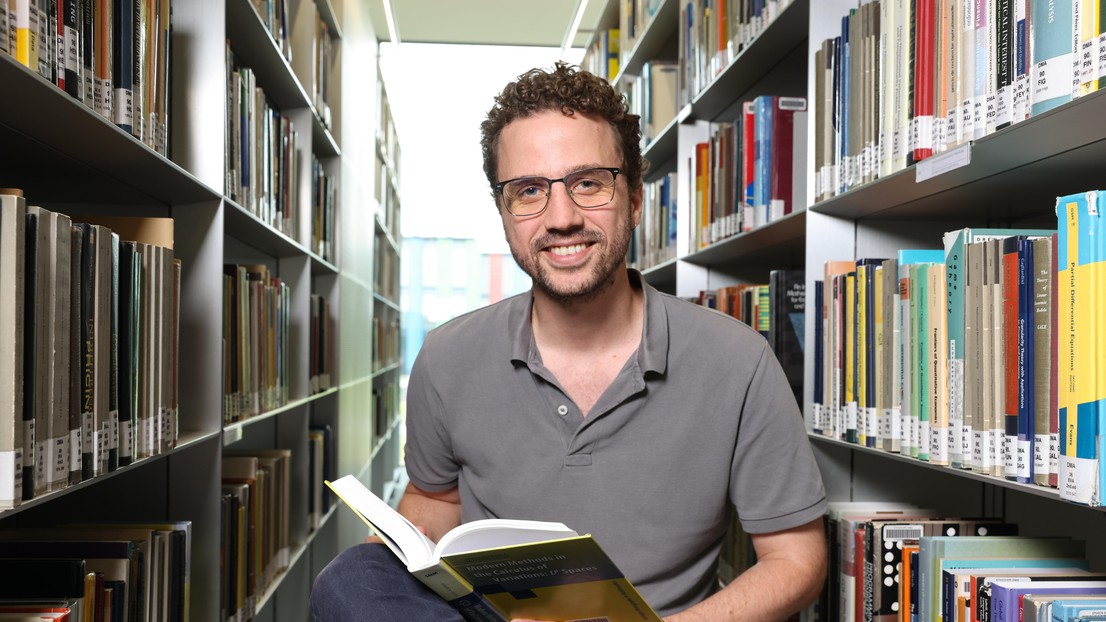
David Strütt was recently named the best teacher for the mathematics section in 2025 - 2025 EPFL/Alain Herzog - CC-BY-SA 4.0
David Strütt has been enamored with science ever since he was a kid. Yet he’s quick to point out that what really matters in life is our relationships – not how good we are in a given field. Strütt was recently named the best teacher for the mathematics section in 2025.
For David Strütt, the transition from high school to college was traumatic. “The identity I’d built up as a student came crumbling down,” he says. That identity was based on getting top grades in science. “I’d dreamed of going to EPFL ever since I was eight years old.” But when he started there in 2008 with the goal of getting both a bachelor’s and master’s degree in mathematics, “it was a real shock.” The days of smooth sailing were over. “The classes were really hard, and I thought I simply wasn’t going to make it past the first year.” He adds that he “struggled with some mental health issues.”
Closing the loop
However, the young Strütt summoned up his courage and kept going to class and “being social.” Most significantly, “I learned how important it is to have a plan B. That keeps you from constantly feeling like your whole life is hanging in the balance.” His own plan B was drama school, as he did a lot of theater alongside his studies at EPFL. “When I sat down to take the final exams at the end of my first year, I was sure I’d fail.”
Yet he passed. And he’s done so well since then that he’s never left the School. In September 2026, Strütt will have spent more than half of his life at EPFL: first as an undergrad, then as a graduate student, and now as a teacher and scientist. “I tell new students the same story every semester – I didn’t understand anything when I took my first analysis class, then ten years later I gave my first analysis class!”
Social animals
Strütt is just as passionate about math now as when he was a teenager, when he remembers “being quite gifted – and a know-it-all!” He tries to impart his enthusiasm to everyone around him, such as by developing educational tools that can be used beyond EPFL. One such tool is Matheminecraft, a video game modeled after the similarly named bestseller.
What’s fundamentally changed for Strütt is “my relationship with math, which has become much healthier. I learned – albeit the hard way – that in the end, math isn’t so important. It’s great to be able to make a living doing something I enjoy, but that doesn’t define me as an individual.”
This is also a key message he conveys in his teaching, which he does both in the mathematics section and through EPFL’s Propaedeutic Center for first-year students. “It’s very important for me that my students understand they won’t be judged on their skills while they’re learning, and that it’s perfectly OK to have trouble understanding something – or even many things!” he says. “That doesn’t make them losers, no matter what some people may think.” That said, “I do give my students exams at the end of the semester. But their learning trajectory doesn’t have to be linear. And above all, they need to know they have a fundamental right to make mistakes.”
Strütt strongly encourages his students to nurture their social ties. “You can get by just fine in life without a university degree. But it’s almost impossible without people around you,” he says, before adding: “You’ll forget much of the math you learn, but friends are for life!”
Drawing from the entertainment industry
For Strütt, “teaching math is a daily pleasure.” Then he corrects himself: “Actually, I should say ‘interacting with students’ is a daily pleasure.” That’s because it doesn’t have to be formal teaching – he also enjoys helping students with their exercises or simply answering their questions during a chat in the hallway. And the pleasure is clearly mutual, as EPFL students have selected him twice for the Polysphère d’Or award – in 2020 and 2025.
When Strütt gets up in front of the classroom, with dozens of pairs of eyes staring at him, he likes to “put on a show – which is a lot of fun too,” he says. Here, his amateur acting experience comes in handy.
Strütt believes that laughter and amusement are useful tools for getting and keeping his students’ attention. “I find it disappointing that our educational system basically draws a line between learning and playing.” He borrows freely from techniques used in the entertainment industry – whether from stand-up comedy, acting, YouTube or even Twitch – to make students laugh. And he lets his own excitement show: “One thing I learned from acting is that having fun is contagious!”