
Water-soluble 3D micro molds for complex-shaped lipid microparticles
© 2025 EPFL
Congratulations to our colleague Dr. Jongeon Park, for his recent publication entitled "Additive manufacturing of water-soluble 3D micro molds for complex-shaped lipid microparticles" in the journal "Nature Communications".
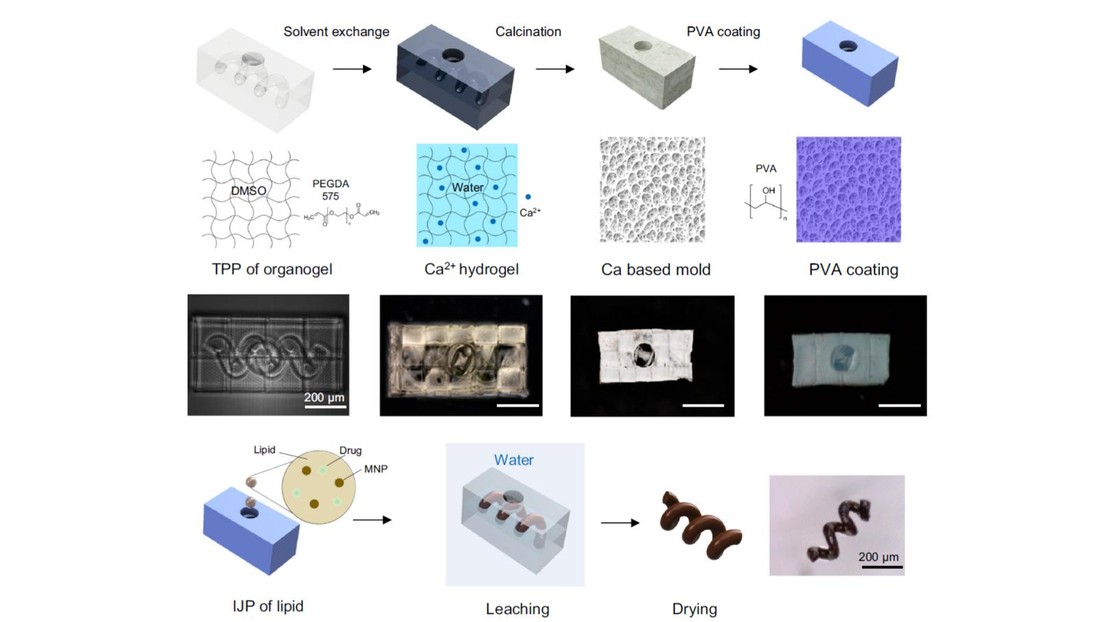
Micro and nanoparticlesmade from polymers,metals, ceramics, and lipids are crucial for biomedical devices, energy storage, and electronics. Traditional fabrication methods like grinding, milling, and emulsification result in monolithic shapes and heterogeneous sizes. To improve shape control, techniques such as photolithography, inkjet printing (IJP), and molding are employed. Water-soluble molds are particularly promising for materials with solvent incompatibility, thermolability, and poor mechanical properties. Among them, lipids are interesting for their use in biomedical applications, however, current fabrication methods limit lipid microparticles to monolithic spherical shapes. This study presents calcium-based water-soluble 3D micro molds fabricated using two photon polymerization (TPP) for complex-shaped lipid microparticles. TPP-fabricated organogels are converted to hydrogels, loaded with calcium nitrate, and calcined into Ca-based materials. Lipids are infiltrated into PVA-coated Ca-basedmolds via IJP, and selective mold leaching in water creates lipid microparticles with 2 μm resolution. The lipid microparticles can encapsulate and release lipophilic and hydrophilic drugs.
For more details, please visit: https://www.nature.com/articles/s41467-025-56984-7
Authors acknowledge funding from the European Research Council (ERC) under the EuropeanUnion’sHorizon 2020 research and innovation program (Project “MEMS 4.0”, ERC-2016-ADG, grant agreement No. 742685).