
Wafer-scale lasers bring fiber performance to photonic chips
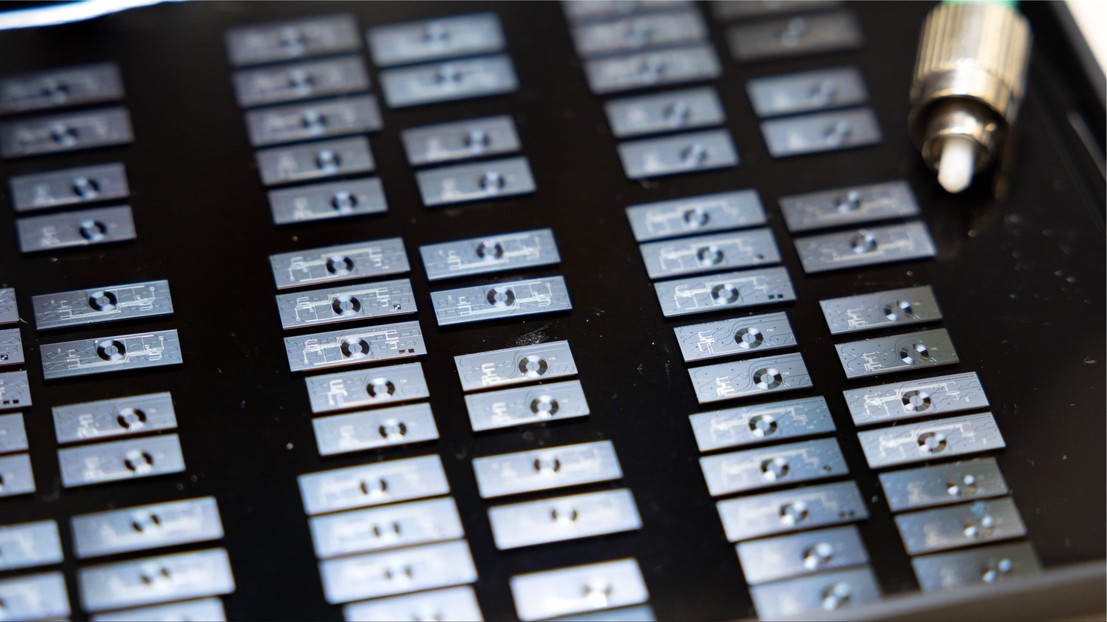
Volume-manufactured, erbium-doped, high-power tunable waveguide lasers. Credit: Yang Liu, Tobias Kippenberg © 2026 EPFL
Researchers at EPFL have developed the first wafer-scale, foundry-compatible erbium-doped integrated lasers, combining industrial manufacturability with performance approaching that of state-of-the-art erbium‑doped fiber lasers.
Erbium-doped fiber lasers are widely regarded as the benchmark for ultra-low-noise, highly stable light sources used in telecommunications, LiDAR, precision sensing, and quantum technologies. Their performance stems from the unique properties of erbium ions, which provide long excited-state lifetimes, low noise, and strong temperature stability.
Yet these lasers typically rely on bulky optical fibers and complex assembly, limiting their integration into compact photonic systems.
Researchers at EPFL led by Tobias J. Kippenberg have now taken a major step toward solving this problem by integrating erbium-based lasers directly onto silicon photonic chips. Their approach implants erbium ions into ultra-low-loss silicon nitride (Si₃N₄) waveguides using a process compatible with standard semiconductor manufacturing tools.
The study is published in Nature Communications.
Crucially, the researchers redesigned the photonic platform using thinner, 200-nm-thick waveguides. This reduced the required ion-implantation energy from around 2 MeV to below 500 keV, allowing the fabrication process to run on industrial 300-mm semiconductor equipment. The change enables wafer-scale production while also improving device performance.
Wide tunability and high output power
The resulting chip-scale lasers combine compactness with performance approaching that of traditional erbium-doped fiber lasers.
The devices achieve a record 91-nm tuning range that spans nearly the entire C- and L-bands used in optical communications.
They also deliver up to 47.6 mW of fiber-coupled output power and exhibit an intrinsic linewidth of just 78.5 Hz, a measure of the laser’s spectral purity. Together, these metrics place the devices in the same coherence range as commercial erbium-doped fiber lasers while offering broad tunability on a chip.
The integrated architecture also supports stable single-mode emission across the tuning range, enabled by a Vernier-filter cavity design that selects the lasing wavelength on chip.
Stable operation under demanding conditions
Beyond performance, the EPFL team demonstrated the robustness required for real-world photonic systems.
The lasers operate at temperatures of up to 125 °C, higher than the operating range of many semiconductor lasers. Long-term measurements also showed less than 15 MHz of frequency drift over six hours, indicating strong stability for applications requiring precise optical frequencies.
The devices also tolerate substantial optical back-reflections without losing coherence. Such reflections often destabilize conventional integrated lasers, which could simplify the design of future photonic circuits.
“This result removes one of the last barriers to bringing fiber-laser performance onto a chip,” says Tobias J. Kippenberg. “It means that wafer-scale, high-coherence rare-earth lasers can now be manufactured using standard semiconductor tools.”
Toward scalable photonic systems
By combining wafer-scale fabrication with high power, ultra-narrow linewidth, and broadband tunability, the work establishes a scalable platform for rare-earth-doped photonic integrated circuits.
Such integrated lasers could enable mass-manufacturable, high-coherence light sources for a wide range of technologies—from optical communications and data-center interconnects to precision metrology, LiDAR, and emerging quantum systems.
Other contributors
- EPFL Institute of Electrical and Micro Engineering
- Varian Semiconductor (Applied Materials)
Swiss National Science Foundation (SNSF)
Xinru Ji, Xuan Yang, Yang Liu, Zheru Qiu, Grigory Lihachev, Simone Bianconi, Jiale Sun, Andrey Voloshin, Taegon Kim, Joseph C. Olson, Tobias J. Kippenberg. Wafer-scale manufacturing of ultra-broadband, high-power erbium-doped integrated lasers. Nature Communications 10 March 2026. DOI: 10.1038/s41467-026-69787-1