
UN archivists visit the ACM
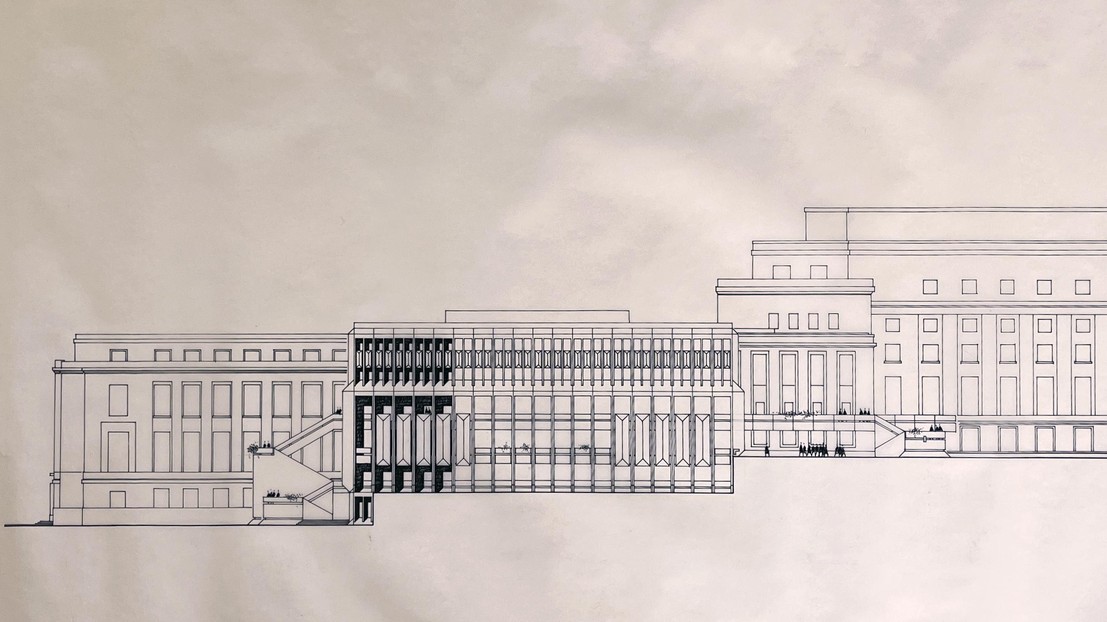
© 2026 EPFL / Fonds Gaillard
On January 8, the Archives de la construction moderne (ACM) at EPFL welcomed a delegation from the United Nations Archives in Geneva for a discovery and exchange visit. The visit provided an opportunity to present the ACM’s collections and practices, to discuss shared archival issues, and to highlight several emblematic fonds related to the Palais des Nations. Through the ACM’s collections, the visit illustrated the richness of archives as sources for documenting the history of construction, landscape, and International Geneva.
On January 8, the Archives de la construction moderne (ACM) at EPFL welcomed a team of archivists and librarians from the United Nations Archives in Geneva for a discovery and exchange visit focused on presenting collections and sharing professional practices. The meeting fostered constructive dialogue between heritage institutions, addressing the role of archives in documenting the history of construction, landscape, and international institutions, as well as shared professional challenges.
The visit provided an opportunity to present the ACM’s missions and activities related to the processing and valorisation of archives of architecture, urbanism, and landscape. Discussions addressed common issues such as the management of large-format documents, the conservation of fragile media, the preservation of digital records, and the contextualisation of fonds for research purposes. The visit also highlighted that the ACM and the United Nations Archives rely on shared tools and standards for archival description, notably the AtoM (Access to Memory) system, which underpins both our research platform Morphé and the UN platform in Geneva. These open-source platforms make it possible to structure fonds according to international standards, document relationships between records, creators, and contexts, and provide access to archives within a framework of interoperability, data sustainability, and reuse of archival corpora.
The visit included the presentation of several emblematic documents and files from our collections, as well as materials more specifically related to the Palais des Nations, notably from the Correvon and Gaillard fonds. It continued with visits to the storage facilities located on the EPFL campus and at the Crissier site, which houses in particular the collection of nearly 1,000 architectural models that the delegation was able to explore.
Henri Correvon
Among the collections presented, a file from the Henri Correvon fonds offered particularly rich insight into the landscaping of the Palais des Nations gardens in the 1930s. Commissioned by the League of Nations for tree planting and various landscape interventions, Correvon left behind a corpus documenting the everyday work of landscape design as it developed through a series of decisions and adjustments. Two garden plans occupy a central place within the file. Depicting trees, planted areas, and paths, they graphically translate planting intentions and relate administrative decisions to their spatial implementation.

André Gaillard
A file from the André Gaillard fonds provided another perspective on the history of the Palais des Nations, focusing on an extension project developed between 1967 and 1973. Although the file contains only façade drawings, these are sufficient to convey the main features of the project. Designed by Eugène Beaudoin (chief architect), Arthur Lozeron, François Bouvier and André Gaillard, the project reflects architectural thinking aimed at supporting the evolving activities of international organisations in Geneva.

Traces of International Geneva
The visit also served as a reminder that the Palais des Nations and, more broadly, Geneva’s international institutions are represented transversally across numerous fonds preserved at the ACM. Beyond the Gaillard and Correvon fonds, other collections (notably the Jean Tschumi, Lamunière, or Steinmann fonds, to name just a few) provide material documenting different moments and aspects of the history of International Geneva. Plans, drawings, technical files, correspondence, and administrative records constitute traces produced by various actors in different contexts. In today’s context, marked by renewed questions regarding the role, adaptation, and long-term sustainability of international organisations, these archives offer reference points for situating transformations of the built environment within a longer historical perspective.