
“Twenty students can be more intimidating than 100 peers”
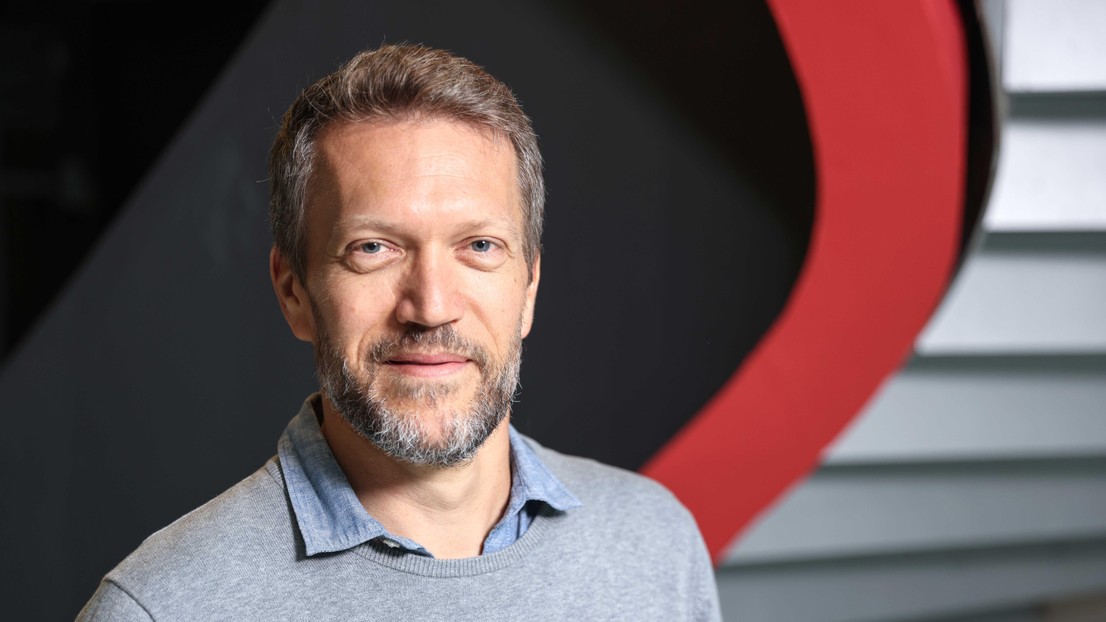
Mathieu Salzmann, 2025 best teacher award for the digital humanities section. 2026 EPFL/Alain Herzog - CC-BY-SA 4.0
Mathieu Salzmann initially studied to be an electrician but ended up becoming a leading expert in machine learning. And he’s now won the 2025 best teacher award for the digital humanities section.
Mathieu Salzmann’s experience is a perfect example of the flexibility and broad range of opportunities offered by Switzerland’s educational system. He started out on the conventional high-school track but then decided to switch gears: “I transferred to a vocational school at the end of my freshman year. Regular high school didn’t really suit me, and if I had continued down that path, I might have given up on my studies,” he says.
Salzmann still ended up pursuing a higher education. After completing his Swiss vocational training certificate, he went on to acquire a vocational high-school degree, which enabled him to enroll in EPFL’s computer science section. Around ten years later, he graduated from EPFL with a PhD in computer science.
Salzmann’s interest in computers developed gradually. “I’m not a digital native,” he says. “I still remember the day when my mother, who was a teacher, came home with our very first Mac.” He became familiar with the computer by playing video games and grew curious about programming – “but I didn’t really get into it at that point.” His taste for coding came later, when he took computer science classes as part of his vocational training in electronics.
Circling the globe
Salzmann completed his PhD at EPFL on the 3D reconstruction of deformable surfaces using monocular images. He then worked as a postdoc at UC Berkeley and TTI-Chicago. He subsequently headed to Australia, where he took a senior researcher position with the National Information and Communications Technology Australia (NICTA) center, affiliated with the Australian National University.
In 2015, Salzmann returned to Switzerland and joined EPFL’s Computer Vision Laboratory (CVLab), where he now works as a lecturer and senior scientist. In 2024, he was named Deputy Chief Data Scientist of the Swiss Data Science Center – a national research center established jointly by EPFL and ETH Zurich (joined later by the Paul Scherrer Institute) to promote data-driven science that makes a positive societal impact.
“EPFL introduced a master’s in digital humanities program at roughly the same time I came back from Australia,” says Salzmann. He developed an introduction to machine learning class as part of this program and then used the curriculum as a basis for a bachelor’s class he began teaching in 2019 within the computer science and communication systems section.
Rookie mistakes
“That was the first time I had taught a class,” says Salzmann. “I was already accustomed to giving presentations to hundreds of people, but finding myself in front of a classroom of students was intimidating!” Fortunately, it turned out to be “a nice surprise.”
Salzmann patterned his curriculum after training programs he found online. He took a meticulous approach, but that didn’t prevent him from making a few rookie mistakes, including a common one: “I tried to cram too much material into the first semester,” he says.
Today, after eight years of teaching, Salzmann has hit his stride – although he does come up against new challenges from time to time. One example was in the fall of 2024, when the number of students in his machine learning class jumped to 450 after the class format changed.
A trial-and-error mindset
Salzmann is careful to structure his class in a way that supports students’ learning. “I aim to give them a common theme that they can use as a guidepost throughout the semester,” he says. However, he admits that he hasn’t yet found the secret to interacting with the entire classroom instead of “only two or three of the same people.”
Unlike Salzmann himself, most of his students are digital natives. But that doesn’t mean they were born knowing computer science. “What I have noticed is they incorporate new technology – like the latest artificial intelligence models – much more readily into their projects,” he says.
This probably reflects the widespread adoption of such technology, but it also points to a paradigm shift under way. “Today’s youth are more inclined to try something new with the idea that, even if it fails, it’s no big deal.”