
“To create Scala, we could start from scratch”
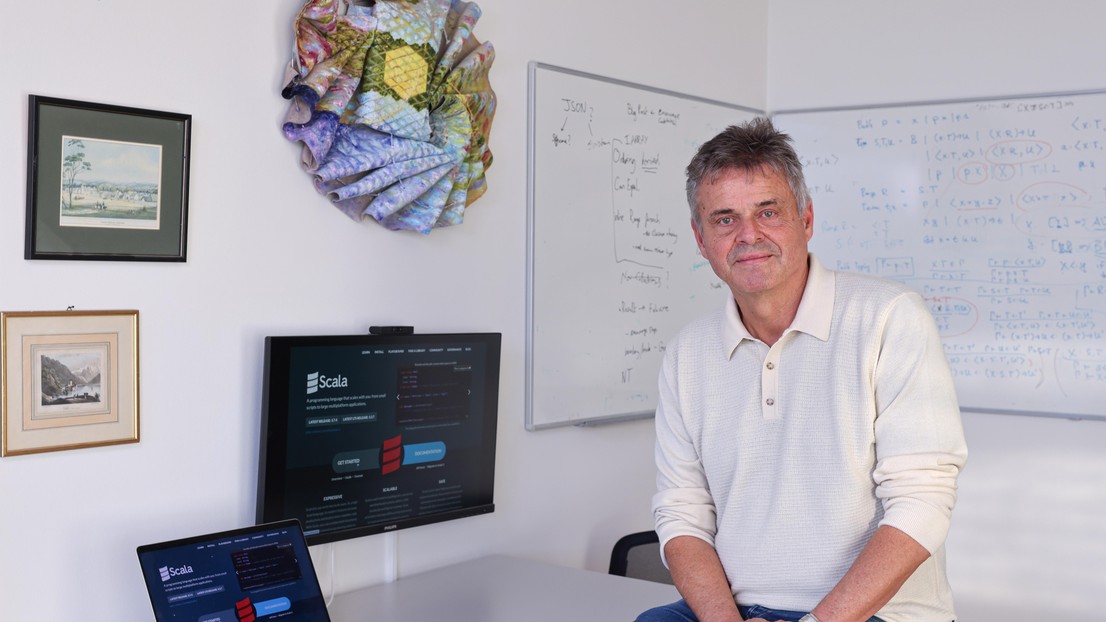
Martin Odersky © 2026 EPFL/Alain Herzog - CC-BY-SA 4.0
Martin Odersky, a professor at the EPFL School of Computer and Communication Sciences (IC) and head of the Programming Methods Laboratory, developed the programming language Scala, which is used by thousands of companies worldwide. In 2025, he was awarded the Programming Languages Achievement Award.
Martin Odersky first became interested in programming languages thanks to a bookstore called Blackwell’s on the campus of Oxford University, where he spent an exchange year during his university studies in mathematics at the Ludwig Maximilian University of Munich. The book was on compiler construction, looking at the theory and process of building software that translates high-level programming languages into code that computers can execute into actions.
“I came to programming languages from compilers, because I found them to be a fascinating subject,” Odersky says. “Before long, I was designing my own extensions of programming languages and then went into the more theoritical academic side of programming languages. But it was really this book that started me on that track.”
He doesn’t remember anymore why he chose this seemingly random book off Blackwell’s shelves, but it led him to a PhD at ETH Zurich with Swiss computer scientist Niklaus Wirth and onto a nearly 40-year career designing widely-used programming languages.
Between two programming worlds
When his interest in programming began, Odersky found himself between two worlds: that of imperative programming, and that of functional programming, which was a new field at the time. Imperative, or structured, programming essentially tells a computer how to do a task step-by-step, while functional progamming instead combines functions that work on data without changing it, focusing on what to compute rather than how to do it.
“For a long time I've been between the two worlds and thinking that there should be a way to combine the best elements of both structured programming and functional programming,” Odersky says.
This led him to work on Java, an imperative language, and to create an extension called Pizza that added key elements of functional programming to this imperative language.
Odersky worked at IBM, Yale University, the University of Karlsruhe, and the University of South Australia before coming to EPFL as a full professor in 1999, where he decided to do more fundamental work.
“I decided that we could start from scratch and ask, with a blank page, ‘how would we put together elements of structured, or object-oriented, programming, and functional programming?”
Starting with some preliminary designs and mini-languages to try out different concepts, Odersky and his collaborators eventually found a way to make this into something practical, which became the Scala programming language “that has been keeping me busy now for more than 20 years,” he says.
Scala runs on the Java platform and mixes object-oriented and functional programming styles. This means you can write programs using classes and objects, while also using functions as values, avoiding changing data. The name Scala stands for scalable language, meaning that it’s a programming language where you can start small with just a few lines of code and grow bigger.
“At the beginning, we didn't expect anything, but five years later, suddenly a lot of people in San Francisco, in Silicon Valley and elsewhere jumped on it,” Odersky explains. Now it is used by thousands of companies worldwide including the new Duolingo, Volkswagen, and X (formerly Twitter). It is also an essential pillar of open source software, for instance as the implementation language of the popular Spark framework for big data analytics. Odersky also created the Scala Center at EPFL, which coordinates support and oversees the development for Scala.
In recognition of the importance of the Scala programming language, as well as Odersky’s long and impressive career in research, teaching, and mentoring, he was awarded the Programming Languages Achievement Award from ACM Special Interest Group on Programming Languages (SIGPLAN).
“Martin Odersky has had a profound and lasting impact on the field of programming languages through both groundbreaking research and transformative practical contributions,” they wrote on their website. “His work has directly impacted hundreds of thousands of developers worldwide and inspired a new generation of researchers and practitioners.”
“We are very fortunate to have such a talented researcher as part of our School,” says IC Dean Sabine Süsstrunk. “Throughout his long and distinguished career, he has made an invaluable impact on the world of programming, most notably through the Scala language, as well as through his dedication to teaching and mentoring EPFL students.”
“Using untrusted components in a safe way”
Odersky and his research group are currently working on an SNSF project looking at using capabilities, which are essentially tokens that allow certain things, to provide security in programming languagues as people are increasingly using untrusted components from the internet, including those created by AI.
“What we’re essentially working on is to give better support for capabilities in order to combine trusted and untrusted components in a safe way,” he says. “People get stuff from everywhere, including a lot that could be written by AI. Some of this code you shouldn't trust because you haven't reviewed it line by line yourself. So the question is, how can you combine these untrusted things which you rely on with your own kernel, which is assumed safe, in a way that doesn't compromise the safety of the whole system? Capabilities can do that, and they can be even more effective if they are embedded in a language's type system. So we're betting on capabilities as the technique to deliver on that challenge.”