
Time resolved cathodoluminescence: High-Res. Ultrafast Spectroscopy
© 2016 EPFL
We are very pleased to announce and cordially invite you to our monthly EPFL Photonics Chapter (EPC) 'Pizza-optics-beer' (POB) seminar on May 4th, 2016 (Wednesday) at 18h15 (6.15pm). The seminar will take place in the room CM1106. This month Gwénolé Jacopin will give us some insights in his field of expertise. His presentation is entitled: “Time resolved cathodoluminescence: A High-Resolution Ultrafast Spectroscopy Technique”.
Abstract:
Semiconducting nanostructures have developed into attractive building blocks for nanoscience and nanotechnology applications, especially for energy harvesting, energy-efficient devices, and energy storage. In particular, optoelectronic devices such as solar cells or LEDs are very promising to answer major concerns of the 21st century like climate change and increasing energy needs.
Yet the reduction of the dimensions of these optoelectronic devices challenges researchers to develop new techniques to characterize them. Their properties are indeed driven by the charge dynamics at nanometer scale and picosecond scale. Hence, to characterize and understand the physics at play in such devices, one needs both good spatial and temporal resolutions.
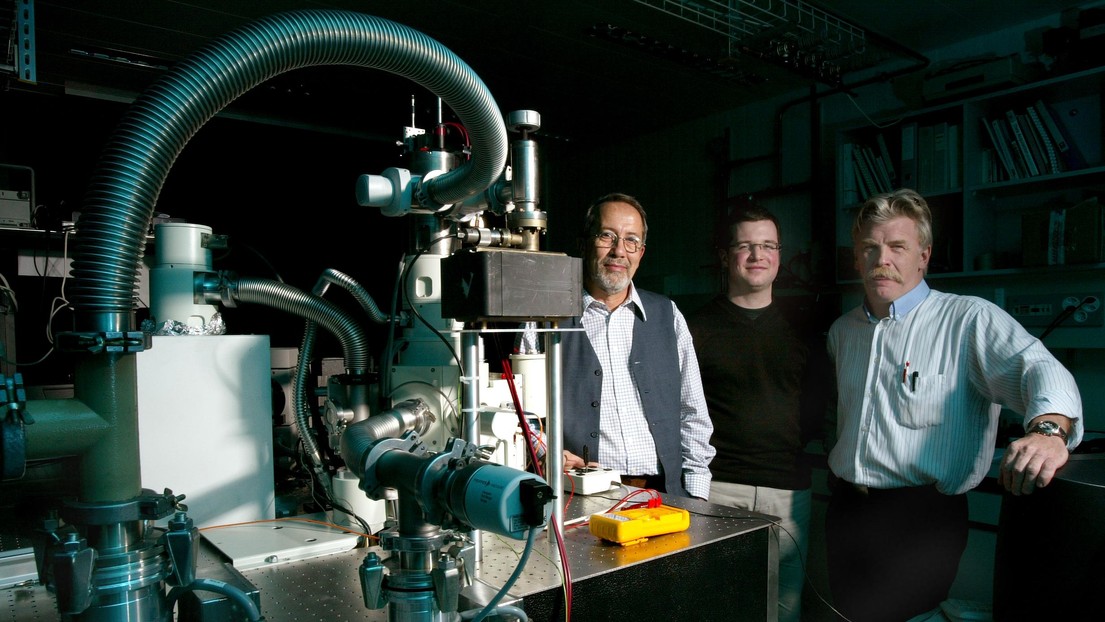
In this seminar, I will provide an overview of the time-resolved cathodoluminescence (TR-CL) spectroscopy, which meets these requirements by combining the spatial resolution of a secondary electron microscope (50 nm) and the temporal resolution of a pulsed laser (10 ps). These properties can advantageously be used to explore a wide range of nanomaterials and reveal underlying phenomena. In this regard, I will describe in more details two striking examples.
First, I will present a study of the carrier dynamics in bent ZnO microwires. I will argue that these structures are perfectly suited to probe the mechanisms behind the carrier motion in such systems at low temperature. By comparing experimental results with Monte Carlo simulations, I find that the hopping process is responsible for the observed motion.
Second, I will show very recent results on the recombination dynamics around single dislocation in GaN. In particular, I will demonstrate that the TR-CL spectroscopy measures some characteristics that we are not able to get otherwise.
Finally, I will briefly discuss some future directions to fully take advantage of the TR-CL spectroscopy when correlated with HR-TEM techniques.