
Tibor Pataky at the Chicago Schools Symposium
© Vasileios Chanis, 2017
The graduate student event is held from the 17th to the 19th of November, at the IIT campus in the United States
Tibor Pataky participates in the “Chicago Schools” – an international peer-reviewed graduate student symposium – held at the campus at the IIT from the 17th to the 19th of November. The papers revisit past and present Chicago Schools - from Henry van Brunt’s "School" and William James’ "Chicago School of Thought" to Sigfried Giedion’s "Chicago School of Architecture,” and beyond - as well as the emergence of new historiographic and architectural traditions within a global context.
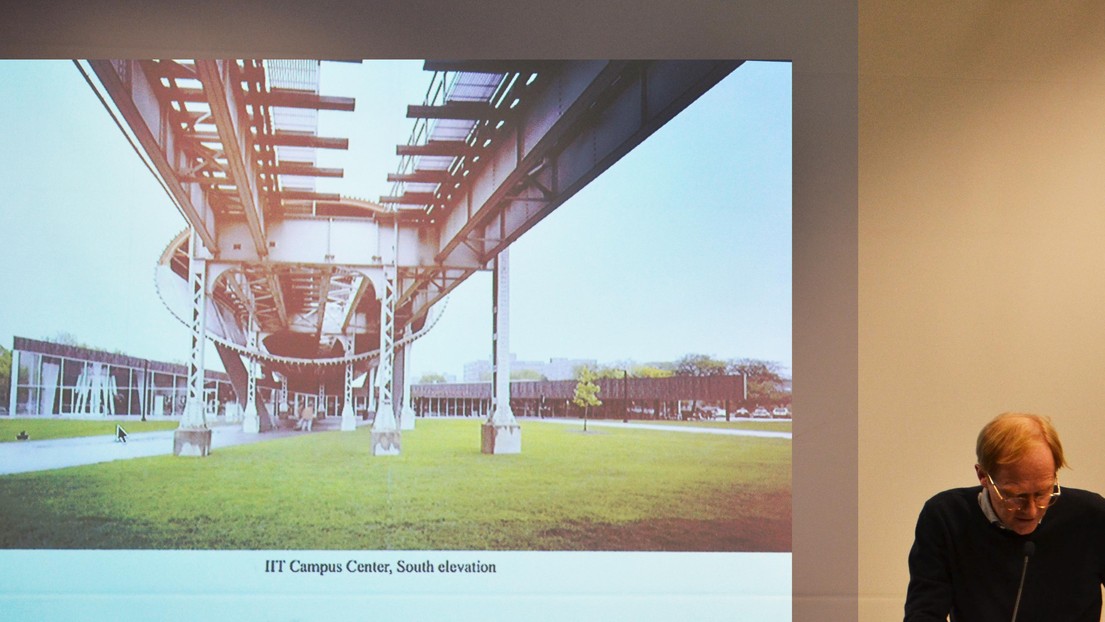
His paper discusses the IIT Campus Center by Rem Koolhaas and his Office for Metropolitan Architecture as a built answer to the ‘American Mies’. It concerns what usually is referred to as the second ‘Chicago School’, or, the architecture marked by Mies van der Rohe’s teachings and the example of his practice in the US.
Abstract
The Campus Center at the IIT: What the Author of Junkspace Told Mies in the ‘Jungle’
Traces of Koolhaas’ lifelong fascination with the legacy of Mies are present in many early OMA projects, such as the competition for Checkpoint Charlie, the apartments and the bus stop in Groningen, the Triennale Pavilion in Milan, the Patio Houses and the Rotterdam Kunsthal. A number of statements from Koolhaas indicate a persisting reflection on Mies’ work both before and after his emigration from Germany. As for the IIT Campus, parallels can be observed between the situation of Mies, settling down in the US, and the realities Koolhaas met, working increasingly on a global scale after the fall of the Iron Curtain. Both architects dismiss the city as ‘lost’, drawing conclusions, though, that could hardly differ more. Essays like Generic City and Junkspace, and the research performed by Koolhaas’ students at Harvard on shopping, form the theoretical backdrop of the project in Chicago.
Based on an explication of this context, the paper discusses the Campus Center (1997-2003) as a built answer to the ‘American Mies’. Discussed will be arguments such as the Berlin Mies vs. the American Mies, affinities between the mall and the ‘carpets’ of Mies and Pompeii, affinities between Junkspace and the Center, steel frame vs. sheetrock, neutral space vs. space defined by program. If Mies’ ‘common language’ was a first attempt to cope with the jungle of the lost city by means of architecture, the OMA project appears a critique, half a century later, precisely of this vision.