
“The SHS taught me a different way to do research”
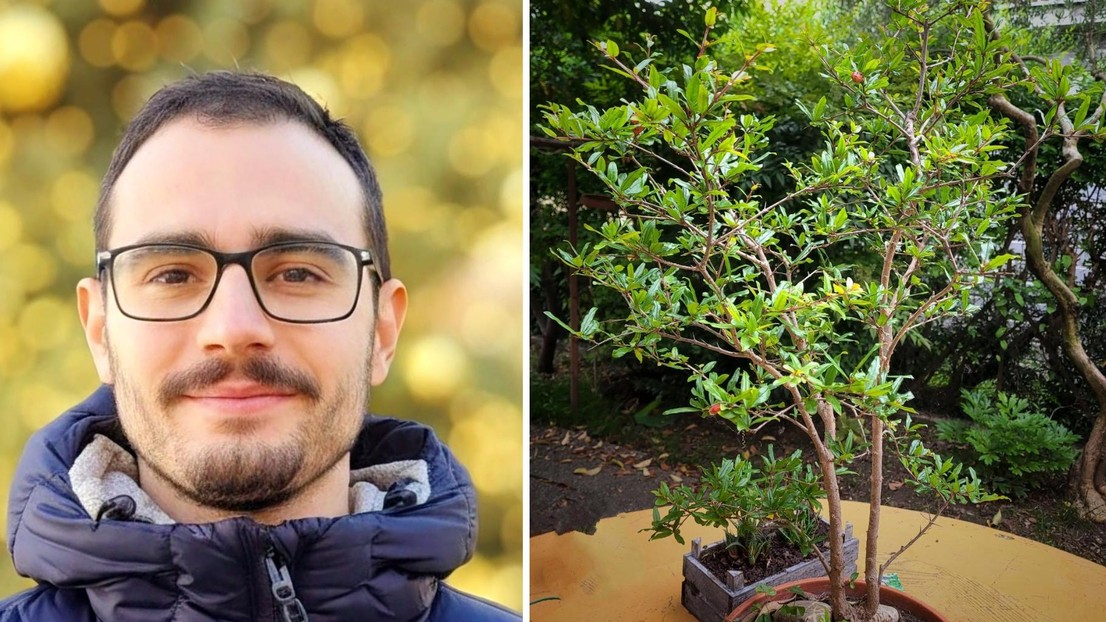
Gabriele Dall'Aglio and his miniature pomegranate tree. © 2026 EPFL/Gabriele Dall'Aglio
Awarded the 2025 SHS Prize, Gabriele Dall’Aglio is currently completing his Master’s project in Neuro-X. As part of his work in the social sciences and humanities, he developed a strong interest in the history of bonsai and its deep roots in Japanese culture.
When you are eager to feed your mind with new knowledge, choosing from among 150 courses is no easy task. A self-described “very organised” person who sometimes tends to “ over-engineer things”, Gabriele Dall’Aglio drew up a shortlist, weighing the pros and cons of each option. Contemporary Japan ultimately won over the neuroscience student, drawn both by his fascination with Japanese culture and by the contagious enthusiasm of Irène Vogel Chevroulet, a lecturer at EPFL. For his project, he explored the close ties between bonsai cultivation and Japanese culture. And, true to his experimental spirit, he now has a miniature tree of his own: a one-year-old pomegranate. “I collected a small plant from the wild using a technique known as yamadori. I dream of one day seeing it covered in vermilion blossoms.”
Looking back, what did the SHS courses — and your project — give you, both in terms of skills and personal growth?
They helped me develop new skills and perspectives. Having always worked in a scientific framework, I wasn’t used to approaching a research question in this way. I learned a different way of building a project, drawing on a wide range of sources rather than relying solely on academic papers. I worked with books, different types of media, and even conducted interviews.
Personally, the course also helped me grow in many ways, not just by learning new aspects of Japanese culture, but by trying to understand how a different culture thinks and sees the world. For instance, I was surprised to discover that Shinto's concept of ritual impurity (kegare), despite its origins in a genuinely admirable reverence for nature and purity, has historically been extended to certain groups of people, contributing to social exclusion and discrimination in Japanese society. A theme explored in Naomi Kawase's film Sweet Bean.
Every Wednesday, it was a real breath of fresh air to step away from the hectic routine and focus on something completely different.
Why did you choose to explore bonsai’s roots in Japanese culture?
I have always loved gardening, trees, and nature. I remember spending much of my childhood in the garden and orchard with my father and grandfather. We enjoyed planting, pruning, and learning together. I was particularly fascinated by the question: why does such a simple idea, growing a miniature tree, have such strong cultural ties in Japan but not in other places?
Could you briefly summarize the essence of your work?
I approached bonsai primarily as a cultural phenomenon rather than a horticultural practice. I looked at why bonsai became so deeply rooted in Japan from scientific, historical, and cultural perspectives. Science highlights the mental health benefits of bonsai care, but these are universal: they don't explain Japan's uniqueness. History and geography provide important context: the art traveled from China through Buddhist monks, and Japan's proximity to China certainly helped. But even history alone can't fully account for bonsai's exceptional status in Japan. My main argument is that culture is the dominant explanation. The values and practices already present in Japanese society made bonsai a natural fit: it resonated with the love of miniaturization, Shinto spirituality and aesthetic concepts like wabi and sabi. Bonsai didn't impose itself on Japanese culture; it grew out of it.
We need to know about the broader world too. School and university are there to teach you many things, but in particular things you would not be able to learn later on your own, or that you would never even know existed.
More broadly, how would you describe your overall experience with the SHS Programme?
I really enjoyed the overall experience, not just for the things I learned but also for how it fit into my student life. Every Wednesday, it was a real breath of fresh air to step away from the hectic routine and focus on something completely different.
Spending time on my SHS project on a regular basis also taught me to step back from my usual work and do research simply for the pleasure of knowing more about a topic I genuinely cared about.
Why are SHS courses important in an engineering curriculum?
If I want an optimal engineer in a purely technical sense, nowadays I would just pick an AI agent or the marvelous tools we are going to create in the near future. But an agent is not a human. We need to learn about science, yes, but also about art, culture, and society.
A conversation with someone who only understands technical matters is limited, and it would be very risky to train brilliant engineers who have never learned to think beyond their equations. There’s something quite impoverished about a life shaped only by what Heidegger calls “calculative thinking” (Rechnendes Denken). We need to know about the broader world too. School and university are there to teach you many things, but in particular things you would not be able to learn later on your own, or that you would never even know existed. To give a concrete example: this summer I was in Japan for an internship, and at the same time Japanese elections were taking place. I can say that thanks to the SHS course I followed, I could really understand what was going on. It gave me the tools and the basic knowledge to then tackle new topics independently.