
“The knowledge is there—it takes humans to put it into perspective”
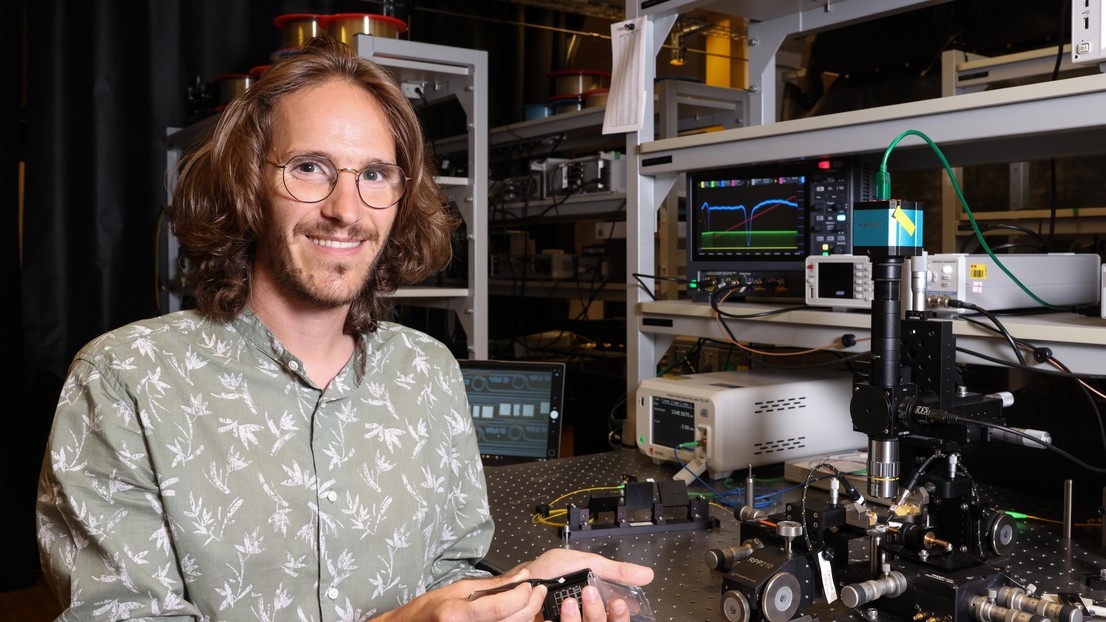
Christian Lafforgue, best teacher in the electrical engineering section for 2025 - 2026 EPFL/Alain Herzog - CC-BY-SA 4.0
Christian Lafforgue knows only too well how a professor can influence a student’s academic decisions. He believes that a good teacher is one with a keen sense of humanity. He was named best teacher in the electrical engineering section for 2025.
“Ever since I started taking your class, I’ve enjoyed learning about electricity!” For Lafforgue, that’s the “coolest compliment” he’s gotten as a teacher. Back when he was a student, he saw first-hand how a student’s interest in a subject can vary considerably depending on who teaches it.
“A single professor can help someone discover their calling – or turn them off a subject for life,” says Lafforgue. That’s what sparked his own interest in teaching. He got a first taste of it as a teenager, helping out his classmates by explaining scientific concepts and sharing his knowledge more formally as a tutor.
Lafforgue attended high school and did a preparatory course in Aix-en-Provence, where he had “two amazing physics teachers,” he says. “They both had a really strong human side. Today, I’m convinced that’s an essential trait for teachers to have. Students can find raw scientific knowledge in textbooks and online, but it takes a human touch to put them in perspective.”
Doing more teaching
Physics was, indeed, the first subject that Lafforgue fell in love with. “I wanted to major in physics at university, but several of my teachers discouraged me,” he says. “They said there wouldn’t be any job opportunities in that field.” He therefore decided to study engineering and enrolled in France’s École Normale Supérieure (ENS) – a prestigious university specialized in training academics, and a natural choice for someone interested in teaching. “We took classes in several different fields early in our degree programs, and I was attracted to electricity in particular,” he says. “The fact that it involves a fair amount of physics probably also played a role!”
Lafforgue obtained a French national teaching qualification in electrical engineering from ENS Paris-Saclay and a master’s in electronics and photonics from Université Paris-Sud. He subsequently joined the Centre for Nanoscience and Nanotechnology in Orsay, France, where he completed his PhD on silicon photonics for use in non-linear optics. He moved to Switzerland in 2022 to take up his current postdoc position at EPFL.
I believe that, as scientists, we need to think about the potential ramifications of the work we do.
Lafforgue is a scientist at EPFL’s Photonic Systems Laboratory and teaches an introductory class on electrical engineering science and technology for first-year bachelor’s students in mechanical engineering. Over 500 students usually sign up. “Right now I spend more time on research than on teaching. But if circumstances were to change, I’d be more than happy to step up my teaching role,” he says, before dropping a hint: “My postdoctoral contract runs until the end of 2026. Afterwards, I may be able to stay on at EPFL – and do a little more teaching.”
Ethical duty
If Lafforgue’s wish comes true, EPFL’s students will be big winners. In their class evaluations, they point to the way he genuinely takes time to listen, adapts his lectures based on their comments and structures the curriculum in an intuitive way. “I think the positive feedback also reflects the fact that I’m careful to fit my class in with the rest of their bachelor’s program in mechanical engineering.” Last but not least, he tries to “convey the material in a light-hearted way and through an interactive approach.”
But what really wins students over is Lafforgue’s relentless effort to bring the material to life. “I always start my lectures by explaining why we’re going to study a given topic,” he says. “I do that by giving concrete, local examples and discussing the environmental impact.” He also peppers his lectures with anecdotes from science history. He finds they’re effective at getting students’ attention. And most importantly, “they let me address the ethical issues related to the topic we’re covering.”
Such ethical issues are a key focus for Lafforgue, in both his teaching and research. “I believe that, as scientists, we need to think about the potential ramifications of the work we do.”