
“The best way to learn something is to teach it”
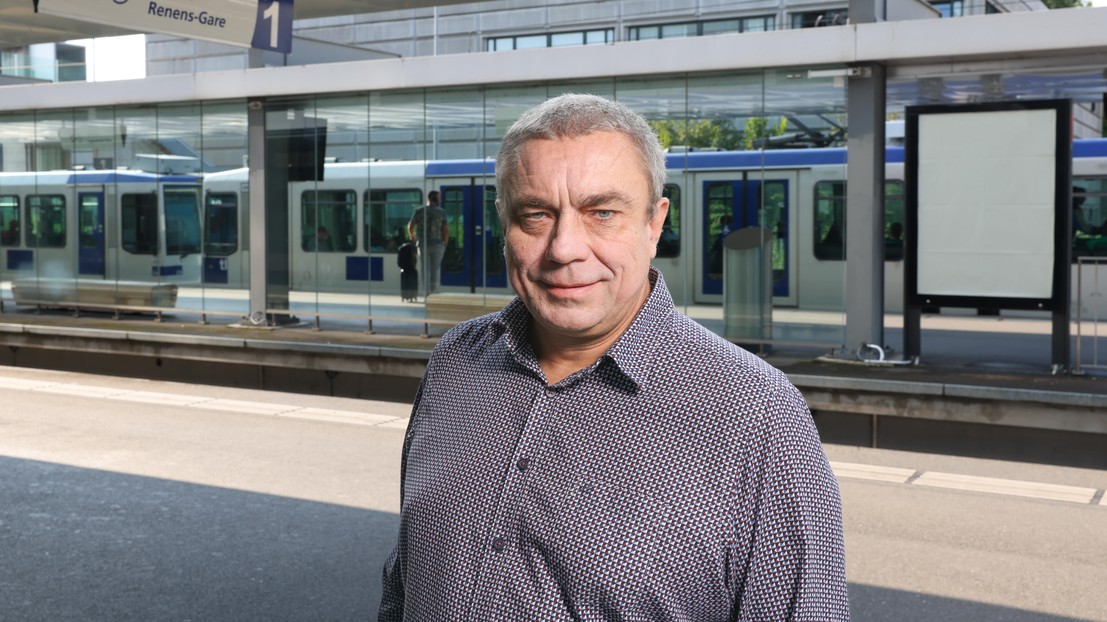
Michel Bierlaire, the winner of the 2025 best teacher award for the civil engineering Section. - 2026 EPFL/Alain Herzog - CC-BY-SA 4.0
Michel Bierlaire, a world-renowned expert who always makes time for his students, isn’t just “Mr. Transport” – he’s also the winner of the 2025 best teacher award for the civil engineering Section.
It wasn’t until his own son was in college that Michel Bierlaire realized “how important a professor’s availability is for students,” he says. For his part, he always sits in on his students’ exercise sessions – “they ask me a lot more questions there than in class!”
“I tended to step back a little when I first started teaching, because I thought that would make students more comfortable,” says Bierlaire, who runs the Transport and Mobility Laboratory at EPFL. But when he began to engage more actively, he saw two benefits: the students were more highly motivated, and he “was better able to pinpoint their needs and adapt my lectures accordingly.”
Adaptation has been a key feature of Bierlaire’s approach throughout the nearly 30 years that he’s been teaching at EPFL. “I revamp my lectures as soon as I start to get bored with them, because I figure the students are probably bored too,” he says. He redoes his teaching material “every two or three years.” When asked about the other characteristics of his teaching style, Bierlaire replies: “I put a lot of effort into making sure that the information I communicate is clear. And I always tell a story in connection with the concept being discussed, which brings it to life and anchors the theory in the real world.”
Very prepared and very nervous
Bierlaire obtained his PhD from the University of Namur in Belgium, but it was at the Massachusetts Institute of Technology, where he worked for two years as a research associate, that he was given his first class to teach. “I was extremely prepared – and nervous! – because I had heard that US students can be demanding,” he says. But once the initial jitters passed, Bierlaire found he really enjoyed teaching, to the point where he’s never stopped since. “I continued even when I held management positions at EPFL,” such as when he was the head of the PhD program in civil and environmental engineering (2009–2017) and the head of the civil engineering institute (2017–2021). “My teaching feeds into my research,” he says. “I feel I have a duty as a professor to see things through and to know the material inside and out. In fact, the best way to learn something is to teach it.”
There’s no doubt that Bierlaire knows his field like the back of his hand – just take a look at his CV. He’s been developing and implementing algorithms and mathematical models for transportation systems for upwards of three decades. “Programming was actually my first love as a teenager, but that field of study wasn’t (yet) offered in college, so I studied math.” But he never lost his interest in coding. “For instance, I developed a software program for assigning referees to volleyball matches – the sport I was into at the time.”
I’d say what probably sets me apart as a researcher is my ability to combine approaches from mathematics and civil engineering. That’s what I’ve built my career on.
However, math wasn’t just the default option for Bierlaire. “I like the abstract, formal aspect of mathematics, and working through problems is a great intellectual exercise,” he says. “Mathematical rigor is what runs computers and lets engineers solve concrete problems.” His work in academia has consistently involved building bridges between mathematics and tangible applications in civil engineering. “I’d say what probably sets me apart as a researcher is my ability to combine approaches from the two fields. That’s what I’ve built my career on.”
Modeling human behavior
Bierlaire’s interest in the field of transportation arose when he was a PhD student and his supervisor suggested he do his thesis on a highly applied topic – the use of mathematical models to analyze transportation demand. “It’s a field that never ceases to amaze me. It has so many facets, and there are so many tools to examine it,” he says. He also points to the human aspect of transportation systems, “because it’s all about predicting how people will behave.” This topic gained prominence in 2000 when US economist Daniel McFadden won the Nobel Memorial Prize in Economic Sciences for his research on the discrete choices that influence individual decision-making, such as which mode of transport to use.
Today, Bierlaire is a leading international figure in transportation behavior modeling. Yet despite his expertise, he finds himself faced with a formidable challenge: the growing complexity of transportation systems coupled with the increasing prevalence of leisure activities, which are inherently harder to predict and “require an advanced set of skills.” Fortunately for Bierlaire and his team, they can draw on ever-more granular data. “That’s a big help in building models to describe something as complex as human behavior.”