
Tech4Dev advances six new projects into Prototyping Phase for 2026
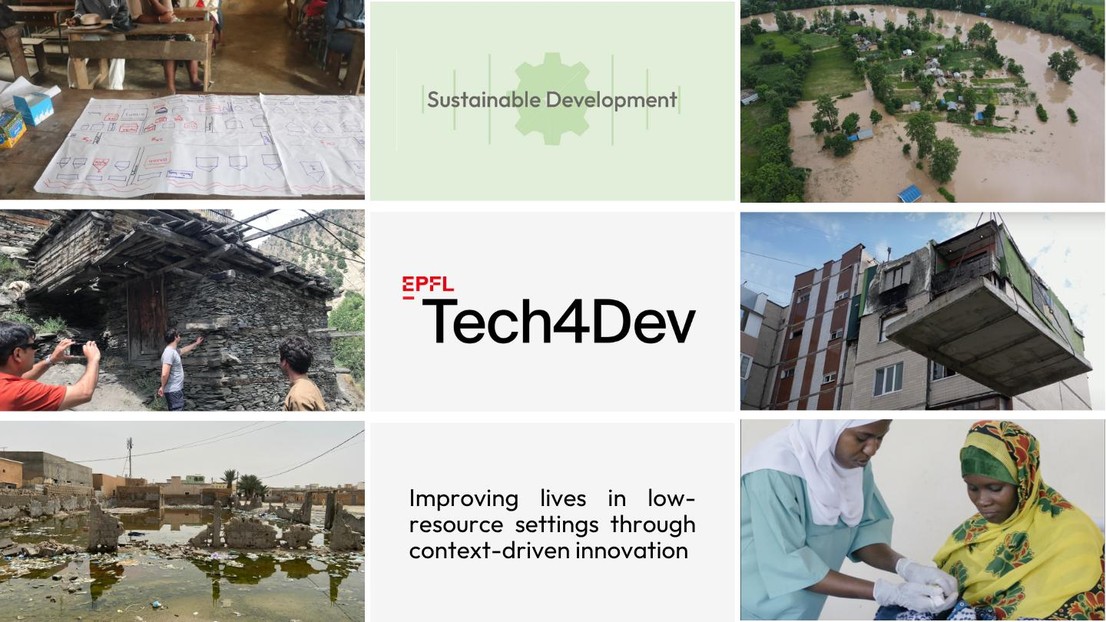
© 2026 EPFL ALICE Lab / Medair Madagascar; © OpenStreetMap Contributors; © EPFL EIRA / TUCAN-GS Project Team; © UAWRA © D-tree, © EPFL Tech4Dev;
From climate resilience and disaster response to sustainable reconstruction, the next cohort of Tech4Dev projects moves from research to real-world testing. The Tech4Dev programme has selected six new projects to enter its prototyping phase in 2026, marking the next step in transforming research into practical solutions for communities facing urgent global challenges.
Supported through grants and tailored coaching, each selected team will now develop and validate a Minimum Viable Product(MVP) by the end of 2026. The projects address issues ranging from disaster preparedness and post-crisis recovery to climate adaptation and resilient housing.
This year’s selected projects reflect the diversity of challenges where technology, local knowledge and interdisciplinary collaboration can create meaningful change.
Madagascar: Strengthening Risk Communication for Vulnerable Communities
Link : https://www.essentialtech.ch/projects/warnings-that-reach-the-last-mile
The project Sensitive Risk Warning Infrastructure(SRWI) focuses on improving how communities receive and respond to hazard alerts. In regions exposed to climate-related risks, effective communication can save lives. The initiative aims to design more inclusive, trusted and resilient warning systems adapted to local realities.
Funded by Tech4Dev, the project brings together Medair Madagascar, the University of Antananarivo, EPFL's ALICE Laboratory led by Lucía Jalón Oyarzun, and the Cellule de Prévention et d'Appui à la Gestion des Urgences (CPGU).
Nepal: AI for Faster Post-Disaster Damage Assessment
Link: https://www.essentialtech.ch/projects/smarter-mapping-for-recovery
In Nepal, teams are using artificial intelligence to quickly identify damage to buildings and infrastructure after disasters. By speeding up the mapping and analysis process, the project can help authorities and communities plan reconstruction faster and make better decisions in areas most at risk.
Funded by Tech4Dev, the project brings together EPFL's VITA Laboratory led by Prof. Alexandre Alahi, the Humanitarian OpenStreetMap Team (HOT), NAXA and Tribhuvan University.
Pakistan: Strengthening Traditional Construction for Earthquake Resilience
Link : https://www.essentialtech.ch/projects/t4d-safer-traditional-houses
This project explores how dry stone masonry (an established Pakistani construction technique) can be optimised to better withstand earthquakes. By building on existing knowledge rather than replacing it, the initiative promotes affordable and culturally relevant resilience solutions.
Funded by Tech4Dev, the project brings together EPFL's EESD Laboratory led by Prof. Katrin Beyer, the University of Engineering & Technology Peshawar and the Sarhad Rural Support Programme (SRSP).
Mauritania: Urban Afforestation for Climate Adaptation
Link: https://www.essentialtech.ch/projects/t4d-tucan-gs
The project Testing Urban Conditions for AfforestatioN in Hot-Dry Climates for Groundwater Management and Socioeconomic Benefits (TUCAN-GS) investigates how strategic afforestation (the deliberate introduction of salt-tolerant trees into previously unforested urban areas) can help reduce flooding caused by rising groundwater, while improving liveability and social wellbeing in Nouakchott.
Funded by Tech4Dev, the project brings together EPFL's PL-LCH Laboratory led by Prof. Paolo Perona, the Région de Nouakchott, the University of Nouakchott and the NGO BiodiverCités.
Ukraine: Concrete Reuse for Reconstruction
Link : https://www.essentialtech.ch/projects/concrete-reuse-for-reconstruction
Across Ukraine, the war has left millions of damaged buildings and vast amounts of concrete rubble. This project explores how that debris can become a resource rather than waste, salvaging reusable concrete panels before demolition to give materials a second life, cut pollution and help communities rebuild more sustainably.
Funded by Tech4Dev, the project brings together EPFL's Structural Xploration Lab led by Prof. Corentin Fivet, the Waste Recycling Association of Ukraine (UAWRA) and Skat Consulting Ltd.
Zanzibar: Support for Safer Maternal and Newborn Care
Link: https://www.essentialtech.ch/projects/enhancing-maternal-health-in-zanzibar
In Zanzibar, the MAM*AI project is developing an AI-powered assistant to support nurse-midwives during pregnancy, childbirth and newborn care. Designed to work offline and in local languages, the tool provides quick access to trusted medical guidance in situations where time and resources are limited. By helping frontline health workers make informed decisions with greater confidence, the project aims to improve care for mothers and babies while strengthening the local health system for the future.
Funded by Tech4Dev, the project brings together EPFL's LIGHT Laboratory led by Prof. Mary-Anne Hartley, the Swiss Tropical and Public Health Institute (Swiss TPH) and D-tree.
A Collaborative Innovation Ecosystem
The selected teams bring together researchers, NGOs, public institutions, universities and technical partners from Switzerland and around the world. Their work will be supported by Tech4Dev’s methodology framework and guided by an International Expert Panel composed of experts in innovation, humanitarian action and applied research.
By investing in prototyping, these specific grants help bridge a critical gap between academic discovery and implementation in the field, where promising ideas are tested, refined and prepared for scale.
Looking Ahead
Over the coming months, the six teams will move from concept to experimentation, working closely with local stakeholders and end users. Their progress will shape the next generation of technologies designed not only to innovate, but to respond to real needs with relevance, sustainability and impact.
To follow their journey, visit the Tech4Dev Programme page on our website, essentialtech.ch
The Swiss Agency for Cooperation and Development (SDC)
EPFL