
«Teaching sustainability forces schools to break down silos»
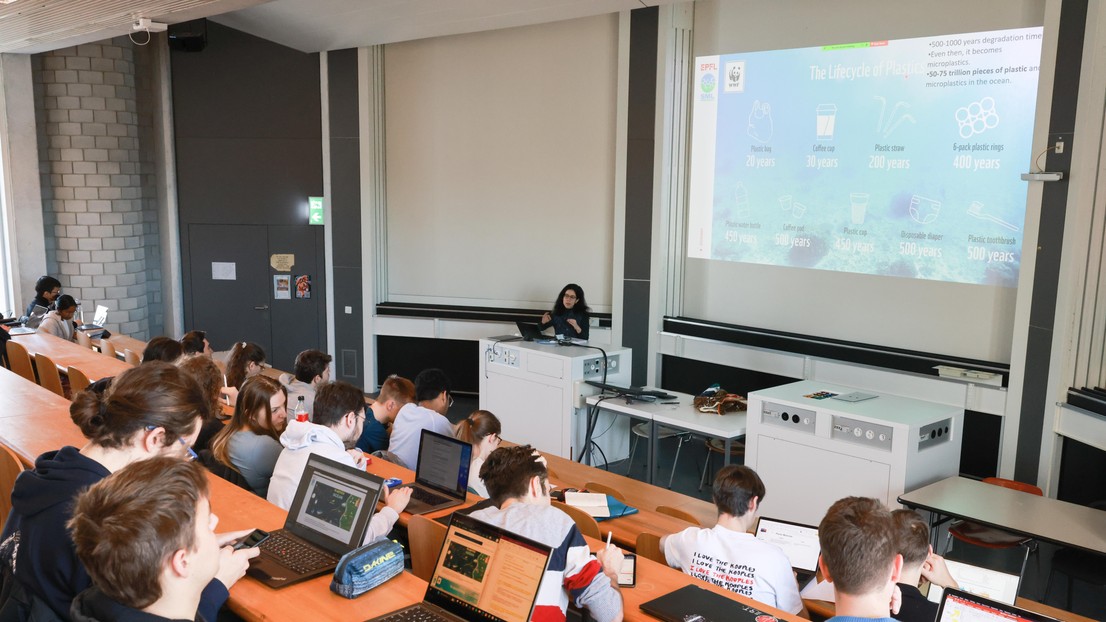
The lecture "Sustainability and materials". © 2023 EPFL/Alain Herzog - CC-BY-SA 4.0
In Switzerland, sustainability education is now being integrated into the curriculum starting in high school. How can this interdisciplinary subject be taught without coming across as moralizing or activist? Drawing on their work in sustainability education at EPFL, Adélie Garin, Ilaria Rossinelli and Michka Mélo share their experience.
Training students in sustainability—an inherently cross-cutting subject—requires dialogue not only across disciplines, but also among teachers themselves. It calls for strong coordination, as well as a shift in mindset. Interview with Adélie Garin, Ilaria Rossinelli and Michka Mélo, lecturers at EPFL and members of the Sustainability Education team within the Vice Presidency for Support to Strategic Initiatives (VPS).
Since the start of the 2024 academic year, EPFL students have been required to take a mandatory first-year course on sustainability, with each section required to offer courses at both a Bachelor’s and Master’s level. What challenges have you encountered in implementing this from a teaching perspective?
Adélie Garin (A.G.) : One of the main challenges is the siloed nature of disciplines. It becomes a real obstacle when trying to address issues from a systemic perspective. Lecturers are experts in their own fields, and working across disciplines requires them to shift their role and act more as facilitators. This requires a lot of coordination which means making time for it.
Michka Mélo (M.M.) : As soon as you limit yourself to a single discipline, you inevitably miss part of the greater picture. Students are asking for more cross-disciplinary approaches. The real challenge is convincing lecturers that they don’t need to be sustainability experts to include the topic in their teaching activities. In my opinion, a good ground for discussion is focusing on the methodology. Beyond the knowledge itself, we want to give students a way to approach problems that can be very similar across different disciplines.
Ilaria Rossinelli (I.R.) : We have developed workshops to help lecturers integrate sustainability into their courses and to equip them with pedagogical tools, such as the UNESCO’s Education for Sustainable Development Goals or the A Rounder Sense of Purposecompetency framework.

Based on your experience, what advice would you give to high school teachers starting to teach education for sustainability ?
A.G. : It’s important to build a support network among teachers. It creates space for exchange and coordination, and allows everyone to contribute. I would recommend choosing a theme and exploring it across different subjects, while ensuring overall coherence. Take the carbon cycle, for instance—it can be addressed in biology, chemistry, physics, and geography. Linking these topics to students' eveyday lives is also essential, as it increases their interest.
Ilaria and I also run workshops on sustainability for high school mathematics teachers. At first glance, maths may not seem like an obvious entry point. Yet both fields rely on systemic thinking—the ability to shift scales, to zoom in and out, and to grasp orders of magnitude. Climate issues, in particular, are grounded in statistics and mathematical models.
I.R. : Another exercise we propose is mathematical modelling. It’s a very common classroom activity, but one that is closely linked to systems thinking. It allows maths teachers to engage with sustainability in a meaningful way. They are often surprised to discover these connections, and they really value the opportunity to exchange with colleagues who share similar ideas and face similar challenges.
M.M. : It's very important to demonstrate the process, share information, and break down barriers of isolation. At EPFL, what encouraged lecturers to get involved was becoming familiar with key sustainability concepts. They sometimes underestimate how transferable their skills are. One initiative that worked particularly well is pairing teachers with student assistants who have expertise in sustainability. These students support the transformation of teaching practices and also challenge teachers on both content and course design.
How do you teach sustainability without veering into moralizing or activism?
I.R. : It is essential to clarify the role and responsibility of the teacher. The classroom should remain a space for objective discussion. The aim is not to impose change, but to provide tools and support reflection.
A.G. : We need to set a clear framework and rely on scientific methodology. It is important to distinguish between values and established facts, and to approach those facts from a systemic perspective.
M.M. : It’s a controversial topic. In fact, in partnership with EPFL and HEP Vaud, the University of Lausanne is currently conducting a research project on “the ideal of neutrality and sustainability education in higher education.” This project is part of the programme “Strengthening sustainability culture in Swiss higher education”, coordinated by Swissuniversities and supported by the Swiss Confederation.
How do you foster critical thinking while tackling issues that may worry students?
M.M. : It’s crucial to present the data as it is; otherwise, it leads to a distorted view of reality. But students also need tools to cope with it. They need to understand how change happens and to develop a sense of agency. In the Master’s courseDesign for Sustainability, which I co-teach, I always present several possible solutions, outlining both their strengths and their limitations. Without the right framing, a solution simply won’t be appropriate.
I.R. : We need to encourage objective analysis and reflection, while avoiding guilt. It is important to aknowledge and manage both negative and positive emotions.
A.G. : Research shows that taking action helps. We can support students in acting and in developing their ability to reflect. This can be done through simple projects, such as creating a community garden.