
“Teaching gives me a chance to develop my own transferable skills”
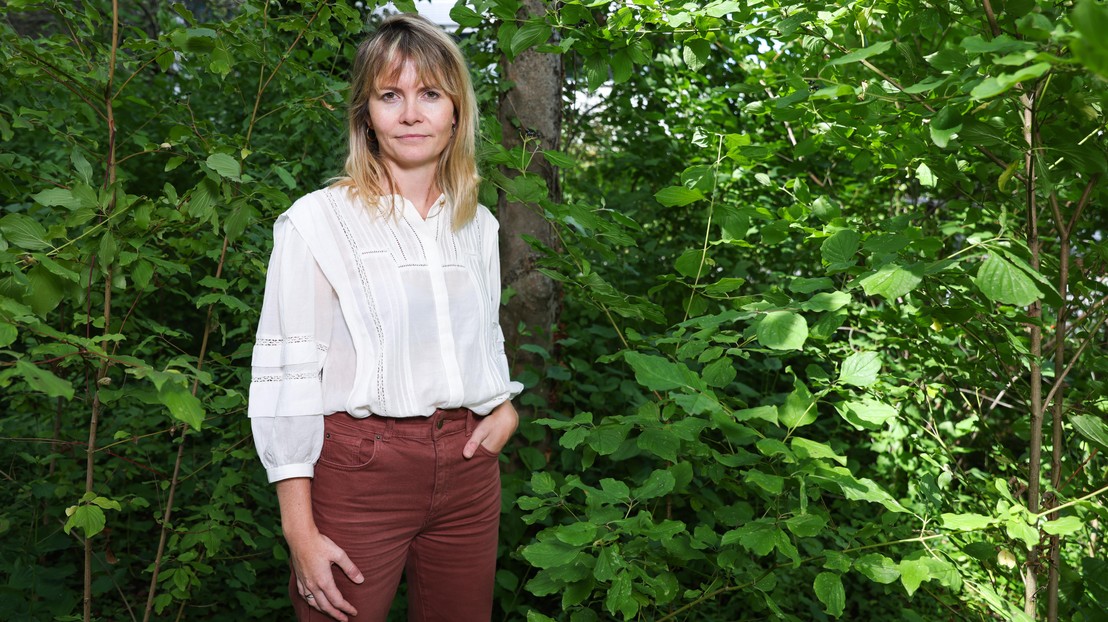
Charlotte Grossiord, best teacher in the environmental sciences and engineering section for 2025 - 2026 EPFL/Alain Herzog - CC-BY-SA 4.0
Charlotte Grossiord believes that forests – like classrooms – offer excellent learning opportunities. Her unique approach is one reason why she was named best teacher in the environmental sciences and engineering section for 2025.
Charlotte Grossiord always got a boost from being among trees, long before forest bathing became a thing. As a child, she spent a lot of time in the woods and developed an early interest in different types of natural habitats owing to the many trips she took with her parents, including to Africa. “I had no doubt I’d become a scientist when I grew up!” she says.
After graduating from high school, Grossiord, who holds both French and German citizenship, obtained a bachelor’s degree in biology in Strasbourg, France, followed by a master’s in ecology from the French National Research Institute for Agriculture, Food and Environment (INRAE), at its Grand-Est site in Nancy. “That coincided with a time when several INRAE professors were conducting forest research,” she says. Inspired by their work, she decided to pursue a PhD in forest ecology – thus combining her two childhood loves of trees and travel. “My thesis looked at how biodiversity affects European forests from Spain to Finland,” she says.
Donning her hiking boots
Grossiord’s postdoc took her to the Los Alamos National Laboratory near Santa Fe, New Mexico. That’s where she discovered the two types of forests that have impressed her the most. “Sequoia National Park in California is amazing,” she says. “The trees are enormous and incredibly old.”
The other type is shrublands, “although they aren’t forests per se,” says Grossiord. “Instead, they’re wide open, resilient spaces that have been shaped by stress and the arid climate. Every tree is a story in adaptation and survival.”
Grossiord is quick to add that you don’t necessarily have to travel thousands of kilometers to see beautiful woodlands. “I really enjoy hiking through the forests here in Switzerland,” she says. These outings leave her both relaxed and recharged. “It’s been scientifically proven that trees have many benefits for our physical and mental health.”
Plant responses to climate stress
After her postdoc, Grossiord spent two years conducting research at the Swiss Federal Institute for Forest, Snow and Landscape Research (WSL), on a project funded by the Swiss National Science Foundation, before joining EPFL as a tenure-track assistant professor in 2020.
Today Grossiord is an expert in tree physiology and head of the Plant Ecology Research Laboratory (PERL), which is run jointly by EPFL and WSL. Its scientists study the essential role that biodiversity plays in ecosystem functions and services and the physiological processes involved in plant responses to climatic stress. In 2021, Grossiord obtained a research grant from Fondation Philanthropique Famille Sandoz as part of the Monique de Meuron program for assistant professors. These funds enabled her to hire additional staff at PERL and purchase field equipment.
In all kinds of weather
When it comes to teaching, Grossiord describes her philosophy as “learning by doing.” She’s happy to take students out in the field no matter what kind of weather – and no matter what size the class. With the help of teaching assistants, “it’s perfectly possible to take large groups of students,” she says.
Grossiord also feels it’s important for budding engineers to acquire transferable skills. “In my class, I try to help students develop their public speaking, teamwork and technical writing skills,” she says. She also has students participate in role-playing games focused on current issues, such as the proliferation of quagga mussels, to hone their problem-solving skills.
“Teaching also gives me a chance to develop my own transferable skills,” says Grossiord. “For instance, I’ve learned to better capture an audience’s attention, keep people interested in what I’m saying and explain complicated topics.” These skills are useful in other areas too, such as when interacting with media outlets or managing staff.
Keeping the classroom’s attention
In the few years she’s been at EPFL, Grossiord has made her mark as a professor. That’s thanks to the way she regularly takes students’ feedback on board in preparing her lectures, makes her classroom a “safe space” for students to speak up, and structures her class in a way that breaks the monotony. Yet that doesn’t mean she intends to rest on her laurels.
“I face many challenges as a teacher,” says Grossiord. A big one is “keeping the class’s attention.” However, she’s ruled out the possibility of adopting the same approach that her own professors used when she was a student. “Many of our teachers simply imposed their knowledge on us, without considering whether that worked for us.” Grossiord has chosen the opposite approach, tailoring her lectures to students’ specific needs.