
Switzerland regains its place in European fusion research
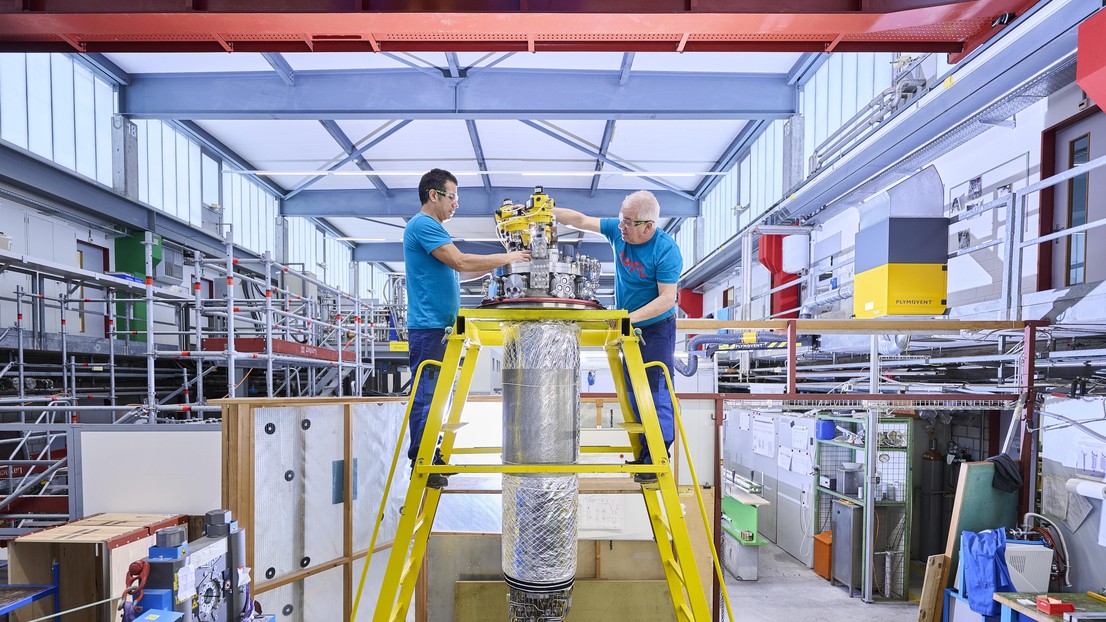
Frank Levano and Franz Oberle, from the EPFL's SPC team working on the upper part of the superconducting transformer © Zeljko Gataric
As of 1 January 2026, Switzerland is once again officially participating in the ITER project thanks to the agreement on the European Union programs signed at the end of 2025. This agreement confirms Switzerland’s association with the European Union’s main funding programmes for research and innovation, following the halt of negotiations in 2021. For the Swiss Plasma Center, a leading actor in global fusion research, this reintegration represents a major milestone and closes a transition period marked by the continued support of Switzerland and its European partners.
“We warmly welcome Switzerland’s integration into the Horizon Europe Program and the Euratom Research and Training Program,” says Paolo Ricci, Director of the Swiss Plasma Center (SPC). This decisive step was officially confirmed on 10 November 2025 in Bern by Federal Councilor Guy Parmelin and European Commissioner Ekaterina Zaharieva, with the signing of the agreement on the European Union programs.
The association is retroactive to 1 January 2025 and covers not only Horizon Europe, but also the complementary Euratom Program and the Digital Europe Program. Switzerland’s participation in the ITER project - the global cornerstone of fusion research - resumed on 1 January 2026, marking a full return of Switzerland to the European fusion ecosystem.
A strengthened strategic role
“This affiliation strengthens Switzerland’s strategic role in the implementation and development of the European fusion roadmap,” Paolo Ricci continues. It enables Swiss institutions and industry to contribute more effectively to key priorities, such as ITER operation, the design of future fusion devices, the development of materials and components, tritium technologies, and advanced diagnostic systems.
More broadly, this commitment reaffirms that fusion is a collective endeavour, facing scientific and technological challenges of such scale that no single country can address them alone. ITER is a flagship example of international cooperation: no fewer than 35 countries are joining forces to push the boundaries of science and technology, with the ambition of delivering a safe, abundant and sustainable source of energy for the benefit of all.
Support and resilience during the transition
Being aware of the importance of these scientific and technological challenges, the Swiss fusion community demonstrated considerable resilience during the recent period without association to Horizon Europe and Euratom. Thanks to strong, uninterrupted national support and robust international partnerships, our scientific momentum was maintained,
long-term projects were sustained, and Switzerland’s commitment to fusion research was never called into question. This continuity enabled a smooth and efficient reintegration into the European programs.
“We would like to express our sincere gratitude to the Swiss Government, and in particular to the State Secretariat for Education, Research and Innovation (SERI), for ensuring the continuation of Switzerland’s participation in the European Union Programs during the period of non-association,” emphasises Paolo Ricci. This participation was made possible through dedicated funding instruments, enabling a Swiss contribution to ITER via specific agreements between SERI, EPFL and the European domestic agency for the ITER project, Fusion for Energy (F4E).
The key role of European partners
At the European level, the EUROfusion consortium, which coordinates fusion research and development activities, played a decisive role during this transition phase. It maintained collaboration with Swiss partners and ensured their full scientific participation, notably through affiliate partner status with the Max Planck Society (Max-Planck-Gesellschaft, MPG) in Germany, to whom Paolo Ricci expresses his sincere gratitude. This relationship reflects European recognition of the scientific and technological value that Switzerland brings to the fusion program.
Switzerland’s contribution to the European fusion programme
The Swiss Plasma Center, situated in the EPFL campus, plays an important role in training future generations of fusion scientists and engineers. Through a rigorous program supported by internationally recognised research infrastructures, the Swiss Plasma Centre contributes to training specialists who will be essential for the realisation of fusion energy in the decades to come.
Switzerland contributes significant expertise in both research and industry. “We are proud of the highly skilled workforce, the infrastructures and the industrial capabilities that Switzerland has developed over the decades,” notes Paolo Ricci. In a context of rapidly expanding public and private partnerships worldwide, this excellence represents a significant asset for accelerating progress toward fusion energy.
Public–private partnerships: a key lever
As research progresses, technological development and close ties with industry become increasingly crucial, while remaining firmly rooted in fundamental research. A robust fusion program relies precisely on this close coupling between cutting-edge science and applied innovation.
“This trend is also reflected in the emergence of new start-ups, which do not aim to develop alternative fusion concepts, but rather to provide technologies, components and critical skills that are essential to the success of large-scale fusion programs,” points out the SPC Director.
Looking Forwards
Switzerland’s full integration into the Horizon Europe and Euratom programs further strengthen its role; enabling Switzerland to better leverage its excellence, and provide an enhanced contribution to the European fusion effort. This coupling also better aligns with the long-term vision of a safe, sustainable and resilient energy system on the continental scale.
While fusion alone cannot address the immediate challenges of the energy transition, it nonetheless represents a long-term investment. As a low-CO₂ energy source, it is expected to complement renewables by eventually providing large-scale, stable power generation with minimal environmental impact. “In this context, Switzerland’s commitment to the European fusion program is essential to support long-term energy security and the development of high value-added skills aligned with climate objectives,” concludes the Director of the Swiss Plasma Center.