
“Superpowers can be learned”
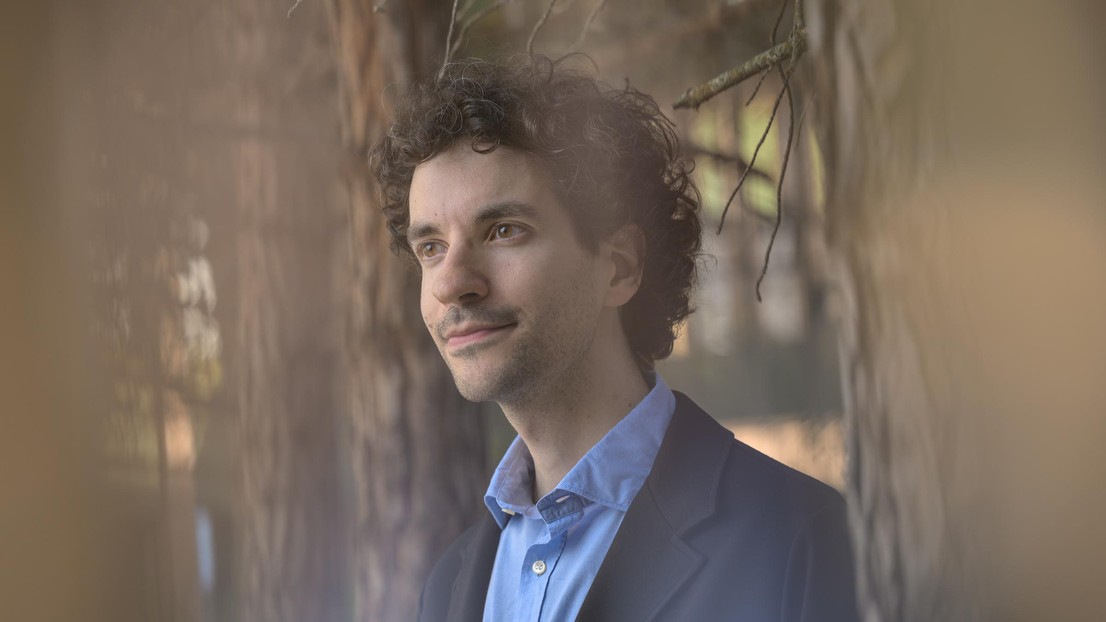
Clément Pit-Claudel is the winner of the EPFL Award for Best Teaching 2026. EPFL/Lundi13/François Wavre -CC-BY-SA 4.0
Clément Pit-Claudel, an assistant professor at EPFL’s School of Computer and Communication Sciences, is the winner of this year’s best teaching award. That’s no surprise given his contagious enthusiasm.
“In computer science – just like with life in general – you can’t do big things without first knowing how to do the little ones,” says Pit-Claudel, in a typically catchy turn of phrase. He also has strong ideas when it comes to teaching – his approach is hands-on, demanding and designed to help students grow. At the Magistral ceremony on Saturday, 3 October, he received the 2026 EPFL Award for Best Teaching before an audience of over 1,500 freshly minted master’s graduates.
Pit-Claudel, 34, obtained a PhD from MIT in 2022 and joined EPFL one year later as head of the Systems and Formalisms Lab (SYSTEMF). An expert in programming languages and software verification, he teaches the Software Construction class (CS-214) jointly with Martin Odersky and Viktor Kunčak. This class is given to as many as 400 computer-science bachelor’s students in their third semester. “I like to tell people that what I teach isn’t programming, but rather engineering through the prism of a computer program,” he says.
Making it all click
Since his students already have a year of coding under their belt, what Pit-Claudel tries to do is “make it all click.” And he does that in two ways: by having them see the value in their work from day one, and by enabling them to measure their progress over the course of the semester.
A key to Pit-Claudel’s approach is having students write programs that will be useful to them, such as to search for files or solve riddles. They start the semester by writing some basic code, and then flesh it out as the weeks go by with things they learn in class. “The superheroes you see in comic books when you’re little are born with their superpowers – they don’t have to learn them,” he says. “But things are different in computer science. You’ve got to acquire your superpowers! And once you do, you realize that you can have a computer do whatever you want and that you understand what’s happening. It’s amazing!”
Pit-Claudel also teaches a master’s and PhD level class on interactive theorem proving – his field of research. At SYSTEMF, he and his team study formal methods and translate computer programs into mathematical equations in order to prove that the programs work, as opposed to merely testing them.
AI is changing how programs are built – but not what students need to know to guarantee that their programs will do what they’re supposed to.
In his classes, students develop this analytical rigor by using a scientific approach to chase down bugs – they make observations, formulate hypotheses and then test those hypotheses. As part of this, students must take their exams on computers – a testing method that many large classes no longer use because there isn’t enough space. But Pit-Claudel books up to 14 rooms at EPFL and the University of Lausanne so that students can be assessed on their ability to code under stress, in real-world conditions. He believes “this requires a different set of muscles” than working on paper. Pit-Claudel is appreciative of teamwork and stresses the pivotal role that his colleagues play in making the class run smoothly: his two co-teachers as well as four PhD students and “20 extremely motivated bachelor’s and master’s students who help facilitate the lectures and run the exercise and lab sessions.”
On the issue of artificial intelligence, Pit-Claudel thinks it’s good that coding assistants enable just about anyone to create programs. But “taking a taxi isn’t the same thing as knowing how to drive,” he notes. “One day my students will manage systems that lives could depend on, such as at hospitals or for air traffic control. I want them to be able to state with confidence that their software will work, much like a civil engineer who signs his blueprints. AI is changing how programs are built – but not what students need to know to guarantee that their programs will do what they’re supposed to.”
From Montrouge to Boston to Lausanne
Pit-Claudel grew up in Montrouge, on the outskirts of Paris, the son of an engineer (his father) and a statistician (his mother). “We love math in my family!” he says. In high school, he wrote a backup and synchronization program called Create Synchronicity, which has been downloaded half a million times and is still available free of charge. Pit-Claudel is a staunch advocate of open science – all his course materials are available in open source, and two other universities in Europe have already used them. For him, this is a way to pay it forward. “My lab exists because the Swiss government decided it was worth having research and teaching conducted here,” he says. “So the least I can do is make our research freely available.”
Programming languages aren’t the only ones Pit-Claudel is interested in. In addition to his native language of French, he also speaks English and Spanish, and he studied Japanese and Chinese while a student at France’s École Polytechnique engineering school. Does he see a connection between human languages and computer ones? “Human languages describe the world around us, while programming languages state what we want to do with it. It’s a case of action versus contemplation. But there can still be a form of beauty in programming languages – it is possible to write beautiful code!”
He spent seven years at MIT and one year working as an applied scientist at Amazon, and then wasn’t sure whether to stay in the US or move to Switzerland. But a trip to EPFL’s Lausanne campus answered that question. “I fell in love with this place,” he says. And he’s still enamored three years on. “We train engineers for the country, and the country supports us. Students know why they’re here. I couldn’t hope for anything better.”
Video: Clément Pit-Claudel receives the EPFL Award for Best Teaching at the 2026 Magistrale, which took place on Saturday, October 3, 2026.