
Supermoiré graphene structure reveals new superconducting phases
Credit: Zekang Zhou/2026 EPFL
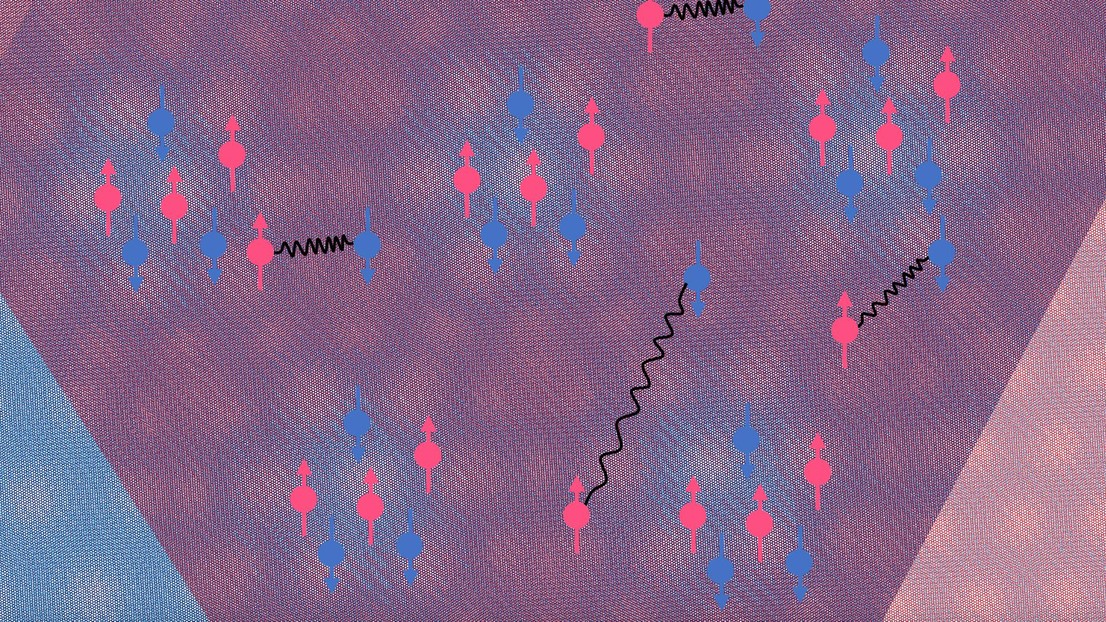
Physicists at EPFL have discovered that a novel graphene arrangement called a “supermoiré lattice” shows superconductivity and causes electrons to behave in unusual, coordinated ways. The findings could help design new kinds of quantum materials with properties never seen before.
Over the past few years, twisted graphene structures have become a rich playground for exploring quantum materials. When two graphene sheets are rotated relative to each other, they form what are known as moiré lattices. At certain “magic” twist angles, the electrons in these moiré lattices interact strongly, giving rise to superconductivity and insulating behavior reminiscent of that found in high-temperature superconductors.
But little is known about what happens when multiple moiré lattices overlap and create an even larger and even more complex ("higher order" in physics) pattern: a supermoiré lattice. Would it amplify the tech-promising effects of the moiré pattern or produce something even more exotic?
The supermoiré lattice imposes a long-periodic potential that reshapes the host material’s electronic band structure by introducing new minibands and modifying the band dispersion. Strongly correlated phenomena have been widely demonstrated in moiré lattices; however, the interplay between supermoiré potentials and strong electronic interactions remains largely unexplored.
A team led by Professor Mitali Banerjee at EPFL has shown the existing of supermoiré lattice in twisted trilayer graphene system. Similar to the conventional moiré lattice, the supermoiré lattice was also found to exhibit superconductivity and strong electronic correlations. Crucially, the study further demonstrated that the supermoiré lattice acts to modulate these quantum phases.
The research is published in Nature Physics.
Building a graphene supermoiré lattice
The researchers built a device using three layers of graphene, where the top and bottom layers were rotated at different angles compared to the middle one. This broke the mirror symmetry of the system and created two slightly different moiré patterns. These patterns overlapped in such a way that they formed a supermoiré lattice.
To study how electrons moved through this structure, the team cooled the device to near absolute zero and applied strong magnetic fields. They observed clear signs of the supermoiré lattice in the form of repeating electrical patterns known as Brown–Zak oscillations and Hofstadter’s butterfly that show how electrons are being steered by the larger-scale interference pattern.
Superconductivity and new quantum states
The researchers discovered that the supermoiré potential fundamentally reshapes the electronic energy landscape of the graphene system. This pattern results in the fragmentation of the material's continuous electronic structure into discrete, smaller bands (minibands). The interplay between the supermoiré potential and the strong electronic correlations already present in the original moiré flat bands leads to complex and emergent electronic behavior.
For example, the team observed that isospin-symmetry-breaking states can manifest even within the isospin-unpolarized regime of the original moiré lattice, thereby providing evidence that the supermoiré lattice enhances the intrinsic electronic interactions.
The team also found that the superconductivity dome is fragmented into multiple smaller domes by the supermoiré lattice, exhibiting a cascade of superconductor-insulator transitions. The characteristic carrier density difference between these insulating states corresponds precisely to half filling of the supermoiré lattice. This observation may provide critical new insights into understanding the mechanism of superconductivity in moiré graphene systems.
The study shows that the supermoiré lattice can be used to tune quantum states in graphene-based materials. It also demonstrates the possibility of leveraging the supermoiré structure to discover and design unexpected electronic quantum phases, building on those already observed in existing moiré lattices.
Other contributors
- Freie Universität Berlin
- Japan National Institute for Materials Science
- US National High Magnetic Field Laboratory
- Florida State University
- EPFL Center for Quantum Science and Engineering
Swiss National Science Foundation (SNSF)
Deutsche Forschungsgemeinschaft
Florida State University
US National Science Foundation
European Union’s Horizon 2020 research and innovation program (QuantERA II Programme)
JSPS KAKENHI
Japan World Premier International Research Center Initiative (WPI)
Zekang Zhou, Cheng Shen, Kryštof Kolář, Kenji Watanabe, Takashi Taniguchi, Cyprian Lewandowski, Mitali Banerjee. Strong Correlations and Superconductivity in the Supermoiré Lattice. Nature Physics 20 January 2026. DOI: 10.1038/s41567-025-03131-0