
Study trip in Ticino
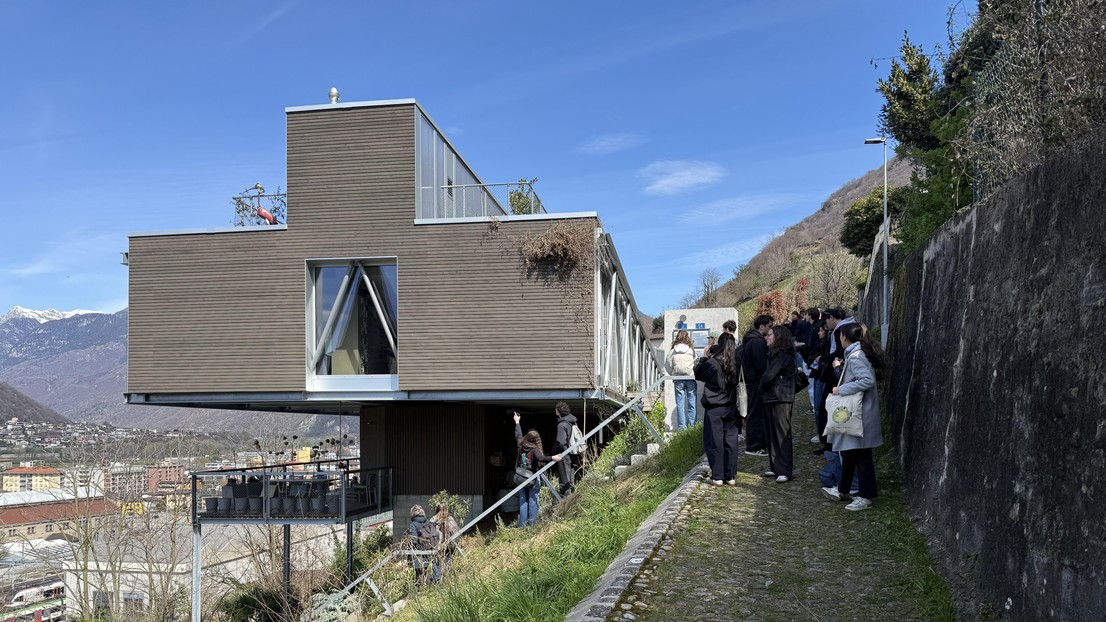
Résidence D-Vision, Bellinzone, Guidotti Architetti + Andrea Frapolli Architteto © EPFL / LAST
This year, the studio of Emmanuel Rey from the Laboratory of Architecture and Sustainable Technologies (LAST) organized its study trip in the Ticino canton. This off-campus teaching activity enabled students to visit architectural projects from various periods that showcase the spatial and constructive potential of urban development on sloping sites. These themes directly echo the issues addressed in the RELIEFS URBAINSdesign studio.
Architectural design is expected to play a central role in identifying alternatives capable of redirecting urban development toward inward growth. Through an approach operating at multiple scales, the LAST studio seeks to analyze, explore, and experiment with the issues surrounding architecture’s contribution to the resilient regeneration of urban territories, particularly those on slopes.
The study trip in Ticino was conceived in this spirit, with the objective of allowing the students to broaden their knowledge in terms of architectural references. It was an opportunity to visit many of the region's most emblematic projects: in Bellinzona, the Castelgrande renovated by Aurelio Galfetti; the various interventions by Luigi Snozzi in Monte Carasso; the historic center of Locarno; and also contemporary housing projects in Bellinzona, Muralto, Ascona and Mendrisio. Urban strolls sequenced by funicular railways, lifts and public staircases allowed students to experiment with sustainable mobility practices adapted to the slope.
Several enriching encounters also characterized the study trip, such as the various guided visits led by architects Renato Magginetti, Simone Biaggi (Oxid Architektur), Andrea Frapolli, Giacomo Guidotti (Guidotti Architetti), Cristina Guerra, Pietro Tovaglieri (Buzzi Architetti), and Ivano Gianola, which highlighted the unique character of architectural production in this canton.
Finally, the trip ended with a visit to the two academic institutions in Mendrisio: SUPSI, accompanied by Francesco Piatti, and to the USI Academy of Architecture, which provided the opportunity to discover the Teatro dell’architettura (Mario Botta) and the library housed in a former hospital (Atelier Cube / Studio SML).
These multiple approaches helped to put into perspective issues of conceptual coherence, built morphology, spatiality, materialization, and expression with broader themes related to the urban mutation processes that most European urban regions are experiencing today.