
Students launch successful quantum hackathon at EPFL
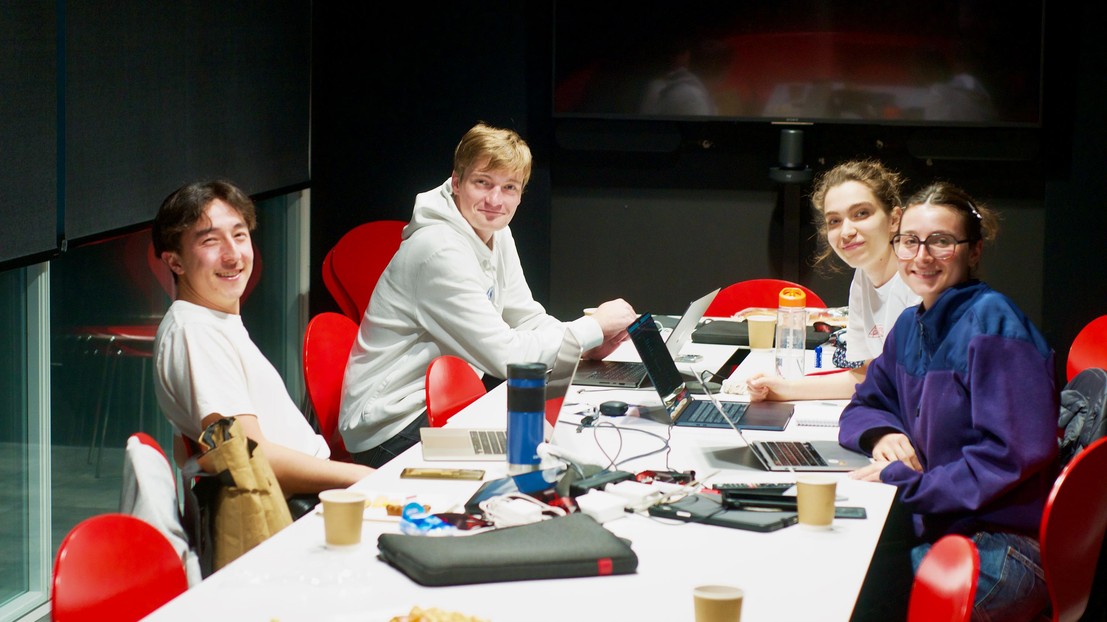
© 2026 Nicolò Battocletti
A group of students from the Master’s in Quantum Science and Engineering and Master’s in Physics organized a quantum hackathon at EPFL with the support of the QSE Center. The first edition of the QPFL Hackathon took place from 27 February to 1 March 2026, received over 200 applications and brought nearly 70 students from Swiss and international universities to campus.
The idea for the QPFL Hackathon first came from Douaa Salah, a second year QSE master’s student, who had been supported by the QSE Center to attend the NYUAD Hackathon a year earlier.
“After coming to EPFL, I attended my first quantum hackathon, and a few more followed, including the NYUAD hackathon,” she says. “I loved those experiences so much, and I learned in ways that I wouldn’t have in more traditional settings, not to mention the memories I made along the way. So naturally, I developed this desire to bring that experience to EPFL.”
In order to realize this big project, Salah brought in other students to help her organize the event – Nicolò Battocletti Sofia Brizigotti, Khurshed Fitter, Hugo Izadi, Ekaterina Pankovets, and Sascha Rivera – and contacted the QSE Center to ask for logistical and financial support.
“The QSE Center was very happy to support this initiative because it fits perfectly with one of our missions, which is to enhance quantum education and develop future talent,” says Charlotte Vandenberghe, research and innovation manager at the QSE Center. “Seeing such a diverse community of talented and motived students come to EPFL to work together on quantum challenges was a really wonderful experience.”
Exceeding expectations, the EPFL Quantum Hackathon received over 200 applications from students across Europe, the Middle East and Asia and the organizing committee selected 75 as participants.
The long weekend kicked off Friday afternoon with two lectures from EPFL professor Zoë Holmes who leads the Quantum Information and Computing Group, and postdoctoral researcher Marco Scigliuzzo who works in the Laboratory of Photonics and Quantum Measurements, followed by a poster session where around a dozen EPFL students and researchers presented their work to the visiting participants.
“I found out about this event from my teammates whom I met two days before on LinkedIn,” says Arda Kara, a bachelor’s student in Electrical Engineering from Bilkent University in Turkey. “They messaged me and said they were looking for a fourth teammate and I was actively looking for quantum hackathons. I also aim to apply to EPFL for a master’s so it was a really great coincidence.”
Kara and his team, Qedi, won first place in the Quandela challenge, one of the three challenges presented by the main sponsors. The other two challenges came from Alice & Bob, and from Quobly/AXA jointly. The event was also sponsored by Zurich Instruments and QBraid, who provided computing power, and the Swiss Quantum Initiative.
Each challenge focused on a different problem, and teams could choose which they wanted to work on. Quandela’s challenge focused on a time-series forecasting problem on swaption surfaces.
“I normally work at the cross-section of finance and engineering so having a challenge that was about quantum advantage and options pricing was really intersting, and as soon as I saw the Quandela challenge, I knew we had to choose it,” Kara says. “It was really fun to work on. I learned a lot about photonic computation, which was a new direction for me.”
For Quobly/AXA’s challenge, participants were tasked with modelling and quantising real-world insurance optimization problems, such as pricing and reinsurance, in order to explore potential quantum advantages.
And Alice & Bob asked the teams to explore how cat qubits enable significant reductions in hardware overhead for fault-tolerant quantum computing and investigate novel error-correcting codes that are particularly well suited for concatenation with cat qubits, enabling many participants to have a first hands-on experience with quantum error correction.
“The challenge we took from Alice and Bob was about quantum error correction and was quite broad, so it was great as we had a lot of flexibility,” says Andriana Misailidi from the National & Kapodistrian University of Athens, whose team Flippers won second place in their challenge.
All the hackers stayed up nearly all night working on their challenges, taking breaks of only one or two hours to rest in the designated resting room.
“So many participants during the hackathon came up to me with great positive feedback saying they loved the experience” says Salah. “I had never done something like this before. Compared to what it might look like, it is a lot of work. I was lucky to work with a great team from the QSE Center and EPFL students who believed in the project and made it possible and I cannot thank them enough. It felt very rewarding and worthwhile to see the Hackathon inspire and create so many memories for these students!”
