
Student Center and Archives: Designing within the Existing
© 2026 EPFL
Within the framework of the ADHER studio, dedicated to the design of a future Student Center on EPFL’s historic campus, the Archives de la construction moderne were mobilized as an active design tool.
During the month of March, the mobilisation of the Archives de la construction moderne (ACM) at EPFL, within the framework of the ADHER studio, takes place within a broader reflection on the role of architectural archives in contemporary design processes. This initiative is part of the Spring 2026 semester, marked by a reflection on a future Student Center and bringing together several studios – ADHER, DC-lab, EAST and RIOT – around a collective research on the EPFL campus. On this occasion, several students were introduced to the consultation of archival fonds and their use as analytical tools.
Led by Professor Claudia Devaux, in collaboration with Martin Lichtig and Balthazar Donzelot, the ADHER studio develops, within this framework, a specific approach focused on working within the existing. It addresses the design of a Student Center on the historic EPFL campus, based on a close reading of its early phases of development. The program articulates different stages and encourages students to consider the built environment as a resource.
Learning to Read Archives
The introduction to archival work addressed a set of fundamental notions: the definition of archive and document, the distinction between primary and secondary sources, and the importance of situating and contextualising information based on its producer. It also introduced the structure of archival fonds and the classification logics that govern their access. In this context, architectural archives, composed of heterogeneous materials – plans, drawings, correspondence, photographs – appear as complex assemblages whose reading relies on interpretation and the establishment of relationships between documents.
The Jakob Zweifel Fonds
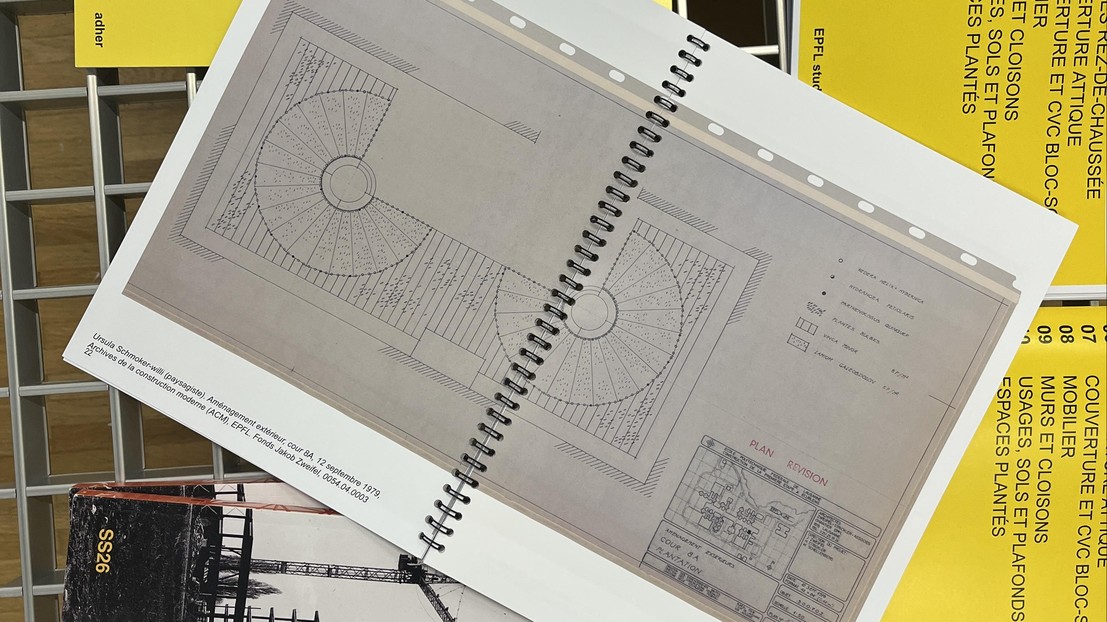
The consultation of the ACM EPFL 0054 Jakob Zweifel fonds is part of this approach. As the architect in charge, from 1970 onwards, of planning the EPFL campus in Écublens, Zweifel documents its early phases of development. The fonds brings together reports, studies, plans, correspondence and administrative documents, which reflect the design principles – grid, modularity, typologies, circulation and networks – as well as their evolution.
Confronting Archives and the Built Reality
Within the framework of the studio, this reading is then extended through in situ survey and analysis. The confrontation between archival documents and the built reality does not aim to establish correspondence, but to reveal discrepancies — transformations, adaptations and uses — that characterise the evolution of the building. This back-and-forth between archives and site encourages students to cross different types of sources and to construct a situated understanding of the existing. Based on this work, students produced a series of graphic, technical and analytical documents, organised according to different registers — construction systems, envelope, roofs, interior spaces, technical systems and uses. At the same time, the production of models at different scales allows the exploration of the building’s spatial and material dimensions, while serving as analytical tools.

Activating the Archives
In this context, archives are not mobilised as a simple documentary background, but as an active tool within the design process. Their consultation anchors the analysis in concrete materials while introducing a critical distance from the existing. It also contributes to situating the design process within a continuity, by reintegrating the historical and documentary dimension into the core of the project.
-