
Strategies for Symbiotic Urban Neighborhoods
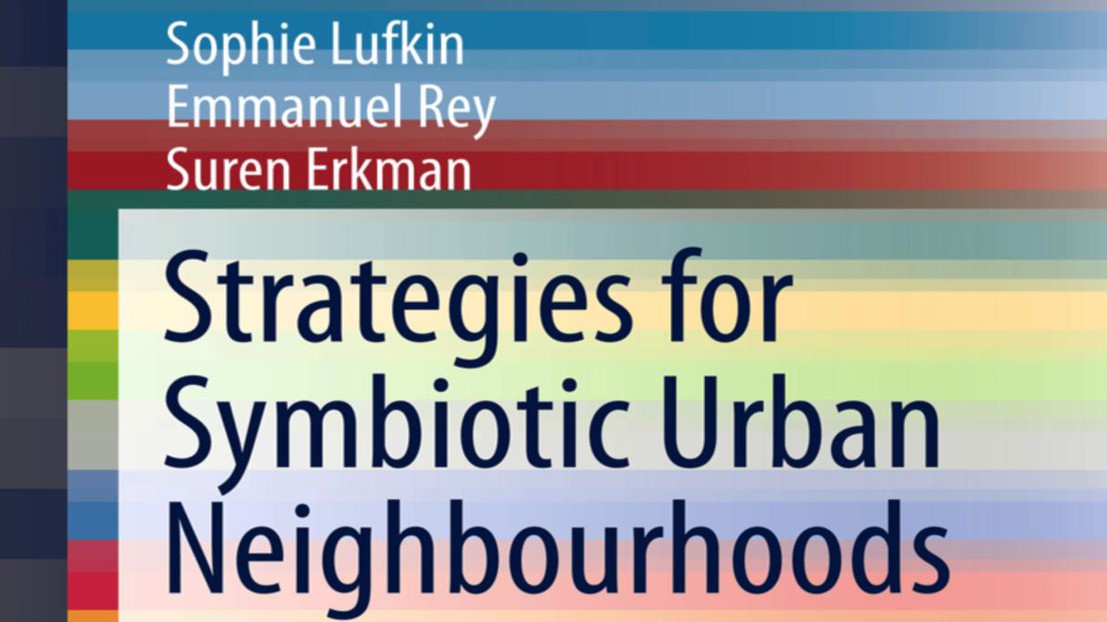
Published by Springer, the book "Strategies for Symbiotic Urban Neighborhoods. Towards Local Energy Self-Sufficiency "summarizes the results of a research project on energy efficiency of symbiotic urban neighborhoods, realized thanks to the support of the Collaborative Research on Science and Society (CROSS). The authors, Dr. Sophie Lufkin and Prof. Emmanuel Rey, from the Laboratory of Architecture and Sustainable Technologies (LAST), associated to Prof. Suren Erkman of the University of Lausanne (UNIL), highlight the necessity of using approaches which simultaneously combine technology, users behavior and urban symbiosis to reach high energy performances on the district scale.
Within a context of a growing effort to create sustainable development strategies, most of the research has focused on energy-related issues in the built environment. And for good reason: over 40% of worldwide energy consumption can be attributed to the construction sector. In Switzerland, total energy expenditures associated with buildings account for no less than half of total energy consumption. Ambitious objectives to reduce non-renewable energy consumption are now being set by several European countries, following the example of the 2000-Watt Society concept developed in Switzerland or the political vision of phasing out nuclear energy.
It is in this spirit that the research presented in this book was designed. Using the results of a case study on the "Gare-Lac" area in the city of Yverdon-les-Bains, Switzerland – the site is currently a large urban disused area, intended to host ca. 3,800 additional inhabitants and 1,200 jobs upon completion – this work examines how to design attractive urban neighborhoods that generate endogenous economic activity and foster socio-cultural dynamics, while moving towards local energy self-sufficiency.
Exploring the different dimensions influencing energy self-sufficiency at the neighborhood scale by integrating parameters related to buildings, infrastructure, mobility, food, goods and services, the work focuses on the exploration of three scenarios (technological, behavioral and symbiotic) for the future development of this neighborhood by 2035.
Strategies for Symbiotic Urban Neighborhoods. Towards Local Energy Self-Sufficiency
Sophie Lufkin, Emmanuel Rey, Suren Erkman
London: Springer, 2016, 65 pages.
ISBN 978-3-319-25610-8