
Slippery ions create a smoother path to blue energy
© iStock
By engineering lubricated interfaces inside nanopores, EPFL researchers have enabled ions to flow through a nanofluidic membrane with unprecedented speed and control. In addition to enhancing nanofluidic technologies, the innovation could help accelerate the development of next-generation osmotic energy harvesting.
Osmotic energy, often called blue energy, is a promising way to generate sustainable electricity from the natural mixing of salt and fresh water. It exploits the voltage that arises when ions from salt water pass through an ion-selective membrane toward water with a lower salt concentration. However, membranes that let ions flow quickly are usually less selective, and challenges such as maintaining charge separation and mechanical robustness have kept most osmotic energy systems at the experimental stage.
Researchers in the Laboratory for Nanoscale Biology (LBEN), led by Aleksandra Radenovic in EPFL’s School of Engineering, and in the Interdisciplinary Centre for Electron Microscopy (CIME) have published a paper in Nature Energy that demonstrates how these challenges can be overcome. For their study, the scientists lubricated nanopores using tiny bubbles made of lipid molecules (liposomes). Normally, the nanopores would enable very slow (but very precise) ion flow. With their lipid lubrication, however, the nanopores allowed selected ions to slip through with much less friction, significantly boosting ion transport and overall performance.
“Our work brings together the strengths of two main approaches to osmotic energy harvesting: polymer membranes, which inspire our high-porosity architecture; and nanofluidic devices, which we use to define highly charged nanopores,” says Radenovic. “By combining a scalable membrane layout with precisely engineered nanofluidic channels, we achieve highly efficient osmotic energy conversion and open a route toward nanofluidic-based blue-energy systems.”

Hydration lubrication optimization
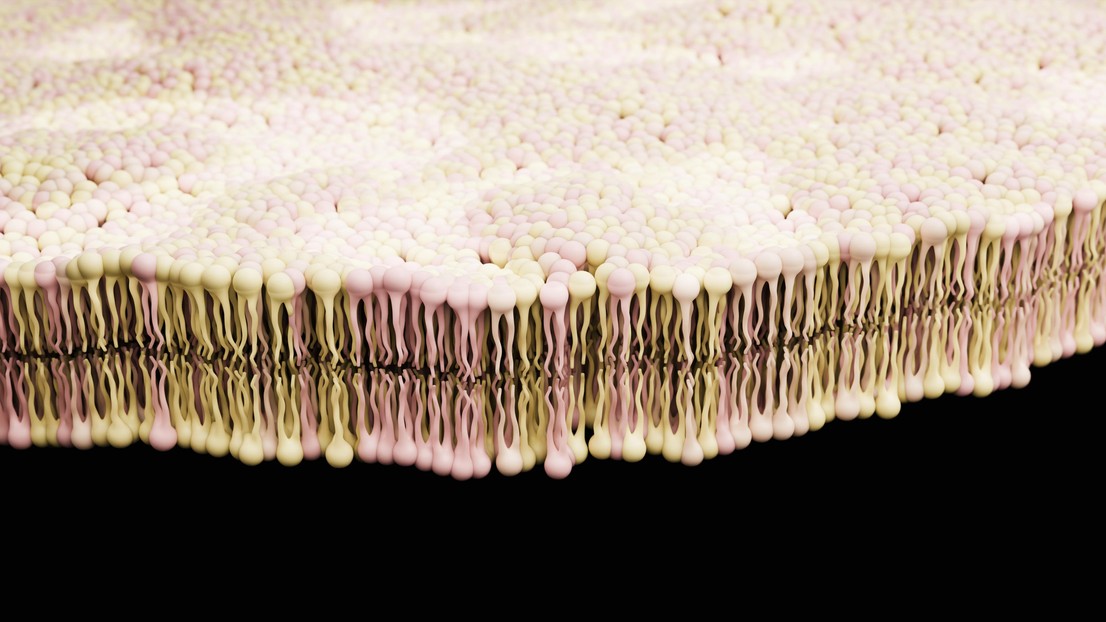
The team formed their lubricating coating from lipid bilayers, which are natural structures found in cell membranes. Lipid bilayers self-assemble when two layers of fat molecules come together by their water-repelling (hydrophobic) tails, leaving their water-attracting (hydrophilic) heads pointing outward. When deposited on the stalactite-shaped nanopores set into a silicon-nitride membrane, the bilayers’ hydrophilic heads attract a very thin layer of water. This layer, just a few molecules thick, sticks to the nanopore and prevents direct interaction with flowing ions, reducing friction.
To demonstrate their method, the team fabricated 1,000 lipid-coated nanopores arranged in hexagonal pattern. When tested under conditions that replicated the natural salt concentrations of sea water and river water, their device exhibited an overall power density of roughly 15 watts per square meter. This is 2-3 times greater than the output of existing polymer membrane technologies.
While simulations have suggested that simultaneously increasing ion flow and selectivity in nanofluidic channels could boost osmotic energy conversion, experimental demonstrations of this combined improvement have been scarce. “By showing how precise control over nanopore geometry and surface properties can fundamentally reshape ion transport, our study moves blue-energy research beyond performance testing and into a true design era,” says LBEN researcher Tzu-Heng Chen.
First author Yunfei Teng adds that the team’s “hydration lubrication” approach could be used not only to advance osmotic energy conversion, but also to optimize other nanofluidic systems. “The enhanced transport behavior we observe, driven by hydration lubrication, is universal, and the same principle can be extended beyond blue-energy devices,” he says.
This project relied on advanced characterization of nanopore morphology and chemical composition, carried out by Dr. Victor Boureau at EPFL’s Interdisciplinary Centre for Electron Microscopy (CIME). It was also supported by EPFL’s shared facilities for nanofabrication, materials characterization, and high-performance computing, including CMi, MHMC, and SCITAS.
Teng, Y., Chen, TH., Cai, N. et al. Charge and slip-length optimization in lipid-bilayer-coated nanofluidics for enhanced osmotic energy harvesting. Nat Energy (2026). https://doi.org/10.1038/s41560-026-01976-0