
Self-Learning Part Feeder Wins “AI-Powered Innovation” Prize
© 2026 EPFL
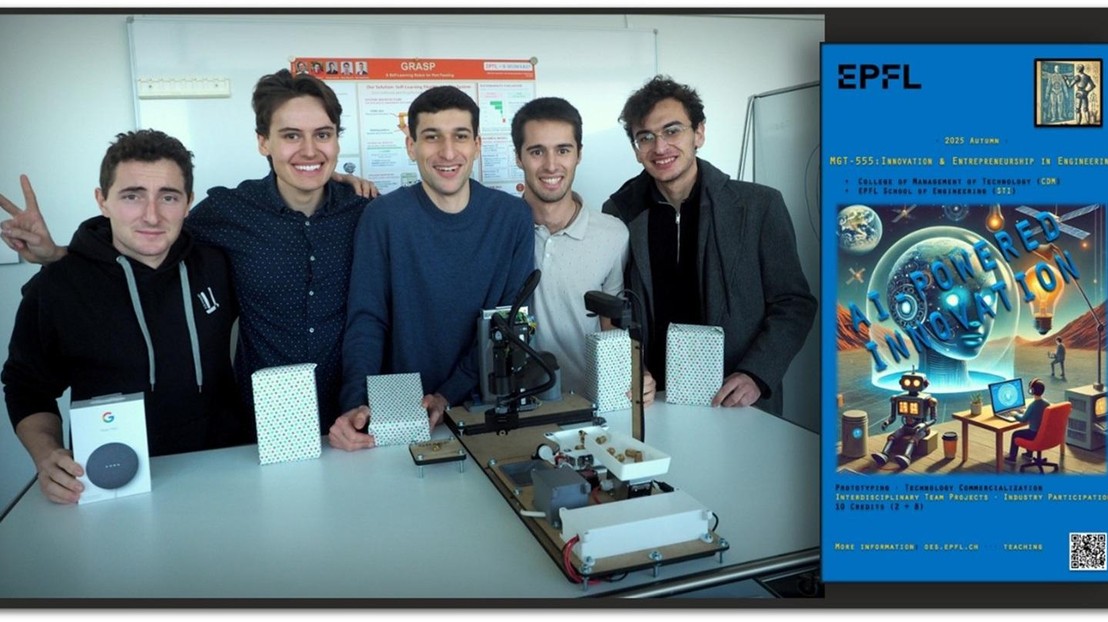
Since 2019, every year the graduate course “Innovation and Entrepreneurship in Engineering” (MGT-555) brings together students from across EPFL to develop product-innovation projects with industry partners. Led by Prof. Véronique Michaud and Prof. Thomas A. Weber, the Autumn 2025 edition focused on “AI-Powered Innovation.” Seven multidisciplinary teams delivered working demonstrators and business cases, with explicit attention to sustainability and risk. The top prize (the 2025 IEE Prize) was awarded to Team 5 for “GRASP,” a self-learning robotic part-feeding add-on for flexible manufacturing, developed with HUMARD Automation. The runner-up was Team 1 for “OptiFlow,” an AI-powered shelf-layout and customer-flow optimization concept developed with Decathlon.
Across the semester, each team combined technical development with market and implementation analysis. The final deliverables included a prototype, a written report, and a business case covering financial viability, sustainability considerations, and scenario-based risk discussion. Together, these projects provide a snapshot of applied work at the intersection of engineering design and entrepreneurship.

Team 1: AI-Powered Shelf Layout and Customer Flow Optimization (OptiFlow), in collaboration with Decathlon Sports Switzerland SA
Students: Victoria Douarche, Oscar de Francesca, Arnaud Levêque, Matthieu Vernhes, Fatima Wissale Zergot, Gaspar Zimbrek-Turkovic.
Industry partner: Alexis Okotnikoff (Decathlon Sports Switzerland).
OptiFlow proposes a wearable sensing and positioning stack (RFID plus ultra-wideband anchors) to link shelf availability with on-the-floor execution. The concept couples real-time measurements with decision support to reduce stockouts, improve replenishment, and connect layout decisions to observed customer movement.

Team 2: Autonomous In-Store Stock Support Robot (Stokko), in collaboration with Decathlon Sports Switzerland SA
Students: Hugo Alarcón Da Costa, Victor Desreumaux, Koray Kelam, Tomás Miravete Jiménez, Agasthya Vivek, Sude Yasar.
Industry partner: Alexis Okotnikoff (Decathlon Sports Switzerland).
Stokko explores a lightweight autonomous robot to support store operations, with emphasis on safe navigation, human–robot interaction, and modular design. Beyond logistics support, the project highlights how onboard perception can generate operational analytics that inform retail process improvements.

Team 3: Portable Full-Pitch Capture and Analytics-Ready Video Output (PitchView), in collaboration with DeepScouting SA
Students: Alexandre Blaga, Aurel Drouart, Kristyn Korboe, Patrick Nolan, Staša Vasilic.
Industry partner: Selim Kebaier (DeepScouting).
PitchView targets grassroots football (and later other ball sports) with an affordable, portable capture concept that delivers both a stitched panoramic view and a broadcast-style cropped view. The prototype combines a telescopic mast, dual cameras, and on-device processing to lower the operational barrier for video-based coaching and scouting.

Team 4: Synthetic Data for Robust Industrial Vision (Data Creation Box), in collaboration with HUMARD Automation SA
Students: Thibaud Biel, Nevò Mirzai Hamadani, Zixu Lu, Haroun Naina, Heling Shi, Nicolas Werlen.
Industry partner: Johan Vuillaume (HUMARD Automation).
The Data Creation Box proposes a compact, repeatable setup to generate labeled image data quickly for industrial object recognition. By standardizing capture conditions and supporting synthetic augmentation, the concept aims to reduce the time and friction of deploying vision models in small-batch automation.

Team 5: Self-Learning Robotic Part Feeding System for Flexible Manufacturing (GRASP), in collaboration with HUMARD Automation SA
Students: Alain Aziz, Loïc Delineau, Thomas Menadi, Alexis Ruprecht, Evan Sapozhnikov.
Industry partner: Johan Vuillaume (HUMARD Automation).
GRASP addresses a stubborn manufacturing bottleneck: configuring flexible part-feeding systems still requires expert time and manual labeling. The team’s add-on concept combines synthetic-data training, Bayesian parameter optimization, and adaptive control so a user can “teach” a new part with a handful of photos and minimal tuning.

Team 6: AI-Enhanced Light Beacon for Firefighter Rescue (Hyperion), in collaboration with Wearin' SA
Students: Thibault Andriot, Nathan Hess, Paul Nauche, Arthus Ribadeau Dumas, Louis Seurre, Hugo Subtil.
Industry partner: Dr. Bastian Peter (Wearin').
The AI-enhanced light beacon project develops a redundant communication channel for emergency response: physiological and location data are encoded into LED light patterns and decoded with computer vision when radio links fail. The prototype aims to shorten rescue time and improve situational awareness under harsh conditions.

Team 7: Wearable Decision Support for Firefighters (GuardIA), in collaboration with Wearin' SA
Students: Amelia Bertolaso, Pierre Jean-François Hervé Griffon, Nora Cécile Rosel Zaballos, Francesco Maria Savoja, Batiste Louis Nahuel Vignau, Vincent Vos.
Industry partner: Dr. Bastian Peter (Wearin').
GuardIA is a wearable safety concept that blends sensing with AI-assisted interpretation to reduce cognitive load during interventions. The team framed a path to deployment that combines technical validation, pilot testing with firefighters, and a sustainability-informed risk discussion.

2025 IEE Prize – Results
The jury evaluated the projects based on the quality and credibility of the business case, the functionality and feasibility of the prototype, and the overall professionalism of the final presentation. The jury consisted of the two course instructors (Prof. Véronique Michaud and Prof. Thomas A. Weber), together with Dr. Marc Laperrouza (EPFL) and Marius Conti (EPFL).
After deliberation, the 2025 IEE Prize for the best project was awarded to Team 5 for “GRASP,” developed with HUMARD Automation. The project stood out for turning an industrial pain point into an implementable add-on: the system reduces the manual burden of configuring flexible part feeders, while remaining compatible with installed equipment. The work combined a concrete prototype story with an explicit economic and sustainability rationale.
This year’s runner-up was Team 1 for “OptiFlow,” developed with Decathlon. The team presented a technically detailed sensing architecture and a careful scenario-based business case. By tying inventory accuracy and shelf availability to a deployable data-collection pathway, the project made a persuasive argument for how retail “last meters” can be improved without asking stores to become research labs.

Acknowledgements
The course was launched in 2019 as a joint initiative of EPFL’s School of Engineering (STI) and the College of Management of Technology (CDM), and it continues to be strongly supported by both schools.
The Autumn 2025 edition was supported by additional lecturers and contributors (in order of appearance): Prof. Chris Tucci (Imperial College London), Prof. Pascal Fua (EPFL), Dr. Mathieu Salzmann (EPFL), Dr. Zimin Xia (EPFL), Dr. Martyn Wakeman (EPFL), and Dr. André Catana (EPFL). The course also benefited from industry input provided by iProva. Hands-on prototyping support was provided by Pascal Vuilliomenet (EPFL Discovery Learning Laboratories) and Julien Delisle (EPFL), and sensor office hours were provided by Prof. Giovanni Boero (EPFL).
The course was coordinated by Ru Zhang, with teaching assistance from Zoubeir Saraw and administrative support from Ilona Ball (all EPFL).

The instructors are deeply appreciative of the generous support provided by the participating companies and their engaged managers, who dedicated significant time to mentoring the students: Alexis Okotnikoff (Decathlon Sports Switzerland SA), Selim Kebaier (DeepScouting), Johan Vuillaume (HUMARD Automation SA), and Dr. Bastian Peter (Wearin' SA).
In the 2026/27 Fall semester, a new edition of MGT-555 Innovation and Entrepreneurship in Engineering will take place under the theme of “Fitness for All,” organized jointly by Prof. Thomas Weber and Prof. Véronique Michaud.
