
“Safeguarding coastlines against sea level rise is urgent."
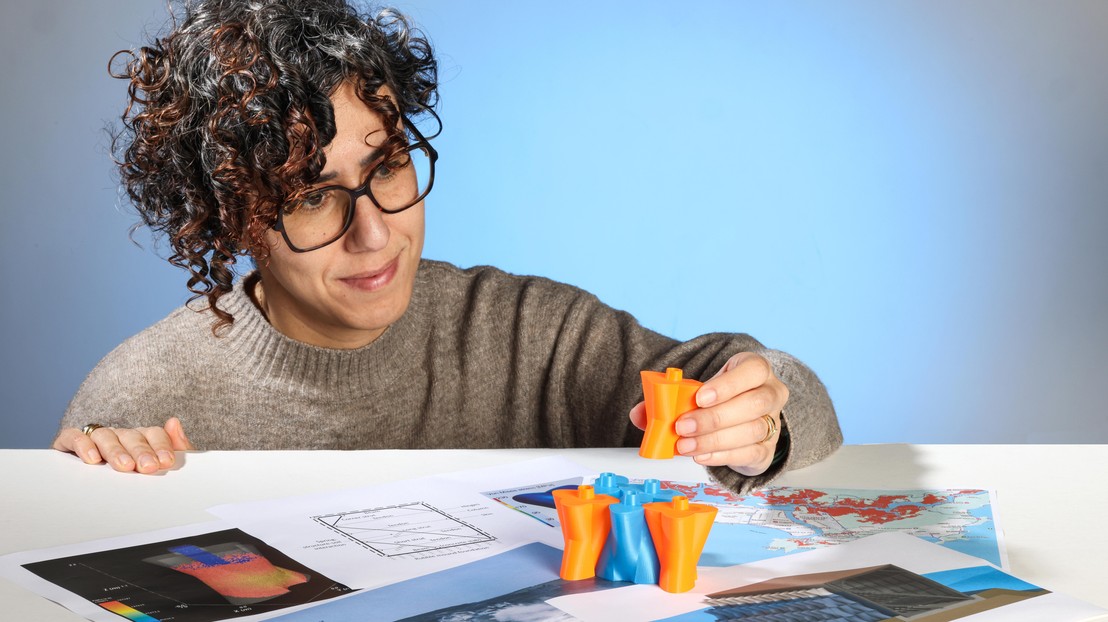
© 2025 Alain Herzog/EPFL - CC-BY-SA 4.0
Tara Habibi combines the lightness of composite materials with the strength of concrete to create a modular solution designed to protect coastal cities. Its quick-to-install units are designed to be more durable than existing structures.
The intensification of extreme climate events along with rising sea levels, will reshape our coastlines. Without sufficient protective measures, the consequences could be devastating: coastal flooding and increased storm surges, submersion of coastal cities and strategic ports, saltwater intrusion into groundwater aquifers, uncontrolled population migration and disappearance of marine habitats. “According to projections, the average sea level will rise by 1.5 meters by the next 70 years, and Europe could face annual coastal flooding damage of up to €800 billion” emphasizes Tara Habibi, postdoctoral researcher at the Hydraulic Constructions Plateform at EPFL. “An effective way to limit damage caused by rising sea levels and storm surges is the construction of shore protection systems, such as barriers and armours,” Tara says. “Conventional solutions based on heavy concrete technology and large sand dikes are hardly able to meet the challenges ahead. They are slow to build, expensive, and often unsustainable given the rapidly growing demand. Worse still, concrete deteriorates under the effects of salinity and abrasion, and these rigid structures are difficult to adapt when conditions change, for instance as water levels continue to rise.”
The SafeShore approach enables deployment that is 2 to 10 times faster, with a significant reduction in costs at every stage of work: construction, storage, transportation, and installation.
Holding a Master’s degree in Civil Engineering from Amirkabir University of Technology (Tehran Polytechnic), Habibi spent ten years working in the maritime industry on conventional shore protection systems. When she began a PhD at EPFL in 2020, she shifted her focus to ultralight composite materials for construction. Habibi began to wonder if these two worlds, one of “ever heavier” and the other of “ever lighter”, could be combined and applied in harsh marine environments? During the last year of her PhD, the idea of a hybrid approach took shape: applying composite materials already used in the aerospace industry, to create lightweight, ultra-resistant, easily transportable thin-walled modules that can be filled on site with locally available heavy materials. According to her investigations, “this approach enables deployment that is 2 to 10 times faster, with a significant reduction in costs at every stage of work: construction, storage, transportation, and installation.”
“With Europe alone needing around 6,000 kilometers of shore protection to shield populated areas, a new faster and greener technology is needed. This is where SafeShore comes in,” says Tara. The SafeShore project has received a Seed Grant from the EPFL-ENAC School, an EPFL Innogrant, and an Innosuisse WIP Grant from the Swiss Confederation. In addition, Tara has been awarded the Sciencepreneur status at EPFL, allowing her to continue refining her start-up project while benefiting from the infrastructure of the School’s Hydraulic Constructions Platform.
A few days is all it takes
The concrete structures currently used for coastal protection must be manufactured using molds in specialized facilities, transported once they have hardened, and then installed on site. “The process requires extremely heavy lifting equipment, specific skills and a lot of time – concrete hardening alone takes 28 days,” says the researcher. “By contrast, we manufacture our modules from lightweight and durable fiber-polymer composites in just a few hours,” she explains. “These modules can be easily transported to their final position at sea, immersed, and then filled to the required weight with locally available heavy materials such as soil, dredging material, or lean concrete,” she adds. “It also becomes easy to increase the height of existing concrete barriers using our novel extension modules, if the structure in place is no longer sufficient to resist ongoing sea-level rise”. This approach makes it possible to respond rapidly in emergency situations and to intervene quickly in coastal areas threatened by erosion or storms.
The composite modules have already been validated through mechanical and hydraulic analysis and modeling and described in peer-reviewed scientific articles. Before moving towards large-scale deployment, however, a comprehensive assessment of environmental aspects is currently being carried out to ensure full compatibility with the marine ecosystem. These considerations have led to an 18-month research project supported by Innosuisse, aimed at systematically evaluating abrasion resistance in water, analyzing interactions with sediments, and confirming that the solution does not harm the aquatic environment.
Partnerships for running pilot projects on European shores
SafeShore is led by a three-member team bringing together complementary expertise: Tara Habibi, a structural engineer, Thomas Keller, an expert in composite materials, and Shahin Maghsoudi Zand, a marine engineer. The team plans to incorporate their start-up upon successful completion of the Innosuisse project. In parallel with this research, discussions are ongoing with European stakeholders to carry out full-scale pilot projects at sea. “We are in contact with authorities and industry in Portugal, the Netherlands, France, Italy, and the Emirates, to develop and install first prototypes; offshore installation sites are under evaluation in Portugal and Italy. We are also looking for partners interested in embarking on this challenging journey together.”