
Public PhD thesis defense of Andreas Schuler
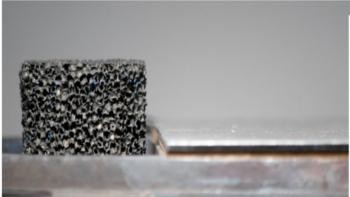
© 2012 EPFL/LENI
On August 16th, Andreas Schuler has successfully defended his PhD thesis entitled "Chromium poisoning: the needle in the SOFC stack".
This thesis was directed by Dr Jan Van Herle and Dr Aïcha Hessler-Wyser and is accessible through infoscience and the EPFL library (N° 5428).
Abstract
This thesis focuses on Cr-poisoning in solid oxide fuel cells (SOFC), which currently presents a key challenge for the development of this technology. By the implementation of dedicated experimental tools, this work offers a new access to, and comprehension of, electrochemical performance degradation caused by Cr contamination accumulation.
An experimental setup for the in situ assessment of Cr vapor concentrations within the hot air flux of an SOFC system inlet gives direct proof, and a measure of severity, of the Cr contamination issue. An energy-dispersive X-ray spectroscopy (EDX) based Cr quantification methodology leads this work to objective and therefore comparable data from post-test observations performed by scanning electron microscopy (SEM). Moreover, the developed methods are time-efficient.
To understand Cr-poisoning, in particular the deposition mechanisms of CrVI to CrsIII, electronic conducting cathode materials such as (La,Sr)MnO3 as well as mixed ionic electronic conductors (MIEC) such as (La,Sr)CoO3, (La,Sr)(Co,Fe)O3, (La,Sr)MnO3-(Y,Zr)O2 and Nd1.95NiO4+δ are investigated during and after medium- to long-term electrochemical testing involving deliberate exposure to Cr contamination in button cell and stack test arrangements. The deposition rate of both chemically-driven and electrochemically-driven cathode mechanisms related to Cr-poisoning depends on the material, its operating conditions as well as on superimposed degradation phenomena, such as sulfur-poisoning.
Investigation and subsequent results at the SOFC stack level combine the different aspects of Cr contamination encountered within this work. The severity of Cr-poisoning of a cathode, depending on the electrode overpotential, guides the development of less-sensitive materials towards high performing cathodes, in particular MIEC electrode materials at lower temperature. The crucial role of electrode proximal layers within the cathodic half-cell, such as current collectors and protective coatings of metallic interconnects (MIC) is found to be adequately dispatched by present SOFC technology. Their role is to lower the concentration of Cr vapor species reaching electrochemically active cathode regions both by diffusion resistance and reactive trapping. In contrary, sealing materials do not achieve satisfactory tightness to hydrogen diffusion into the cathode compartment, causing aggravated Cr-poisoning by local steam generation and hence increased Cr-evaporation. As the protection against Cr evaporation of the entire balance-of-plant (BoP) of a real SOFC system, or its construction with non-emitting components regarding Cr evaporation, is not practicable, a Cr-getter-based air filter, developed within this work and validated in situ, offers a suitable solution for BoP-caused Cr pollution.
Keywords: Solid Oxide Fuel Cell (SOFC), Cathode, Metallic Interconnect (MIC), Balance-of-plant (BoP), Oxidation, Contamination, Degradation, Cr-Poisoning, Solid-State Chemistry, Rare-Earth Compounds, Scanning Electron Microscopy (SEM), Energy-Dispersive X-ray Spectroscopy (EDX), In Situ Gas Sampling.
Résumé
Cette thèse porte sur l’empoisonnement au Cr des piles à combustibles à oxyde solide (SOFC), qui représente actuellement un défi majeur pour le développement de cette technologie. Par la réalisation d’outils expérimentaux dédiés, cet ouvrage offre un nouvel accès à la dégradation des performances électrochimiques causée par l’accumulation de Cr, ainsi qu’une meilleure compréhension des mécanismes liés à cette contamination.
Un dispositif expérimental pour l’évaluation in situ de concentrations de vapeurs de Cr dans un flux d’air chaud à l’entrée d’un système SOFC donne ici une preuve directe du problème de contamination au Cr et une mesure de sa gravité. Une méthodologie de quantification du Cr basée sur la spectroscopie de rayons X à dispersion d’énergie (EDX) facilite dans ce travail l’obtention de données objectives, et donc comparables, provenant d’observations post-test effectuées par microscopie électronique à balayage (SEM), ceci de façon rapide.
Pour comprendre l’empoisonnement au Cr, en particulier les mécanismes de déposition de CrVI en CrsIII, des matériaux de cathode conducteurs électroniques tels que le (La,Sr)MnO3, ainsi que des conducteurs mixtes ioniques et électroniques (MIEC) tels que le (La,Sr)CoO3, (La,Sr)(Co,Fe)O3, (La,Sr)MnO3-(Y,Zr)O2 et Nd1.95NiO4+δ, sont étudiés pendant et après des tests électrochimiques. Ces experiences de moyenne à longue durée impliquent une exposition délibérée à la contamination au Cr, effectuées sur des cellules "bouton" ou empilées. Le taux de déposition lié au mécanisme d’empoisonnement au chrome est entraîné à la fois chimiquement et par l’activité électrochimique de la cathode. Il dépend du matériau, de ses conditions d’exploitation ainsi que de phénomènes de dégradation superposés, tels que l’empoisonnement au soufre.
L’examen et les résultats subséquents au niveau de l’empilement SOFC combinent les différents aspects de la contamination au Cr rencontrés dans ce travail. L’intensité de l’empoisonnement au Cr d’une cathode dépend du surpotentiel de l’électrode ce qui guide le développement de matériaux moins sensibles vers des cathodes à haute performance, en particulier vers les électrodes MIEC à plus basse température. Le rôle crucial des couches à proximité de l’électrode dans la demi-cellule cathodique, telles que les collecteurs de courant et les revêtements protecteurs des interconnecteurs métalliques (MIC), consiste à abaisser la concentration des vapeurs de Cr atteignant les régions de cathode électrochimiquement actives à la fois par une barrière de diffusion et par le piégeage réactif. Ceci est adéquatement accompli par l’actuelle technologie SOFC. Les matériaux de jointures au contraire ne donnent pas une étanchéité satisfaisante contre la diffusion d’hydrogène dans le compartiment cathode qui peut y générer de la vapeur d’eau et ainsi aggraver l’empoisonnement par une évaporation accrue. Comme la protection de l’ensemble de la périphérie(BoP) d’un véritable système SOFC, ou sa construction avec des composants non-émetteurs de chrome, n’est pas envisageable, un filtre d’air basé sur le piégeage de Cr, est mis au point dans ce travail avec une preuve in situ de la réduction de contamination de Cr, et offre ainsi une solution adaptée à la pollution au Cr causée par le BoP.
Mots-clé: Pile à Combustible (SOFC), Cathode, Interconnecteur Métallique (MIC), Système Périphérique (BoP), Oxidation, Contamination, Dégradation, Empoisonnement au Cr, Chimie du Solide, Composés de Terres Rares, Microscope Électronique à Balayage (MEB/SEM), Spectroscopie Dispersive en Énergie (EDX), In-Situ Échantillonage de gas.
Zusammenfassung
Diese Dissertation befasst sich mit der Cr-Vergiftung in Festoxidbrennstoffzellen (SOFC), die gegenwärtig eine zentrale Herausforderung für die Entwicklung der SOFC Technologie darstellt. Mit der Realisierung von adaptierten experimentellen Methoden bietet diese Arbeit einen neuen Zugang und ein Verständnis vom elektrochemischen Leistungsabbau, welcher durch akkumulierte Cr-Verunreinigung verursacht ist.
Ein Versuchsaufbau für die direkte Bewertung von Cr-Dampfkonzentrationen in situ im heissen Luftstrom eines SOFC-Systems beweist und misst die Stärke des Cr-Verunreinigungsproblems. Eine auf energiedispersive Röntgenspektroskopie (EDX) basierte Methodik zur Cr-Quantifizierung erleichtert einerseits die Beschaffung von objektiven und daher auch vergleichbaren Daten aus post-Versuch-Beobachtungen durchgeführt mit Rasterelektronenmikroskopie (REM), andererseits wird durch diese Methodik der Zeitaufwand gering gehalten.
Um die Cr-Vergiftung und insbesondere die Mechanismen der Ablagerung von CrVI in CrsIII, zu verstehen, werden hier elektronisch leitende Kathodenmaterialien wie (La,Sr)MnO3, sowie gemischte ionische und elektronische Leiter (MIEC) wie (La,Sr)CoO3, (La,Sr)(Co,Fe)O3, (La,Sr)MnO3-(Y,Zr)O2 und Nd1.95NiO4+δ erforscht. Diese Untersuchungen werden während und nach mittelbis langzeitigen elektronischen Experimenten vorgenommen, wobei absichtlich die Auslagerung von Knopfzellen oder Zellenstapel gegenüber Cr-Verunreinigung involviert wird. Die Ablagerungsrate von Cr, welche sowohl durch chemische als auch durch elektrochemische Kathodenaktivität angetrieben wird, hängt einerseits vom Material, andererseits von den Betriebsbedingungen der Zelle, sowie von zusätzlichen Degradationsphänomenen (wie Schwefel-Vergiftung) ab.
Die Untersuchungen und anschliessenden Ergebnisse auf der SOFC-Stapel-Ebene verbinden die verschiedenen Aspekte der im Rahmen dieser Arbeit angetroffenen Cr-Verunreinigung. Da die Heftigkeit der Cr-Vergiftung einer Kathode von der Elektrodenüberspannung abhängt, führt die Entwicklung von weniger empfindlichen Werkstoffen zu hochleistungsfähigen Kathoden, insbesondere MIEC-Elektroden bei niedrigeren Temperaturen. Eine entscheidende Rolle von elektrodenproximalen Schichten innerhalb der kathodischen Halbzelle spielen Stromabnehmer und Schutzschichten metallischer Interkonnektoren (MIC). Letztere bewirken die Senkung der Konzentration des zu den elektrochemisch aktiven Kathodenbereiche vordringenden Cr, was wiederum durch Diffusionswiderstand und reaktives Abfangen verursacht wird. Die gegenwärtige SOFC Technologie erfüllt diese Rolle ausreichend. Die Versiegelungsmaterialien liefern hingegen keine zufriedenstellende Dichtigkeit zur Verhinderung von Wasserstoffdiffusion und der folgenden Cr-Vergiftungsverschlimmerung durch Wasserdampferzeugung. Da xi Preface der Schutz der gesamten Systemperipherie (BoP) eines realen SOFC-Systems oder dessen Konstruktion mit nicht-emittierenden Komponenten in Bezug auf Cr-Verdampfung nicht durchführbar ist, bietet ein Cr-abfangender Luftfilter, der im Rahmen dieser Arbeit entwickelt und in situ zur Senkung von Cr-Verunreinigung nachgewiesen worden ist, eine passende Lösung für BoP-verursachte Cr-Verschmutzung.
Stichwörter: Festoxidbrennstoffzelle (SOFC), Kathode, Metallischer Interkonnektor (MIC), Anlagenperipherie (BoP), Oxidation, Kontamination, Degradierung, Cr-Vergiftung, Festkörperchemie, Seltene-Erden-Verbindung, Rasterelektronenmikroskop (REM/SEM), Energiedispersive Röntgenspektroskopie (EDX), In Situ Gasentnahme.
