
Prof. Lesya Shchutska Physics Coordinator of the SHiP Collaboration
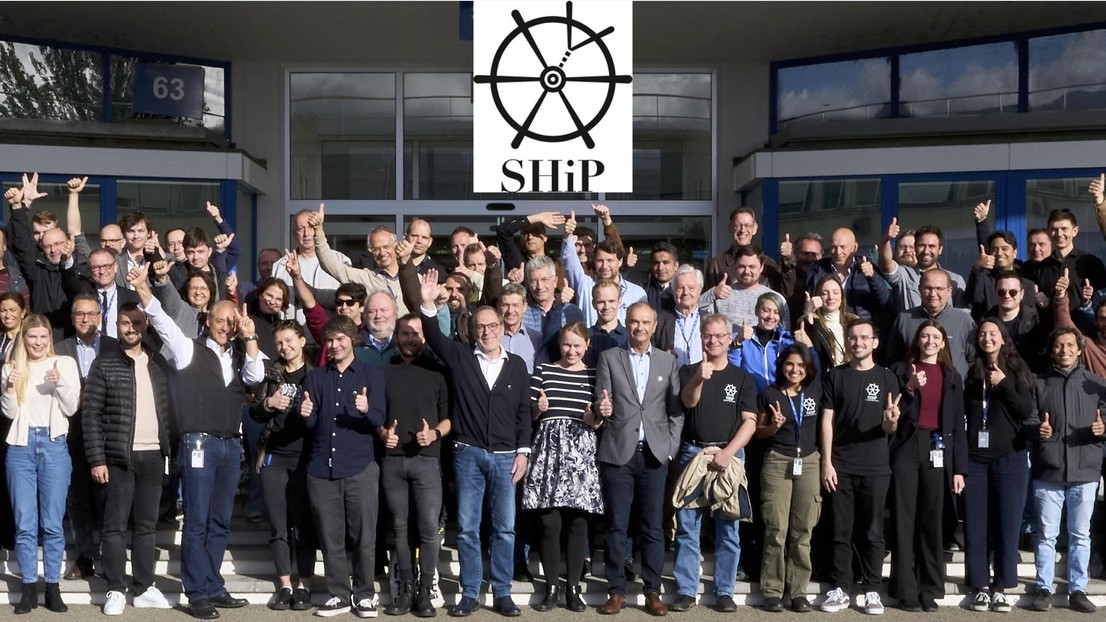
The SHiP collaboration at CERN surrounding Prof. Lesya Shchutska (in the front row at the center). Prof. Mikhail Shaposhnikov is behind in the second row. © 2024-2026 CERN
The SHiP collaboration at CERN has elected Prof. Lesya Shchutska, tenure-track assistant professor at the Institute of Physics at EPFL (IPHYS), as its next Physics Coordinator, for a 3-year term starting on April 1st 2026.
The SHiP collaboration (Search for Hidden Particles) is an international research effort developing a new beam-dump experiment at CERN dedicated to exploring physics beyond the Standard Model at the intensity frontier. By exploiting the high-intensity proton beam of the CERN Super Proton Synchrotron accelerator, SHiP aims to search for long-lived, very weakly interacting particles—often referred to as feebly interacting particles—that could shed light on some of the most fundamental open questions in particle physics, including the origin of neutrino masses, the nature of dark matter, and the baryon asymmetry of the Universe. In addition to this so-called hidden-sector programme, SHiP will host a powerful neutrino detector capable of performing precision measurements of tau neutrino interactions and studying neutrino properties in an unprecedented way.
Among the theoretical frameworks that SHiP will be able to test is the Neutrino Minimal Standard Model(νMSM), proposed by Prof. Mikhail Shaposhnikov at EPFL. This model extends the Standard Model by introducing three right-handed neutrinos that can simultaneously explain neutrino masses, the matter–antimatter asymmetry of the Universe, and provide a viable dark-matter candidate. SHiP is uniquely designed to explore large regions of the parameter space predicted by this model through direct searches for heavy neutral leptons produced in proton–target collisions.
The SHiP Physics Coordinator is responsible for steering and coordinating the experiment’s physics programme. This includes defining analysis priorities, coordinating physics working groups, ensuring the coherence of simulation and sensitivity studies, and connecting the physics goals of the collaboration with detector design and performance requirements. The role is particularly important during the current Technical Design Report phase, when physics studies guide key design choices and help maximise the discovery potential of the experiment.
The importance of SHiP for CERN’s future research programme has also been highlighted by the new Director-General of CERN, Mark Thomson, who identified SHiP as one of the laboratory’s strategic priorities, alongside the scientific exploitation of the High-Luminosity Large Hadron Collider (HL-LHC) and the preparation of the Future Circular Collider of electrons and positrons (FCC-ee).
Prof. Lesya Shchutska has been actively involved in the SHiP collaboration since its early stages. At EPFL, her research focuses on searches for new physics using flavour experiments and intensity-frontier facilities, with particular emphasis on long-lived particles and rare processes.
Her election reflects both her scientific contributions to the collaboration and her commitment to building and coordinating large international research efforts. As Physics Coordinator, she will work closely with the collaboration leadership and detector teams to shape the physics strategy of SHiP and prepare the experiment for its next development stages.
The appointment also highlights the strong involvement of the EPFL Institute of Physics in major international particle-physics projects and its growing role in the exploration of new physics beyond the Standard Model.