
Pierre Wets translates physics into experiments
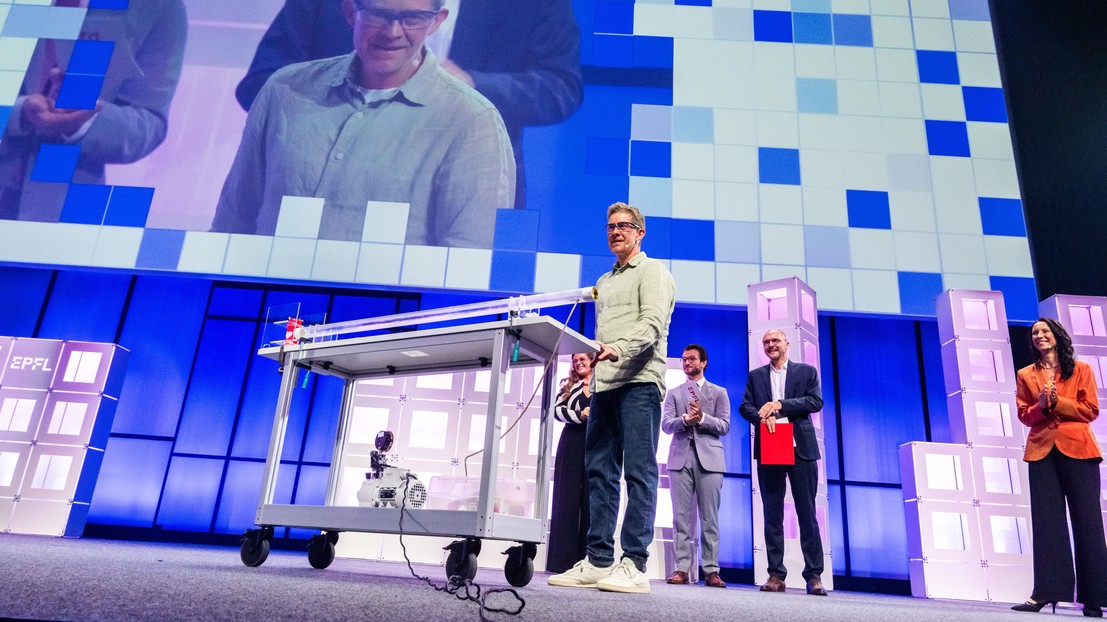
Pierre Wets on the stage at the Magistrale to receive the EPFL Oustanding Commitment Award - 2026 EPFL/Mark Henley - CC BY SA
Designing physics experiments is no ordinary job. But at an engineering school like EPFL, it’s a fundamental one. Pierre Wets, who holds this role at our School, is one of the winners of this year’s Outstanding Commitment Award in recognition of his hard work, creativity and enthusiasm.
There’s one date of particular importance to Pierre Wets: 18 September. Not only is it his birthday, but it’s also the birthday of renowned French physicist Léon Foucault. And Wets, like Foucault before him, is a big fan of experiments. Foucault is known for developing the Foucault pendulum, which is a simple device that demonstrates the Earth’s rotation relative to an inertial frame of reference. Wets, an engineer by training, designs experiments that illustrate the basic concepts of physics. He was selected for the Outstanding Commitment Award owing to his hard work, creativity and enthusiasm in serving the EPFL community over the past 23 years.
“It’s a nice surprise,” says Wets. And a well-deserved one, based on the comments of the 33 EPFL teachers who supported his nomination. They noted “his extraordinary dedication to teaching physics to over 4,000 students per year”; the fact that “he’s undoubtedly one of the most enthusiastic and driven employees at EPFL”; his “remarkable creativity and eagerness to help out others”; his personal investment “that goes beyond what’s required for his position”; the “pleasure of working with him”; and more.
The vaccum bazooka experience
At the master’s graduation ceremony on Saturday, 3 October, Wets was the picture of modesty as he took to the stage, playing it cool as he put on one of the 700 experiments in EPFL’s catalogue: the vacuum bazooka. This experiment demonstrates the force exerted by air pressure. The audience heard a resounding boom and then watched as a ping-pong ball obliterated an aluminum can. Applause all around!
“My role is to strip the concept down to the essentials so that everyone can see it for themselves and understand it,” says Wets. EPFL teachers and professors order experiments for their classes, and Wets and his team prepare them in a large laboratory-workshop where an eclectic collection of items sits on rolling tables. Around 100 of the most requested experiments are “ready to go.” The others require a bit of jury-rigging – the team digs through their inventory of objects to build, assemble and calibrate what they need. “Our experiments cover all areas of physics: thermodynamics, quantum physics, mechanics, magnetism, electricity and sometimes even chemistry,” he says.
Demonstrating a theory, process or law is a powerful way to teach. “It’s really important for students to be able to see things concretely, because they sometimes get lost amid all the information available on social media and in videos,” says Wets. “Watching an experiment with their own eyes makes a much stronger impression.” Experiments fuel their curiosity and prompt them to use scientific reasoning to figure out problems. “They also tap into our emotions,” adds Wets. “Ten years after graduating, students will probably forget the theory they’ve learned, but they’ll remember the experiments.”
Watch the Earth rotate
Preparing the experiments has now become routine for Wets and his team. They print out weekly schedules with teachers’ requests – which can be for as many as 150 experiments per week at the peak of the semester. “The basic concepts of physics don’t change, but how we present them does,” says Wets. And that’s where his job gets really interesting. Old experiments sometimes come back into fashion because teachers find a more elegant way of running them, or new experiments are made possible by technological advances, such as in optics. Wets also enjoys the stimulating discussions with teachers. The demonstrations given to high-school students and the general public, and during science fairs, are also highlights in terms of local outreach.
Wets may have been on the job for over two decades, but his enthusiasm has never waned. He still finds physics an enthralling field. “It’s the science behind the laws that govern our universe, from the smallest to the largest scale,” he says. “Physics can be used to describe much of what goes on around us.” And the new experiments he’s asked to design help keep him deeply engaged. He’s still working to find answers to some of the requests – such as for an experiment to show the pressure exerted by radiation. “This refers to the force generated by light, or the amount of momentum transferred by a photon. But it’s so small that it’s hard to demonstrate in a classroom.” In the meantime, he can be proud of having built a driven Foucault pendulum that’s compact enough to be installed in a lecture hall. Visitors to the physics building on EPFL’s Lausanne campus will soon be able to admire a copy in the entrance hall – and “watch the Earth rotate.”