
PhD Defense of Pedro Abranches
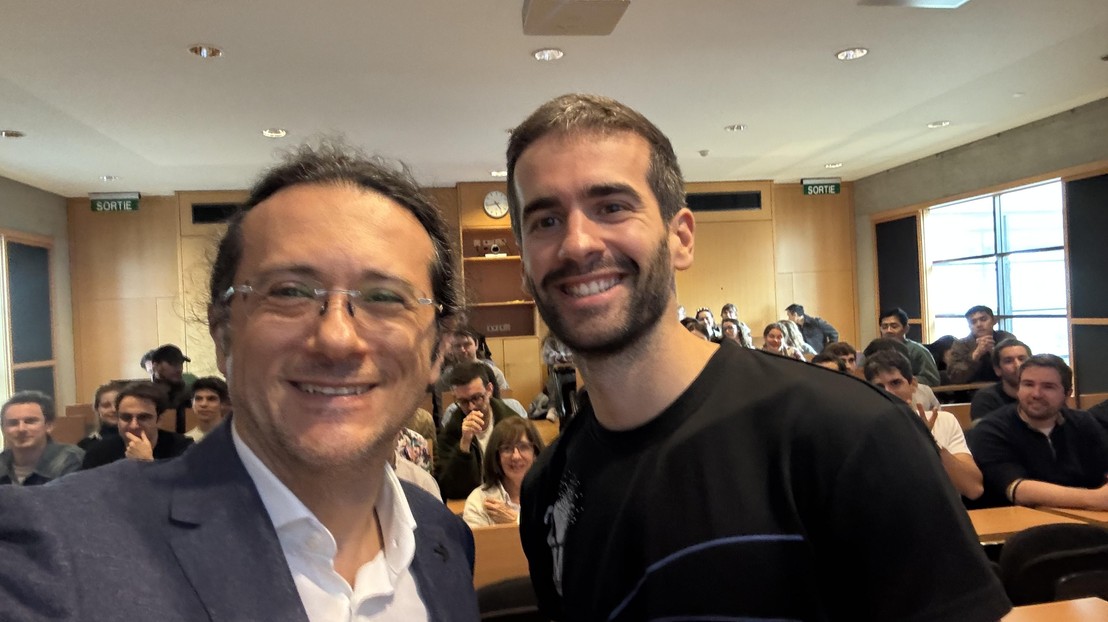
Pedro Abranches PhD defense© 2026 EPFL/Volkan Cevher
On March 6th, 2026, Pedro Abranches De Carvalho, a joint PhD student at LIONS and Courtine lab, successfully defended his PhD thesis. The thesis, entitled "Scalable Neurotherapies with Bayesian Optimization and Beyond" was jointly supervised by Professor Volkan Cevher and Professor Grégoire Courtine. Congratulations to Pedro!
Abstract:
Spinal Cord Injury (SCI) can have a devastating impact on motor, sensory and autonomic functions. Its consequences extend far beyond the loss of physical mobility, having profound effects on psychological health and quality of life. While no established treatment exists, neurotechnologies such as epidural electrical stimulation (EES) have shown promise by restoring standing and walking people with SCI. However, the clinical adoption of EES is hindered by its dependence on expert-driven, time-consuming programming of individualized stimulation patterns. This thesis first introduces an interactive machine learning framework using Gaussian process (GP) based Bayesian optimization (BO) to automatically identify stimulation settings that generate isolated functional movements, creating a stimulation library to support subsequent physical therapy. For this, we formulated a reward function, based on kinematic and electromyography (EMG) signals, tailored to lower-limb motor tasks. To map the input space to this function, our kernel used a distance metric capable of handling both numeric and non numeric parameters present in EES. Yet, for more complex movements, we need concurrent active stimulations. This, however, might cause parameters to interact with each other in a detrimental way. Because the relative coactivation between muscles was the key feature to resolve this problem, we implemented a composite approach whereby the GP models the muscles directly. To validate the methodology, a medical-grade programming interface was built to let the algorithm autonomously adjust stimulation settings. Tests in individuals with complete and incomplete SCI showed that the framework reliably identified effective parameters. To advance integration of this framework into clinical practice, the second part of the thesis involved implanting a brain-spine digital bridge in participants with chronic motor complete SCI, combining electrocorticography (ECoG) recording with spinal cord stimulation. Because these patients have no residual movement, optimized stimulation protocols were critical. Using the developed framework together with a decoding algorithm, both participants were able to walk overground with the assistance of a front-wheel walker. Moreover, by leveraging ECoG signals, we investigated the potential of brain-derived feedback as a direct reward signal for optimization. This strategy circumvents the need for external sensors and manual reward definitions, paving the way for adaptive neuroprosthetic systems guided directly by the patient's brain activity. The final part of the thesis extends EES beyond lower-limb mobility by establishing a brain-cervical spinal cord digital bridge in individuals with chronic incomplete tetraplegia. To target hand and arm movements, stimulation libraries were created through human-guided optimization and by adapting the existing framework with a reward function focused solely on kinematics. Preliminary tests in one participant showed that, the algorithm successfully identified stimulation settings that support useful motor outcomes for rehabilitation. Collectively, this thesis shows that automated optimization frameworks can be applied across different contexts, paving the way for more accessible and personalized neurorehabilitation therapies.