
Paper Alert: PVD-CSS, Wide-Bandgap Degradation and E-Mobility
© 2026 EPFL
Be sure to check out the three newest PVLAB papers focused on PVD-CSS process for depositing perovskites, the degredation mechanism of wide-bandgap perovskites and a model supporting local e-mobility planning.
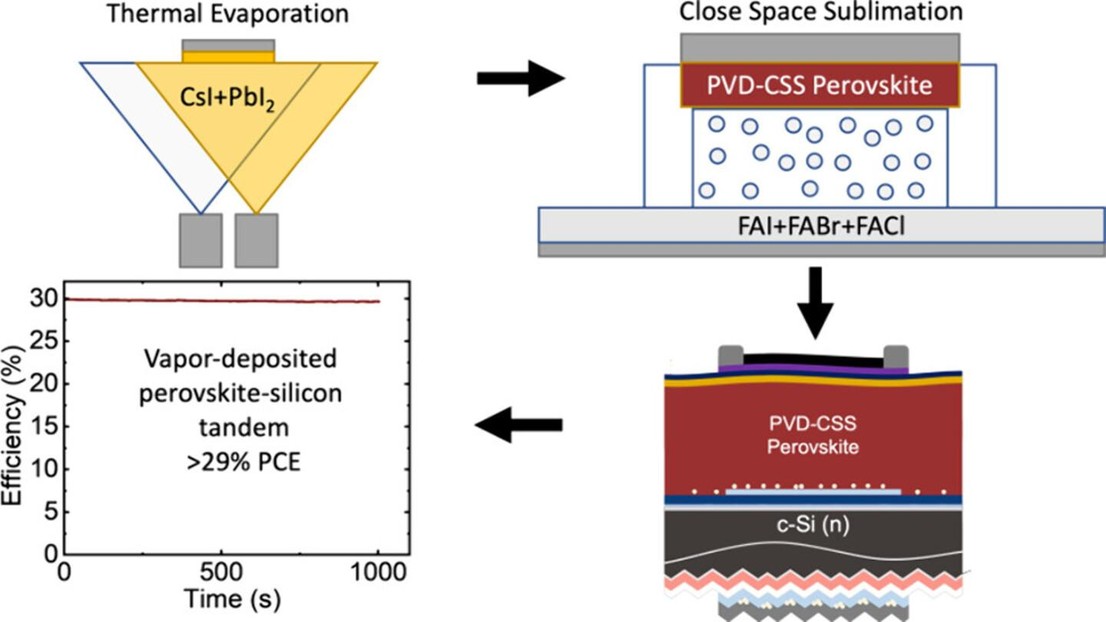
Our latest work shows the potential of PVD-CSS processes for making efficient perovskite-silicon tandem solar cells. We show excellent bandgap tunability in the tandem relevant range with efficiencies >18% for unpassivated devices and >20% with surface passivation for small scale single junction solar cells. These films are integrated into 1 cm2 two terminal tandems with ~30% efficiency on flat front rear textured tandems and ~28% on fully textured tandems without further optimization. They also show good shelf stability and short term unencapsulated operational stability. Thanks to our collaborators at CSEM and Fraunhofer ISE for their help with this one. The future for vapor deposited tandems looks bright!
For wide-bandgap perovskites, instability is less anecdotal, but just as persistent. In our EES Solar review, ‘Unraveling bulk degradation mechanisms of wide-bandgap perovskite absorbers for tandem applications’, we focus on bulk-driven degradation pathways in perovskite absorbers compatible with Si-tandem devices.
Bringing together recent work, we discuss how mixed-cation / mixed-halide compositions inherently lead to compositional inhomogeneities, how crystallization pathways lock these features into the film, and how nanoscale defects and phase impurities then act as initiation points for degradation.
We also go through the different strategies explored to mitigate these effects, in particular by controlling crystallization, composition, and defect chemistry, as a way to better understand what ultimately limits their long-term stability.
The third paper presents a new model designed to support local e-mobility planning, specifically developed for regions where mobility data are scarce. It was created in close collaboration with all the partners of the ongoing OpenMod4Africa project. Our work also includes a case study for , definitely one of the leading African cities when it comes to transport electrification! And of course, the model is openly available on GitHub