
Out on a limb
© 2026 EPFL
Aurélie Terrier is among the winners of the Swiss National Science Foundation’s (SNSF) 2026 Scientific Image Competition. An architect and archaeologist at EPFL's Arts of Science Laboratory (LAPIS), she captured researchers conducting an impressive measurement session that combines modern and traditional tools.
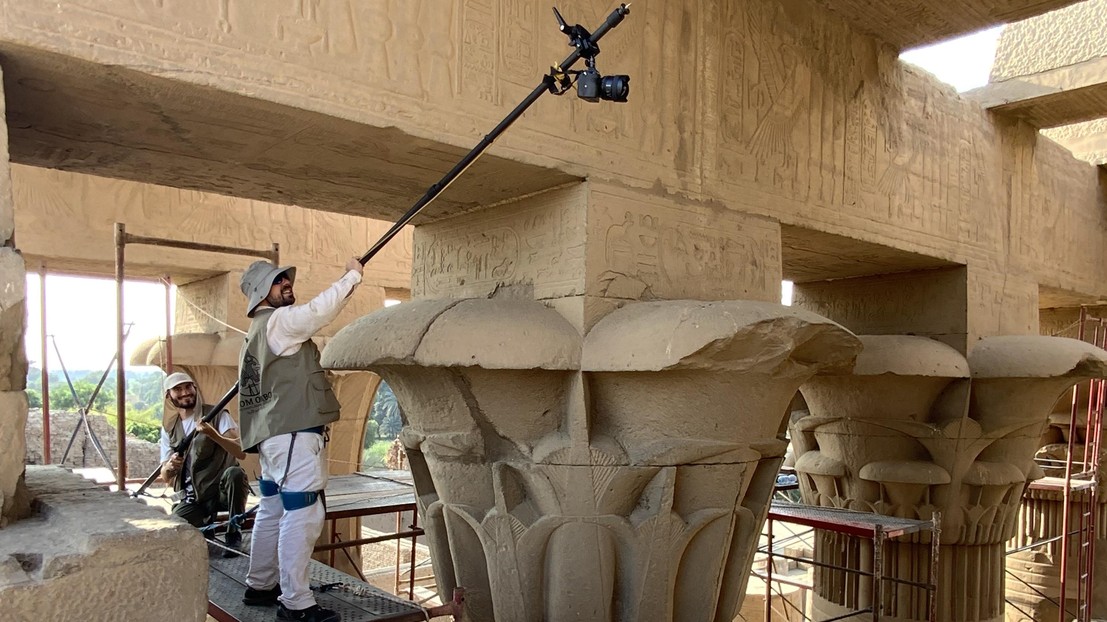
This is a picture of someone taking a picture, although we can’t see the object being photographed. Two colleagues, safely harnessed, seem to be enjoying themselves as they stand on scaffolding over 15 meters off the ground and skillfully manipulate a long extension pole fitted with a camera. They’re exploring the inaccessible heights inside the Temple of Kom Ombo – a Greco-Roman sanctuary dedicated to the gods Sobek and Haroeris, located 40 kilometers north of Aswan. Thousands of tourists visit the temple every day, as it’s one of the main stops on itineraries along the Nile. It’s also the subject of research being carried out by an international, cross-disciplinary team of scientists led by Aurélie Terrier, an architect and archeologist at EPFL’s Arts of Sciences Laboratory. She’s the one who took this picture with her iPad.

Terrier’s picture stands out for the juxtaposition between the ultra-modern instruments suspended on the pole and how the photos will ultimately be used, on one hand, and the two-thousand-year-old sculpted reliefs, on the other. It was the deserving winner in the Locations and Instruments category in the Swiss National Science Foundation’s 2026 Scientific Image Competition. Commenting on the photograph, the selection panel said: “The strong lines of the image’s composition frame the researchers in a somewhat unstable, even dangerous position, in a shot that contrasts modern and traditional tools.”
Much of the Temple of Kom Ombo has been destroyed by Nile river erosion, earthquakes, the removal of stones for use in other structures, wear and tear and, more recently, hordes of tourists. It’s the only large Greco-Roman temple in Egypt that hadn’t been studied by modern architects – until this recent group of researchers took an interest in it.
Terrier has been working on this project since 2019 with the help of Postdoc.Mobility and Ambizione grants from the Swiss National Science Foundation. She and around 20 colleagues are collecting samples and taking pictures of the site in order to perform a complete architectural study. They are looking at the surrounding environment, how the spaces around the temple’s religious features were built and developments in the construction methods and techniques used. For their study, Terrier’s team is using advanced technology and equipment to unlock the past. “The work shown in this picture may seem improvised, but it will give us precise, high quality images,” she says. “It’s a good example of the power of the digital humanities – a field at the crossroads of social science and new technology.”
Terrier and her colleagues plan to use the findings to develop a 3D computer model of the temple by 2027, providing researchers and the general public with a single tool that draws on all existing information sources.