
New study reveals the impact of human mobility on heat exposure

© Street in Stockholm. Source: Urban Insight by Sweco – Building heatwave resilience in European cities
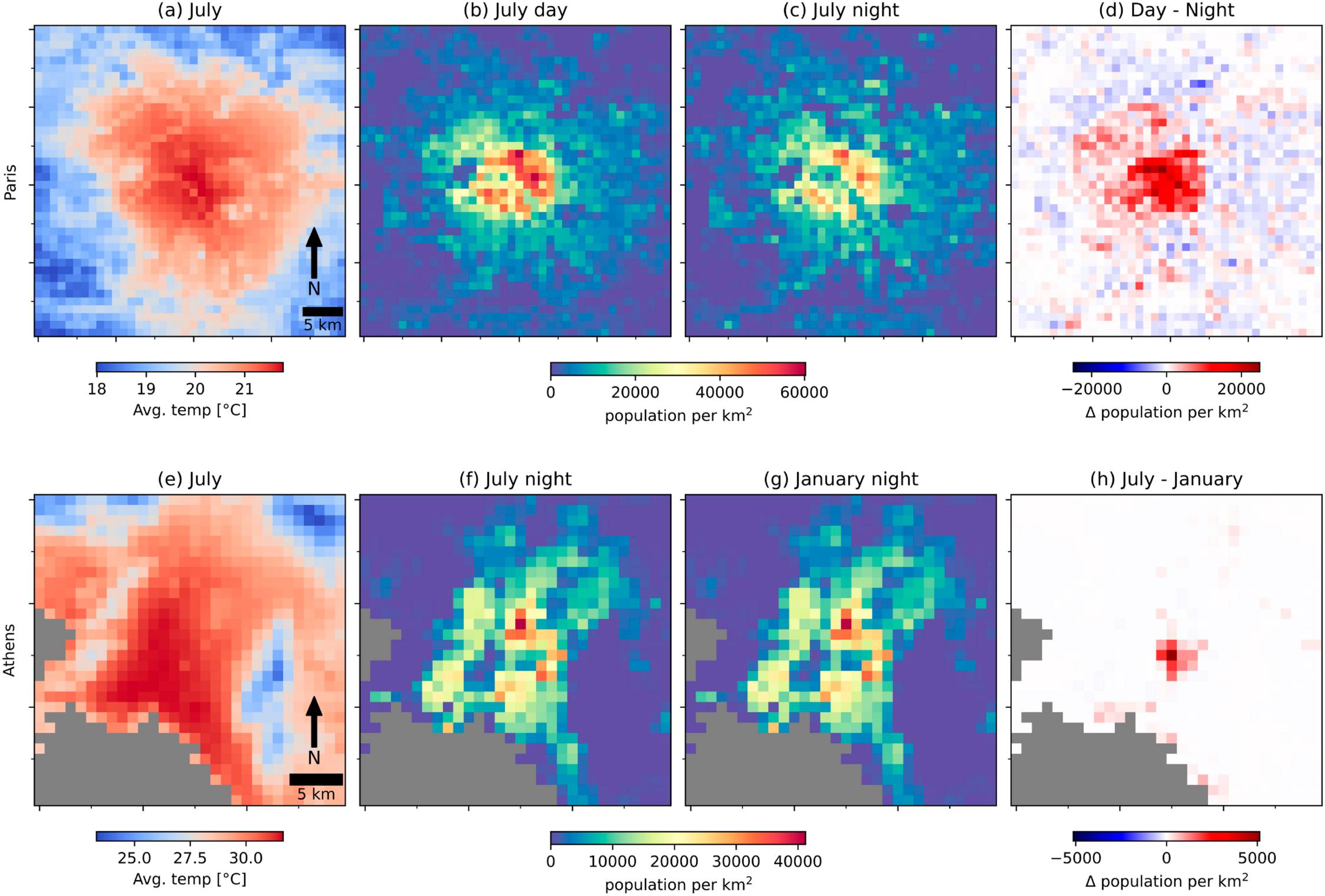
A recent article, led by Guo-Shiuan Lin and published in PLOS One, demonstrates that daily and seasonal human mobility modulates temperature exposure in European cities
Extreme temperatures pose a serious threat to human health, especially in urban areas where the majority of the world population is living. Temperature-related risks are exacerbated by urban-induced warming but existing exposure assessments rely on a static residential population, thus overlooking the dynamic behaviour of people, who commute daily and travel for holidays.
To address this knowledge gap, we combined daytime and nighttime population estimates for 80 European cities with high-resolution urban climate simulations and quantified the impact of daily and seasonal mobility on residents’ exposure to heat and cold. Our results show that, on daily timescales, commuting towards city centers causes a 7.8% average increase in summer heat exposure but, during winter, it provides a slight protective effect against cold. On seasonal timescales, population declines during summer in most European cities, leading to a lower exposure to heat - with the exception of touristic destinations where exposure increases during the warmest months of the year.
These results highlight the key role of human mobility for heat risk assessment and adaptation and they reveal general exposure trends that hold across diverse cities and climates.
SNSF Weave/Lead Agency funding scheme (grant number 213995)
Lin, G. S., Llaguno-Munitxa, M., & Manoli, G. (2025). Daily and seasonal human mobility modulates temperature exposure in European cities. PloS one, 20(9), e0330912.