
New self-assembled molecular layers for perovskite solar cells
© 2025 EPFLhttps://actu.epfl.ch/public/upload/news/images/d9/6d/5f90b3b1.jpg
Research at EPFL, Gyeongsang National University, and Ulsan National Institute of Science and Technology has discovered new charge selective layers that could reduce manufacturing costs while boosting performance of these promising photovoltaics.
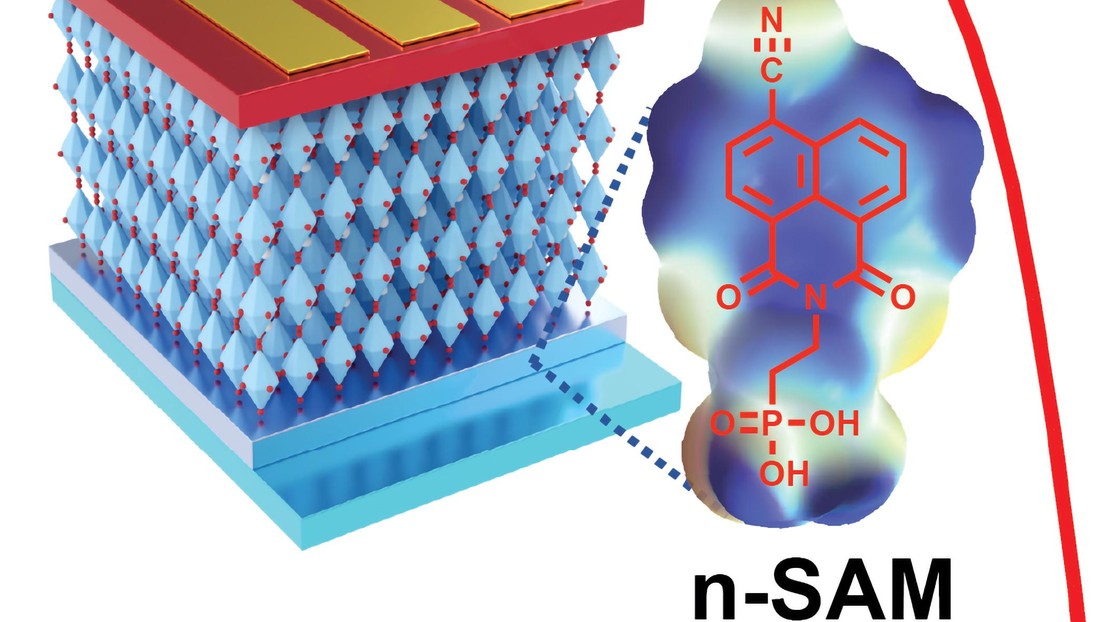
An international reearch team, led by the LIMNO lab at EPFL, created ultra-thin molecular layers that replace expensive conventional materials typically used in perovskite solar cell production. Special naphthalimide-based molecules that self-assemble into layers just a few nanometers thick on transparent electrodes were engineered on a molecualr level for the work. These "self-assembled monolayers" (SAMs) act as highly efficient electron-collecting contacts in perovskite solar cells.
The key breakthrough came from adding a cyano group to the molecular structure, which dramatically improved the alignment of energy levels at the interface between the electrode and the light-absorbing perovskite layer. This optimal alignment allows electrons to flow more efficiently, boosting the solar cell's power output.
The work demonstrates that molecular engineering of SAM interfaces can achieve performance levels comparable to conventional metal oxide electron transport layers without requiring high-temperature processing. The study establishes structure-function relationships showing that electron-withdrawing functional groups and shorter alkyl linkers promote better energy level alignment and charge transport.
While the champion 20.6% efficiency represents one of the highest reported values for standalone SAM-based electron-selective contacts, challenges remain in understanding interfacial chemistry and optimizing long-term stability under operational conditions.
The research report appears in Advanced Energy Materials (DOI: 10.1002/aenm.202502789) and provides design guidelines for SAM-based interlayers that may inform future development of cost-effective perovskite photovoltaics.