
New publication: Rethinking soils in land surface models
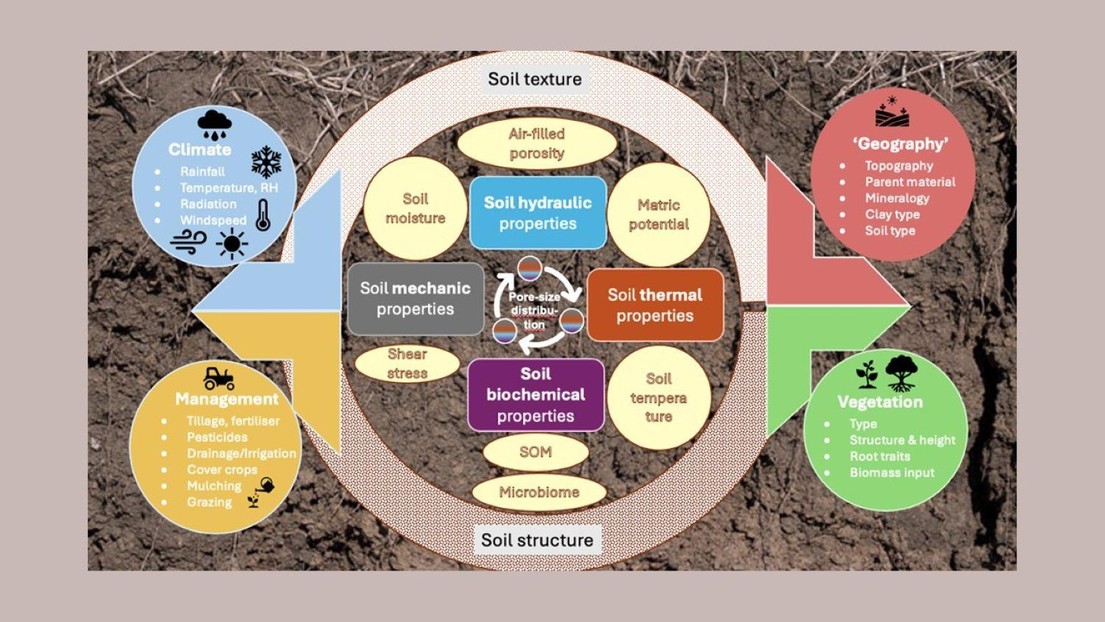
Interactive effects of soil texture, soil structure and external drivers on soil properties and state variables (light-yellow). From Verhoef et al. (2026).
A new paper summarizing the outcomes of the ISMC-GEWEX SoilWat 2025 meeting outlines key challenges and future directions for representing soils and subsurface processes in weather and climate models.
A new paper titled Rethinking Soils in Land Surface Models has been published, presenting the main outcomes and perspectives emerged from the ISMC–GEWEX SoilWat 2025 meeting. The hybrid meeting took place on 14-16 July 2025 (University of Reading, UK and online), bringing together around 40 experts from 12 countries and 30 institutions working across soil science and climate modelling.
The workshop connected members of the International Soil Modelling Consortium (ISMC) with researchers involved in the Global Energy and Water Exchanges (GEWEX) programme. Its main objective was to identify key challenges and future research directions related to the representation of soils and subsurface processes in Land Surface Models (LSMs) used in weather forecasting and climate simulations.
One of the central issues highlighted in the paper is that many current LSMs rely on simplified parameterisations of static soil properties. These approaches often fail to capture the spatial variability and dynamic nature of soils, which can lead to persistent biases in simulated hydrological fluxes and land–atmosphere feedbacks.
The meeting brought together a diverse and interdisciplinary group of researchers, including soil physicists, land surface modellers, micrometeorologists, hydrologists, ecologists, plant physiologists, and remote-sensing experts, representing a wide range of career stages. Among the participants and co-authors contributing to the resulting publication were researchers from several institutions, including Sara and Taiqi from CHANGE.
The resulting publication synthesizes these discussions and outlines research priorities aimed at improving soil parameterisation, reducing model biases, and strengthening collaboration between the soil and climate modelling communities. By highlighting these challenges and opportunities, the paper provides guidance for future research efforts seeking to better integrate soil processes into climate and weather prediction systems.
Verhoef, A., Zeng, Y., Agam, N., Best, M., Bonetti, S., Boussetta, S., Chaney, N., Cuntz, M., Edwards, J., Gupta, S., Heitman, J., Huang, M., Jarvis, N., Jiang, S., Kandala, R., Kiałka, F., Lian, T., Mu, M., Nemes, A., Paulus, S., Raoult, N., Reddy, K., Romano, N., Sabot, M., Vanderborght, J., van der Ploeg, M., van Oevelen, P., Wang, Y., Wang, Y., Weber, T., Marthews, T. and Weihermüller, L. (2026). Rethinking Soils in Land Surface Models. To be published in Bulletin of the American Meteorological Society. Available at: https://journals.ametsoc.org/view/journals/bams/aop/BAMS-D-26-0003.1/BAMS-D-26-0003.1.xml [Accessed 11 Mar 2026].