
New preprint on manganese redox chemistry
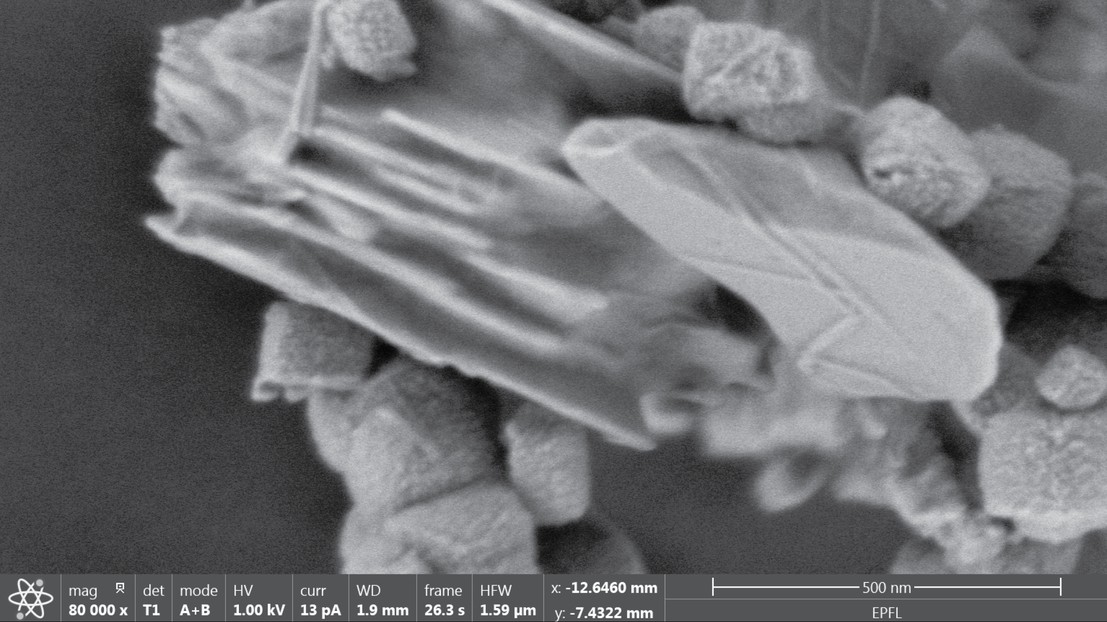
Electron microscopy image of hausmannite, one of the manganese oxide phases that Xinru used © X. Liu 2025
Xinru's manuscript "Predicting rates of manganese oxide reduction from thermodynamic driving forces and structural properties" is now available as a preprint on ChemRxiv. The corresponding dataset can be found on Zenodo. Congratulations to Xinru and all co-authors for this amazing piece of work!
Manganese oxides are important redox-active minerals in the environment. They can undergo a wide range of redox reactions with abiotic and biotic reaction partners. This reactivity stems from their high structural diversity and the wide range of manganese oxidation states these minerals exhibit. As a consequence, manganese oxides can play key roles in nutrient cycling, contaminant breakdown, and ecosystem health. Despite the importance of manganese redox reactions, the influence of thermodynamic, kinetic, and structural factors on manganese oxide reactivity remains elusive.
In this work, we systematically determined the reduction rates of three geochemically relevant manganese oxides that differ in both crystal structure and average manganese oxidation state, under a range of solution conditions (i.e., pH and Eh). We demonstrate, for the first time, that manganese oxide reduction kinetics follow a common relationship with free energies, not only across varying solution conditions but also across different manganese oxide phases. Our three key findings were:
- We show that rate-free energy relationships for individual manganese oxides can be established using our previously developed approach used to characterize iron oxide reduction (doi:10.1073/pnas.211562911).
- We extended this approach by relating reduction kinetics to free energies calculated from differences in the Pourbaix potential (doi:10.1038/s41467-019-08494-6), which incorporates phase formation energies alongside pH and redox conditions without requiring information on exact reaction stoichiometry. Using this approach, we successfully unified rate-free energy relationships across the three tested manganese oxides.
- We developed a model to capture the interplay between kinetic and mass transfer-limited regimes in our experiments. We found that the three oxides differed in their electron transfer rate constants, but showed similar mass-transfer coefficients. We rationalize these differences by applying classical nucleation theory.
Our work not only advances the mechanistic understanding of manganese oxide reduction kinetics but also provides a predictive framework capable of determining manganese oxide reduction rates across diverse environmental conditions. More broadly, the framework presented in our work may be applicable to a variety of redox-active minerals in complex geochemical environments, as it does not require detailed knowledge on reaction stoichiometry.
X. Liu, V. Pothanamkandathil, L. Schwab, S. Mao, and M. Aeppli. Predicting rates of manganese oxide reduction from thermodynamic driving forces and structural properties. ChemRxiv, 2025, doi:10.26434/chemrxiv-2025-5w8sg.
X. Liu, V. Pothanamkandathil, L. Schwab, S. Mao, and M. Aeppli. Predicting rates of manganese oxide reduction from thermodynamic driving forces and structural properties (Version V1)[Data Set], Zenodo, 2025, doi:10.5281/zenodo.16746935.