
New preprint explores soil carbon in subalpine grasslands
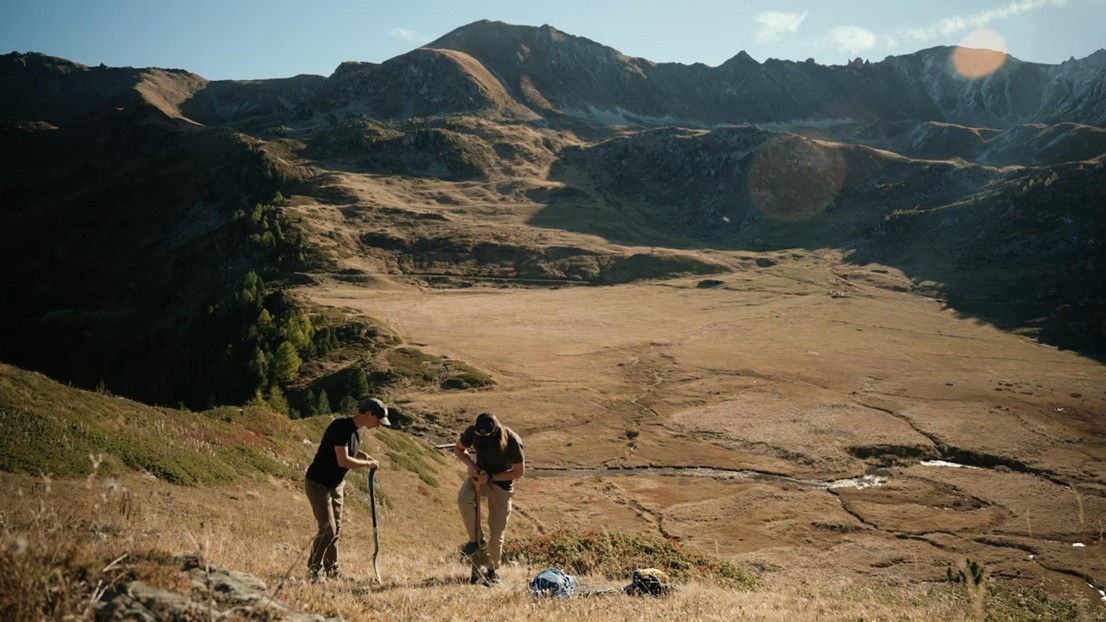
Bence (left) and Damien working in Ar du Tsan. © 2025 Fabiano D'Amato
Why does soil organic carbon build up in some places but not in others, even within the same grassland? In a new preprint, Bence Dienes and colleagues take a closer look at this question in subalpine environments, where soils can change dramatically over short distances.
The preprint, “Interactive effects of landscape position and soil diversity drive the spatial variability of soil organic carbon concentration in subalpine grasslands”, explores how the position of a site in the landscape interacts with soil properties to shape carbon storage. Rather than pointing to a single controlling factor, the work highlights the importance of seeing mountain soils as complex, dynamic systems.
This research speaks to a broader challenge in soil science: understanding why carbon is unevenly distributed, and what that means for ecosystems facing climate change. In subalpine grasslands, where topography, moisture, and soil diversity all come into play, these patterns are especially difficult to untangle. By focusing on these fine-scale variations, the preprint offers a more nuanced view of how carbon is stored in mountain soils. It also contributes to ongoing efforts to better understand and predict the behavior of vulnerable alpine and subalpine ecosystems.
Swiss National Science Foundation, Grant 212056