
New PNAS paper on manganese oxide reactivity
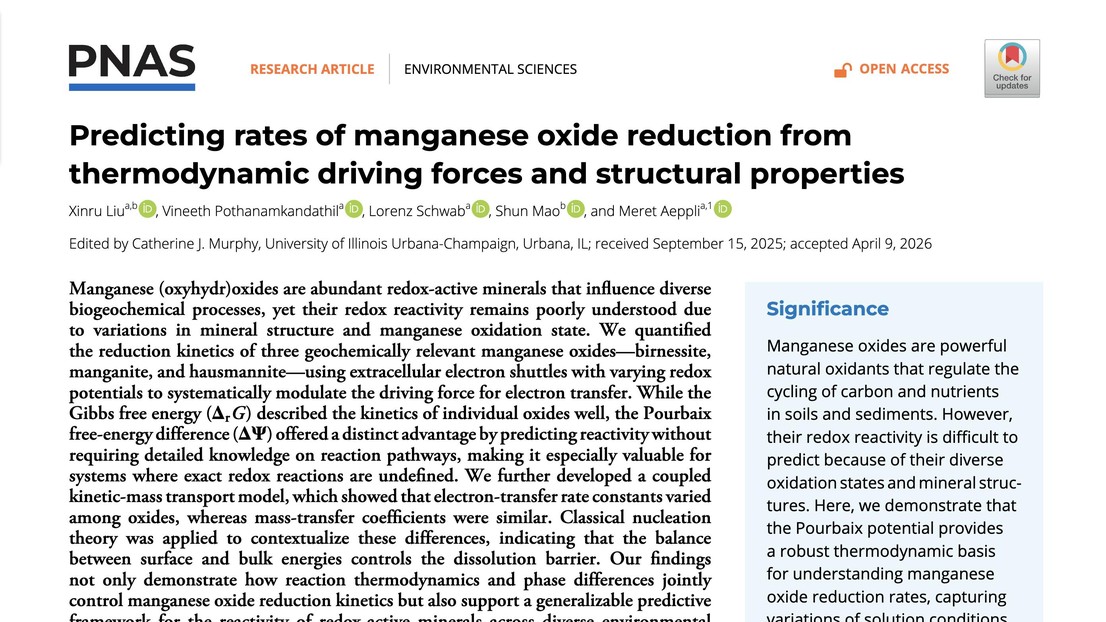
Front page of our new publication. © 2026 PNAS
In our new paper in Proceedings of the National Academy of Sciences, we developed a thermodynamic framework to predict how fast manganese oxides dissolve under environmentally relevant conditions.
In the paper "Predicting rates of manganese oxide reduction from thermodynamic driving forces and structural properties", we asked how thermodynamics and mineral structure jointly control the reactivity of manganese oxides, which are powerful natural oxidants that regulate carbon and nutrient cycling in soils and sediments. We measured the reduction kinetics of three geochemically relevant manganese oxides (birnessite, manganite, and hausmannite) using electron shuttles with varying redox potentials, and showed that the Pourbaix potential predicts reduction rates across all three oxides without requiring detailed knowledge of the reaction pathways. This makes it a particularly useful tool for natural systems where the exact redox reactions are often unknown. We further developed a coupled kinetic–mass transport model to disentangle intrinsic electron transfer rates from physical transport effects, and applied classical nucleation theory to explain why the three oxides react at different speeds.
This paper is the result of a wonderful team effort: Xinru and Lorenz carried out the thorough and careful experimental work that underpins all of our findings, and Vineeth developed the kinetic–mass transport model. Congratulations!
Liu, X; Pothanamkandathil, V; Schwab, L; Mao, S; Aeppli, M. Predicting rates of manganese oxide reduction from thermodynamic driving forces and structural properties. Proceedings of the National Academy of Sciences, 2026, 123 (20), e2525899123, doi:10.1073/pnas.2525899123.