
New paradigm: How energy affects protein binding
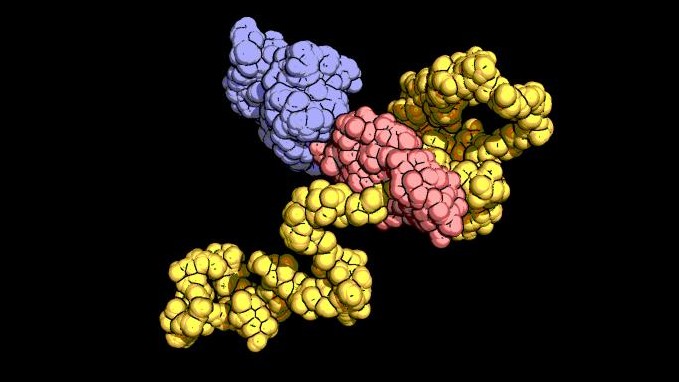
Hsp70 in closed conformation ©2014 EPFL
Understanding how cell molecules interact is critical in deciphering cellular functions. EPFL scientists demonstrate how living systems can use energy to perform function in new, non-intuitive ways. The finding might represent a novel paradigm of biological processes at the molecular scale.
Chaperones are proteins that assist in the folding and unfolding of large molecules like DNA or other protein complexes. One of the best-described chaperones are the heat-shock protein 70 family (Hsp70), which are widespread in the cell and are involved in key cellular processes such as RNA translation, protein trafficking, protein complex disassembly, protein breakdown, and cell signaling. All these processes involve the energy-driven, strong binding of Hsp70s to target proteins, but the crucial relationship between energy consumption and binding strength has remained undefined. Publishing in eLife, EPFL scientists have determined for the first time how energy consumption influences the binding of Hsp70’s to target proteins, offering a new understanding of biological processes in general.
Proteins are essential to the function of a cell, and their activity is often linked to their three-dimensional structure. The stability of this structure depends on chemical and physical interactions that are susceptible to excessive heat, pH changes in the interior of the cell, and the presence of certain chemicals. Such adverse conditions can affect protein structure and, consequently, protein function.
The chaperones are a group of specialized proteins that ensure that other proteins maintain their correct, functional structure, and also can help refold proteins whose structure has been affected. One chaperone family that has been studied intensely is the Hsp70 family. Like other chaperones, the Hsp70s need energy to perform their chaperoning work. In cells, this energy is made available from the breakdown of a molecule called adenosine triphosphate, or ATP.
However, the exact way that Hsp70s work and use this energy is not fully understood. The main question is how Hsp70 binds to a protein to fold it up. Previous studies have shown that this binding is particularly effective when Hsp70 adopts different structures, which appear to be part of a complex cycle that is governed by ATP.
Now, Paolo De Los Rios and Alessandro Barducci at EPFL have discovered that the energy released from ATP breakdown allows a high-affinity binding between the Hsp70s and their target proteins. By developing a theoretical model for the kinetic properties of the Hsp70 chaperone family, the scientists propose that this ATP-driven binding takes place under normal cell conditions, but also requires an excess of Hsp70 proteins than target proteins as well as an extremely high rates of ATP energy production. In addition, the different 3D structures that Hsp70’s can take also show different kinetic properties that play a major role in achieving high-affinity binding.
This principle is not restricted to the Hsp70’s, but implies that energy consumption can increase binding affinity in other proteins and biomolecular systems. If true, this could lead to a new understanding of biological processes on a molecular level, which can have enormous implications for biotechnology and medicine in the future. “The core of our paper sits with the emerging recognition that using energy, living systems can move away from what is possible at a thermodynamic equilibrium and exhibit new, non-intuitive features. Here we have shown that the affinity of Hsp70 for its target proteins can be orders of magnitude stronger than what would be possible at equilibrium. We have called this ‘ultra-affinity’ and we believe that it might represent a novel paradigm of biological processes at the molecular scale.”
Reference
De Los Rios P, Barducci A. Hsp70 chaperones are non-equilibrium machines that achieve ultra-affinity by energy consumption. eLife DOI: 10.7554/elife.02218