
New paper: which eggplant farming practices pay off?
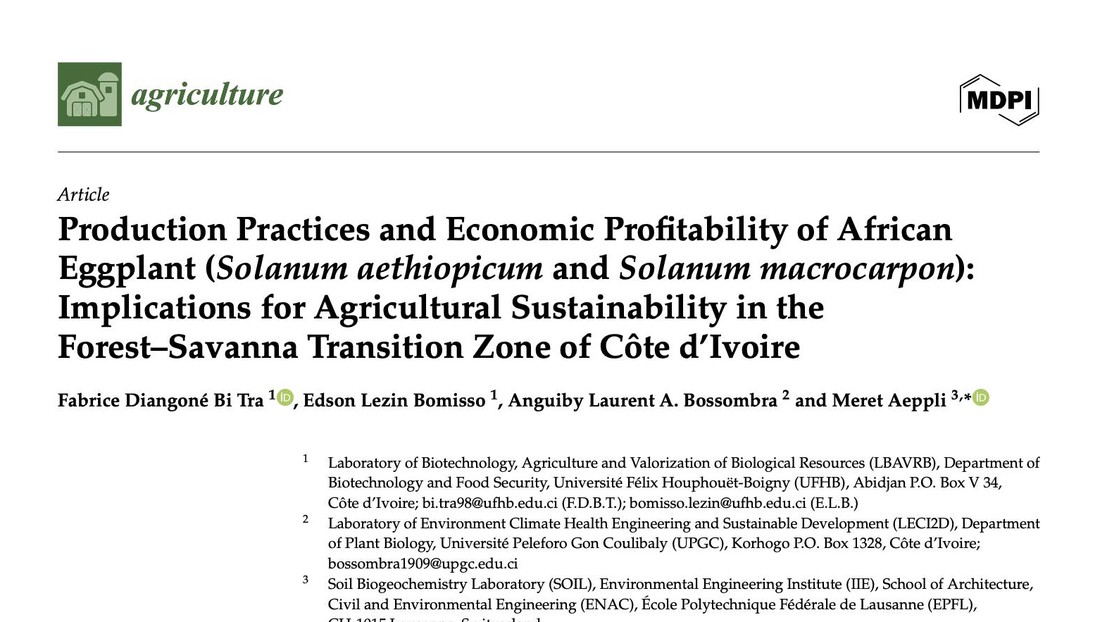
Fabrice's work is published in Agriculture.
How African eggplant is grown in central Côte d'Ivoire varies widely from farm to farm. In his new study in Agriculture, Fabrice surveyed 272 farmers to find out which practices are the most profitable.
Fabrice Diangoné Bi Tra, a doctoral student in the 100 PhDs for Africa program of the UM6P-EPFL Excellence in Africa initiative, has published a new study in Agriculture. Supervised by Meret Aeppli (SOIL lab, EPFL) and Edson Lezin Bomisso (Université Félix Houphouët-Boigny), the work examines how African eggplant is produced in central Côte d'Ivoire and which practices are the most profitable for farmers.
African eggplant is the second most produced vegetable in Côte d'Ivoire after okra and an important source of income for smallholders. Much of it is grown in the forest-savanna transition zone in the centre of the country, where soils are sandy and low in organic matter. How farmers there manage fertilisation, irrigation and pests, and what these choices mean for their income, had not been documented.
Fabrice surveyed 272 producers in six towns (Toumodi, Yamoussoukro, Dimbokro, Bouaké, Bouaflé and Tiébissou). He grouped them by what they do in the field rather than by farm size or capital. Three practice types emerged. Two thirds of producers follow an intensive system based on mineral fertiliser and weekly pesticide sprays. About a quarter combine organic amendments, mostly poultry manure, with mineral fertiliser and treat pests less systematically. A tenth grow a local variety of Solanum macrocarpon on small rainfed plots without synthetic inputs.
The organo-mineral group performed best. It reached the highest median yield (15 t/ha) and net margin (about 7,500 USD/ha) while spending less on production than the intensive group, despite farming smaller plots with more family labour. The input-free group earned the least per hectare but had the highest return per franc invested, and it preserves local varieties that are now rarely grown in the zone.
The results identify input management, not farm endowments, as the main driver of profitability. They also carry a message for soils: mineral fertiliser alone returns no carbon to already carbon-poor soils, so the dominant system is the one least able to sustain the resource its yields depend on. The survey did not include soil measurements, and field trials are needed to test this link directly. The authors see scope for training on need-based use of pesticides and fertilisers, for integrated soil fertility management, and for better market channels for products from traditional systems.
Tra, F. D. B., Bomisso, E. L., Bossombra, A. L. A., & Aeppli, M. (2026). Production practices and economic profitability of African eggplant (Solanum aethiopicum and Solanum macrocarpon): Implications for agricultural sustainability in the forest-savanna transition zone of Côte d'Ivoire. Agriculture, 16(18), 2013. https://doi.org/10.3390/agriculture16182013