
New paper: what does tetrahedral iron do in clay minerals?
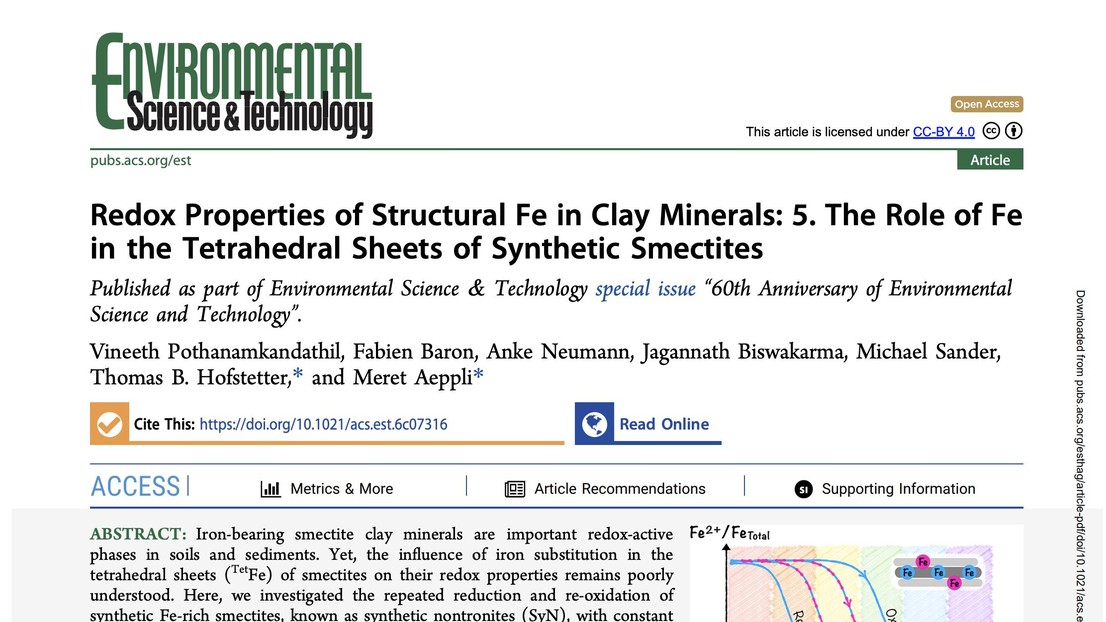
Vineeth's work is published in Environmental Science & Technology.
Iron-rich clay minerals act as rechargeable batteries in soils and sediments. In his new study in Environmental Science & Technology, Vineeth asks how iron in a less studied part of the clay structure affects how readily these minerals take up and release electrons.
Smectites are clay minerals that can contain large amounts of structural iron. Unlike iron oxides, they do not dissolve when their iron is reduced, so they can be reduced and re-oxidized many times. This makes them a recyclable pool of redox-active iron that supports microbial respiration, transforms contaminants, and influences nutrient and trace element cycling. Most of this iron sits in the octahedral sheet of the clay structure, but some smectites also carry iron in the tetrahedral sheets. What this tetrahedral iron contributes has been difficult to study, because natural reference clays contain little of it and its content cannot be varied independently.
Vineeth worked with a series of synthetic nontronites prepared by our collaborators. In these clays, the octahedral iron content is held constant while the tetrahedral iron content varies systematically. He reduced and re-oxidized the clays, measured their redox properties with mediated electrochemical analysis, and used a process-based model to separate thermodynamic parameters from kinetic ones.
The standard reduction potentials and the rates of charge redistribution within the clay particles were largely insensitive to tetrahedral iron. The thermodynamics of these clays are therefore governed mainly by the iron network in the octahedral sheet. Samples containing tetrahedral iron, however, exchanged electrons with dissolved reductants and oxidants about ten times faster than the sample without it, even though much of the tetrahedral iron was lost during the first reduction. The authors propose that tetrahedral iron sites may act as a bridge between the clay surface and the underlying octahedral iron, and note that other structural differences between the samples cannot be excluded as contributors.
When compared with natural reference smectites, the parameters of the synthetic clays fell within a narrow range. This convergence suggests that iron-rich smectites could be represented in geochemical models with a predictable range of reduction potentials.
The study is the fifth in a series on the redox properties of structural iron in clay minerals and is published in the special issue celebrating the 60th anniversary of Environmental Science & Technology. A companion paper led by Fabien Baron describes the structural changes of the clays during redox cycling. The work is a collaboration with Anke Neumann (PSI and Newcastle University), Jagannath Biswakarma (Eawag), Michael Sander (ETH Zurich), and Thomas Hofstetter (Eawag and ETH Zurich).
Eawag discretionary funds
Pothanamkandathil, V., Baron, F., Neumann, A., Biswakarma, J., Sander, M., Hofstetter, T. B., & Aeppli, M. (2026). Redox properties of structural Fe in clay minerals: 5. The role of Fe in the tetrahedral sheets of synthetic smectites. Environmental Science & Technology. https://doi.org/10.1021/acs.est.6c07316