
New paper on microbial carbon cycling in alpine soils
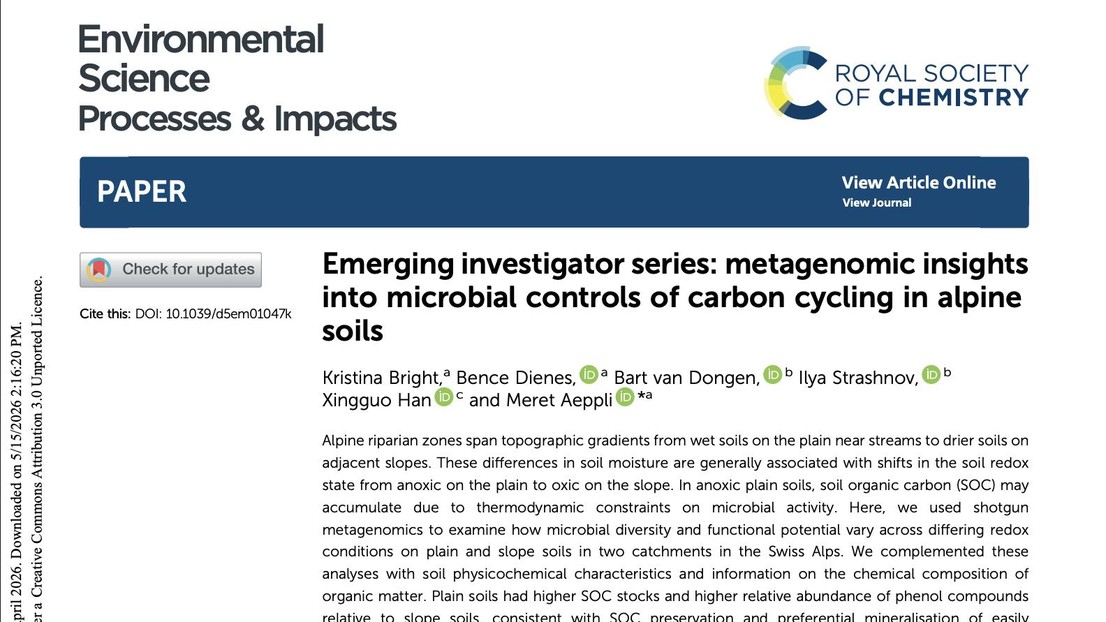
New article in ESPI. © ESPI
In our new paper published as part of the Emerging Investigator Series in Environmental Science: Processes & Impacts, we used shotgun metagenomics to investigate how microbial communities and their functional potential vary with soil redox conditions across alpine riparian landscapes.
In the paper "Metagenomic insights into microbial controls of carbon cycling in alpine soils", we asked whether the shift in soil redox conditions from wet, anoxic plains to drier, oxic slopes in alpine riparian zones is reflected in the composition and functional potential of microbial communities. To answer this question, we combined shotgun metagenomics with measurements of soil redox state, elemental composition, and organic matter chemistry by pyrolysis GC-MS. Plain soils contained three to four times more soil organic carbon than adjacent slope soils and harbored microbial communities enriched in genes for nitrate, iron, and sulfate reduction — consistent with periodic anoxia and thermodynamic constraints on organic matter decomposition. Slope soils, by contrast, supported less diverse communities dominated by aerobic taxa and contained higher proportions of labile polysaccharides.
We are especially grateful for the collaboration with Bart van Dongen and Ilya Strashnov at the University of Manchester, who enabled the pyrolysis GC-MS analyses central to the organic matter characterization, and with Xingguo Han now at Lund University, who provided expertise on metagenomic data analysis.
Bright, K; Dienes, B; van Dongen, B; Strashnov, I; Han, X; Aeppli, M. Metagenomic insights into microbial controls of carbon cycling in alpine soils. Environmental Science: Processes & Impacts, 2026, doi:10.1039/D5EM01047K.