
New grants for MazeBio, Akteon, Larmor and HelixScreen
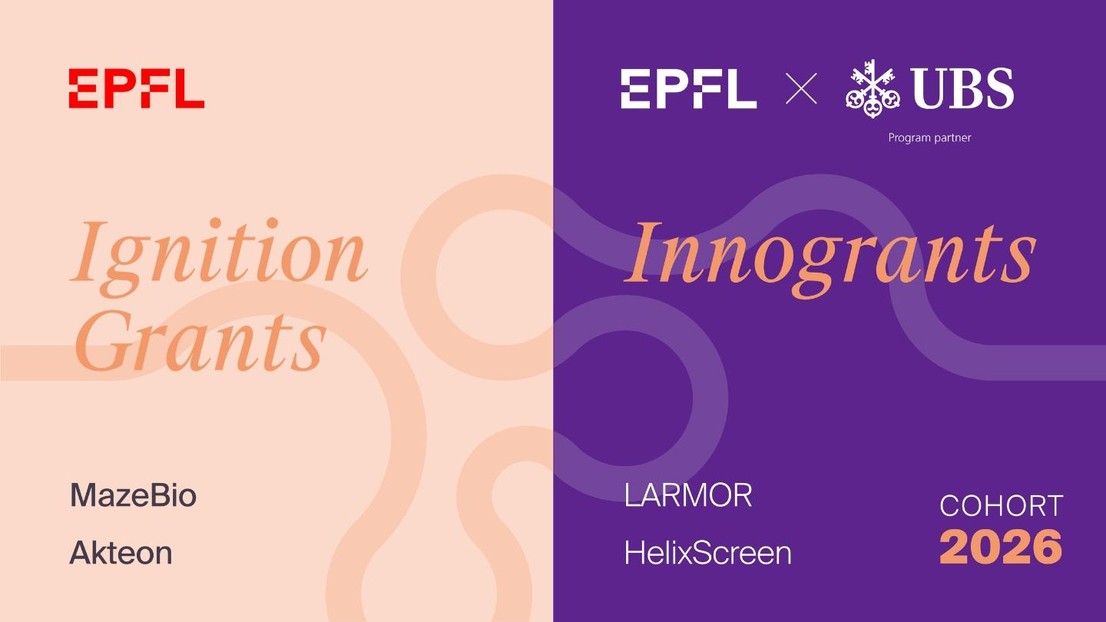
Ignition Grants and Innogrants © 2026 EPFL
Four promising startup projects: MazeBio, Akteon, Larmor and HelixScreen are supported by the EPFL Startup Launchpad and taking the next steps towards bringing their technologies to market. MazeBio and Akteon have each received a CHF 30,000 Ignition Grant, while Larmor and HelixScreen have each been awarded a CHF 100,000 Innogrant.
Spanning AI-powered drug discovery, compact flow cytometry, fusion energy and personalised cancer treatment, the four projects are addressing challenges across healthcare, biotechnology and energy, turning cutting-edge EPFL research into technologies with the potential for real-world impact.
MazeBio
Most drugs work by binding to a specific protein in the body and changing what it does - switching it on, switching it off, or holding it in a particular state. However, around four in five proteins linked to disease are currently classed as “undruggable”, meaning no drug has been found that can act on them reliably enough to become a treatment. Some of this is because certain diseases (particularly neurological and psychiatric conditions) are driven by proteins which are in a state of constant change. Whether a drug works on them depends on it fitting into that movement at the right moment. Current standard computational tools can only check whether a molecule binds to one static shape of a protein. MazeBio goes beyond this and predicts whether that molecule is likely to produce the desired therapeutic function.
The MazeBio team, hosted in Professor Camille Goemans's lab at EPFL, has built an AI platform that predicts how a candidate molecule reshapes a protein's movement, then ranks them based on end result. This means screening for function rather than just fit. Their approach has already found new antibiotic candidates that other methods missed and has shown promising results against a nervous system disease target. The team believes this early selection of promising compounds for further development will cut costs, time, and improve success rates.
The team will use their Ignition grant to run further validation on their proof of concept, screening a library of over 10,000 compounds against a difficult cancer target and benchmarking their results against existing tools to prove the platform's performance.
Team:
Matthieu Marfoglia
Akteon
Flow cytometry, a technique which analyses cells and particles in a fluid by passing it through a beam of light, is an essential tool in biotech, pharma, and environmental science. It is used in a variety of applications from drug development and quality monitoring, water quality analysis or haematology. Conventional flow cytometers cost up to $500,000, can weigh over 50kg, and, because of the way they are engineered, as an assembly of discreet components requiring alignments and complex calibration procedures, are bulky and need to be operated in a lab environment. This means analysis cannot be done in situ: inline in factory production line, in a riverbed, or at a patient’s bedside.
Akteon, a startup project from EPFL hosted in Professor Yves Bellouard's Galatea Lab, has developed a way to manufacture the flow cytometers system directly onto a single piece of glass using a concept of monolithic free space optics based on advanced laser processing methods. This removes the need for manual assembly and complex alignment requirements which make traditional instruments bulky and expensive. Fluid or air carrying the sample instead passes through a disposable glass channel and through a sequence of optical probes achieving multi-modal analysis. The core manufacturing method is already proven, and a first prototype measuring airborne bioaerosols using light scattering will soon be field-tested.

The team will use their Ignition grant to build a complete working demonstrator that combines multiple modal analysis on a single chip. Targeted markets are in pharmaceutical production, environmental monitoring and medtech.
Team:
Alexandre Duval
Larmor
Nuclear fusion is one of the most promising paths to abundant, lowcarbon energy, and the field is now at an inflection point, moving from public research programs toward commercial reality. Fusion reactors rely on highly specialised microwave sources built on gyrotron technology to heat and control the plasma. This creates a market gap worth billions by
the mid-2030s, driven by three pain points: constrained supply, performance that hasn't kept pace with next-generation reactor requirements, and the integration challenges of getting these complex systems working inside a reactor.
Larmor is based at the Swiss Plasma Center, working in the lab of Professor Paolo Ricci, and draws on decades of experience at the centre of the EU supply chain for these systems to help close that gap. The team is rethinking the system architecture and internal subcomponents of gyrotrons for scalability and improved performance, built on unique IP
developed with EPFL, to reduce capital and operational cost and make the technology more scalable. Larmor also supports end-users through integration, offering proven operational know-how that de-risks the process and saves them time and money.

The team will use their Innogrant to convert letters of interest into signed contracts and qualify their supply chain ahead of building their first demonstration units.
Team:
Massimo Carpita (Co-Founder & CEO) and Mackenzie van Rossem (Co-Founder & CTO)
HelixScreen
Breast cancer is the most diagnosed cancer in women worldwide. Each year there are approximately 2.4 million new cases and nearly 700,000 deaths from the disease. Current breast cancer treatment relies heavily on trial and error. While existing genomic tests can flag that a tumour might respond to a given drug based on its mutations, they cannot confirm that it will. Up to 60% of prescribed therapies fail before the right treatment is found.
The HelixScreen team, based in Professor Cathrin Brisken's lab, has developed a technology that tests multiple drugs directly on a patient's own tumour tissue, rather than on a proxy model. Tissue from a routine biopsy is maintained in the lab as a 3D fragments, then exposed to multiple drug candidates simultaneously. An RNA-sequencing readout is delivered within a few days, showing not only which drug is likely to work, but why. For oncologists and patients, this means an end to ineffective prescribing and unnecessary treatment. For pharmaceutical companies, the fast readout supports drug development and biomarker discovery.
The team will use their Innogrant to take the next steps toward a market-ready product: defining a regulatory pathway and expanding their patient validation cohort.
The EPFL Ignition Grant provides up to CHF 30,000 to help early-stage teams explore the potential of promising technologies. It supports the first steps towards entrepreneurship by enabling teams to validate their proof of concept and assess its potential for real-world applications.
The EPFL Innogrant is one of Switzerland’s pioneering instruments for supporting deep‑tech entrepreneurship. Designed to help researchers make the leap from lab to market, it has backed 200+ founders at the earliest and most fragile stage of company creation. The program is made possible thanks to the support of UBS, whose commitment helps EPFL sustain a vibrant pipeline of science‑driven innovation.