
Neutrinos caught on camera
ETH Zurich/Sgalaberna Group
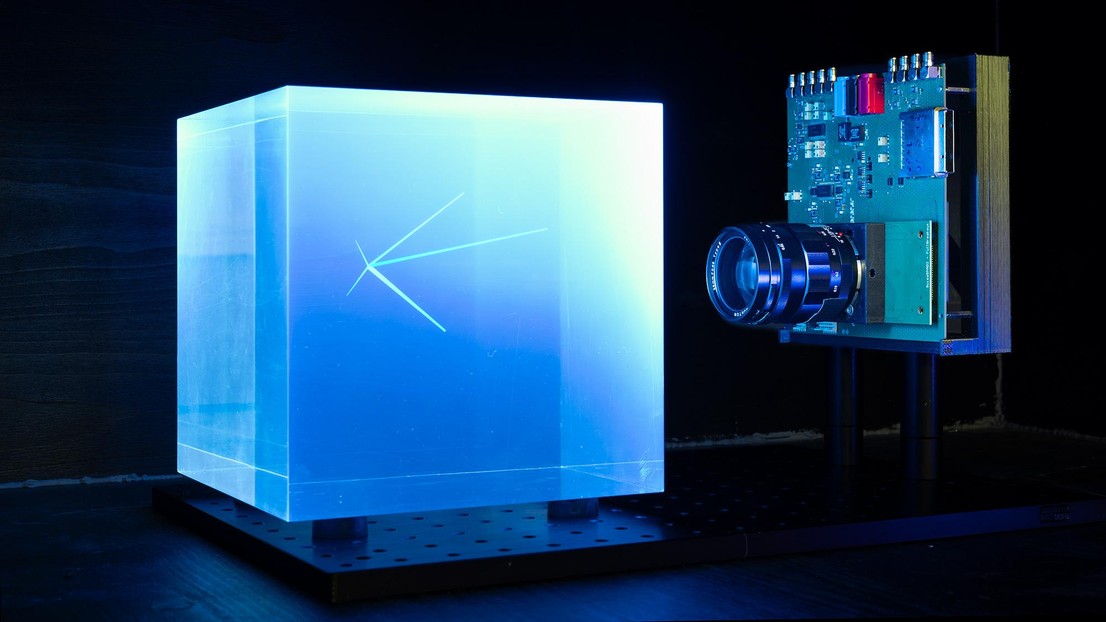
Researchers from ETH Zurich and EPFL have tested the first prototype of a new elementary particle detector for ultrafast, three-dimensional imaging in large-volume, dense materials.
Most particle physics experiments require the 3D tracking of elementary particles like neutrinos. This is typically achieved using materials called scintillators, which are divided into many small segments, each of which emits photons of visible light when charged particles pass through them. The photons are then collected by optical fibers and analyzed. However, as experiments grow larger, this segmentation-based approach becomes prohibitively cumbersome and complex.
Now, a collaboration led by Till Dieminger, Saúl Alonso-Monsalve, and Davide Sgalaberna from the Department of Physics at ETH Zurich, together with Kodai Kaneyasu, Claudio Bruschini, and Edoardo Charbon from the Advanced Quantum Architecture Lab in EPFL’s School of Engineering, invites the research community to change radically the way that elementary particles are detected. Moving away from segmentation, they propose using one large, solid block of scintillator material, and reconstructing particle pathways using advanced optics and timing electronics.
In their study, the team demonstrated and tested the first prototype of a new detector capable of performing ultrafast, 3D and high-resolution imaging of particles in large volumes of unsegmented scintillator material. The demonstration and comprehensive simulations have been published in Nature Communications.
Spatial and temporal precision
Within the framework of the Swiss National Science Foundation-funded PLATON project, the ETHZ-EPFL team built a first concept demonstrator based on a light field camera featuring a micro-lens array (MLA) and single-photon avalanche diode (SPAD) array imaging sensor, SwissSPAD2, developed by Charbon and his team. Crucially, SwissSPAD2 adds gated photon detection to the setup, making it possible to detect, 97,000 times per second, not only where light is produced, but also when. This means that a particle’s 3D path can be reconstructed without physically segmenting the material.
In laboratory tests, the team showed that the device could reconstruct the position of light sources with high precision, even when only a handful of photons were detected. In all considered cases, simulations show good agreement with the measurements performed in the laboratory.
To build on these promising results, the researchers are already developing a novel SPAD array sensor that will allow them to achieve higher photodetection efficiency as well as single-photon sub-nanosecond temporal resolution. Thanks to its unprecedented accuracy and scalability, the researchers believe that their system could provide a performance boost in a variety of imaging applications beyond particle physics.
Dieminger, T., Alonso-Monsalve, S., Alt, C. et al. An ultrafast plenoptic-camera system for high-resolution 3D particle tracking in unsegmented scintillators. Nat Commun (2026). https://doi.org/10.1038/s41467-026-70918-x