
Nanoliter Liquid Packaging in a Bioresorbable Microsystem
© 2023 EPFL
Congratulations to Jongeon Park, PhD student at LMIS1, for his new publication entitled "Nanoliter Liquid Packaging in a Bioresorbable Microsystem by Additive Manufacturing and its Application as a Controlled Drug Delivery Device" in the journal "Advanced Functional Materials".
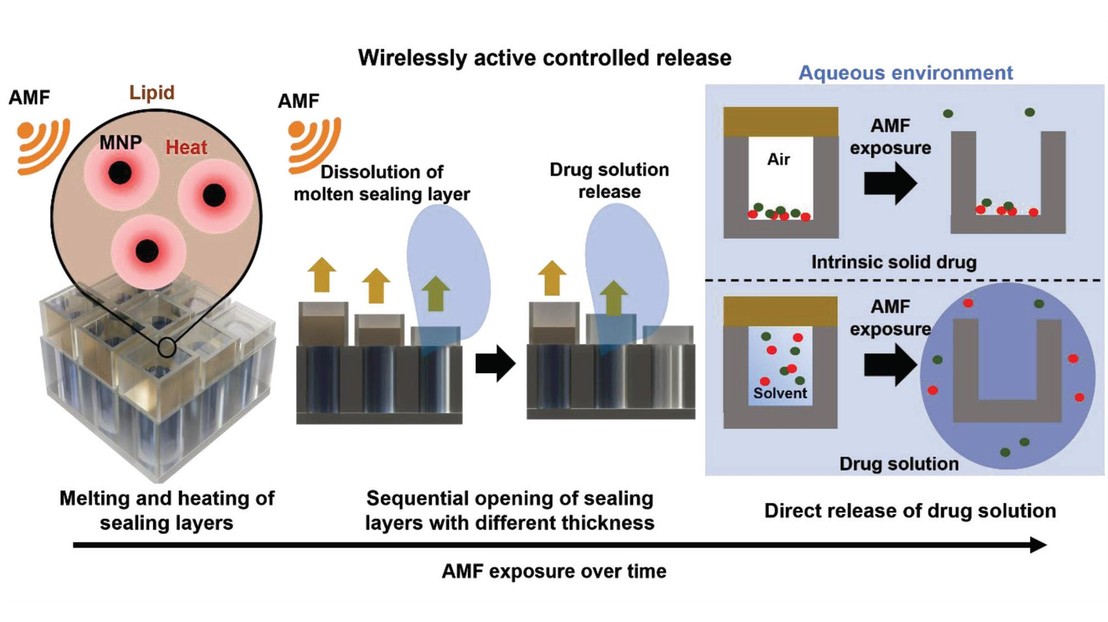
Precise packaging of nanoliter amounts of liquid in a microsystem is important for many biomedical applications. However, existing liquid encapsulation technologies have limitations in terms of liquid waste, evaporation, trapped bubbles, and liquid degradation. In this study, multiple additive manufacturing techniques for nanoliter liquid packaging in bioresorbable microsystems is used. Two-photon photolithography is used for bioresorbable reservoir fabrication, while inkjet printing (IJP) is used for precise nanoliter liquid packaging. Dual IJP allows for micro-reservoirs to be filled with precise amounts of drug solution and subsequently and rapidly sealed with a layer of lipids mixed with Fe3O4 nanoparticles. Combining these two printing techniques can overcome the previous limitations of liquid encapsulation technologies. To demonstrate the relevance of this technique, a wirelessly activated, bioresorbable multi-reservoir microcapsule that can be used for controlled drug delivery is presented. The microcapsules and their content are shown to be stable during fabrication, storage, and operation. Multiple cargo release events are triggered independently by the local melting of the sealing layer, resulting from magnetically induced Fe3O4 nanoparticleheating. The operation of the capsule is demonstrated in tissue phantoms and in vitro cell cultures.
For more details, please visit: https://doi.org/10.1002/adfm.202302385
Part of this work has received funding from the European Research Council (ERC) under the European Union’s Horizon 2020 research and innovation program (Grant No. ERC-2016-ADG, Project “MEMS 4.0” Grant No. 742685).