Nanodevice produces continuous electricity from evaporation

© iStock
A nanodevice developed at EPFL produces an autonomous, stable current from evaporating saltwater by using heat and light to control the movement of ions and electrons.
In 2024, researchers in the Laboratory of Nanoscience for Energy Technology (LNET) in EPFL’s School of Engineering reported a platform for studying the hydrovoltaic (HV) effect – a phenomenon that allows electricity to be harvested when fluid is passed over the charged surface of a nanodevice. Their platform consisted of a hexagonal network of silicon nanopillars, the space between which created channels for evaporating fluid samples.
Now the LNET team, led by Giulia Tagliabue, has developed this platform into a hydrovoltaic system with a power output that matches or exceeds similar technologies – with a major advantage. Instead of relying on heat and light to simply boost evaporation, the EPFL system generates current by harnessing heat and light to control the movement of ions in evaporating saltwater, and the flow of electrons in the silicon nanodevice.
“Heat and light imbalances will always affect a hydrovoltaic device, but we have discovered how these can be leveraged to our advantage,” explains LNET researcher Tarique Anwar.
With three distinct layers dedicated to evaporation, ion transport, and electrical charge collection, the nanodevice’s decoupled design allows the scientists to observe and finely tune each step in the process. The research has been published in Nature Communications.
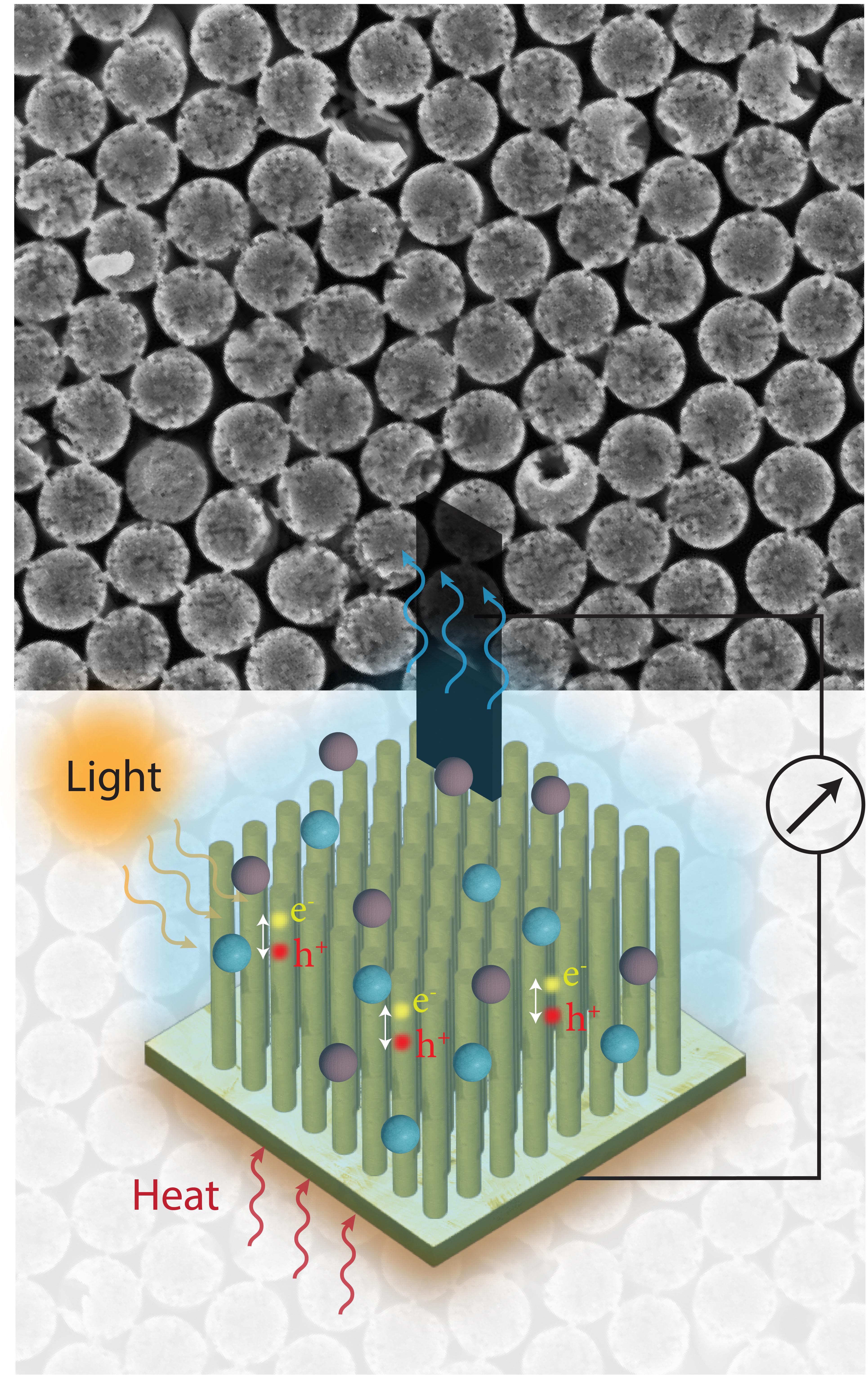
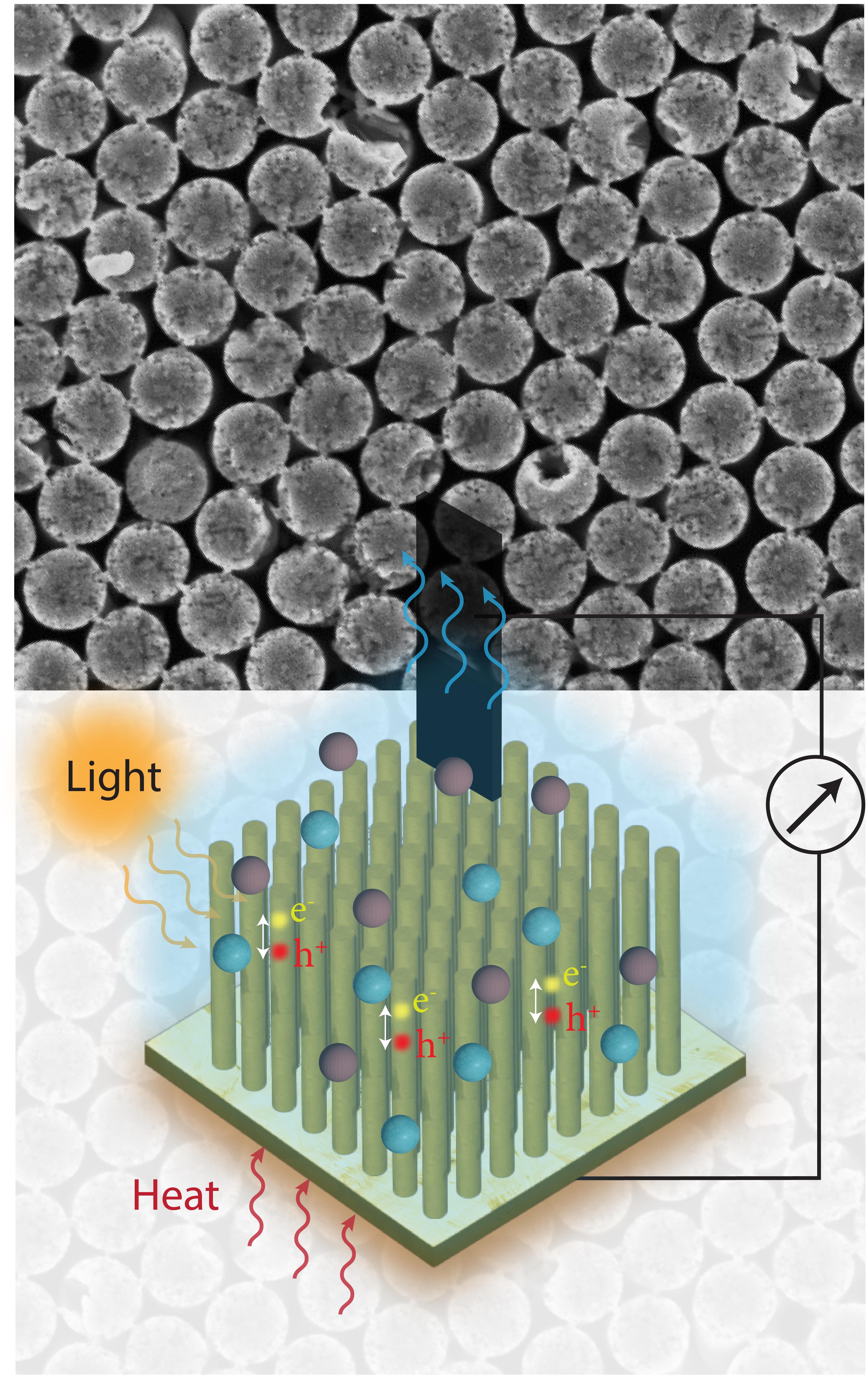
array of silicon nanopillars immersed in water. 2026 LNET EPFL CC BY SA
Harnessing a natural effect
Usually, when we think about the effects of heat and light on evaporation, we understand that heat energy hastens water’s transformation into vapor. Previous studies have focused on this effect for HV energy harvesting, but the EPFL researchers realized that the accelerated energy production they observed wasn’t due to evaporation alone.
Because their nanodevice is made of a silicon semiconductor, the electrons within are excited by photons from sunlight, while heat enhances the negative charges on its surface. At the same time, heat-driven evaporation in a layer of saltwater above the nanodevice causes ions to shift, creating separations between positive and negative charges. This charge separation at the liquid-solid interface creates an electric field that drives the excited electrons through a connected circuit, producing electricity.
“Our work shows that due to this surface charge effect, the addition of solar light and heat can enhance energy production by a factor of 5. This natural effect has always existed, but we are the first to harness it,” Tagliabue says.
Continuous, autonomous power
The researchers emphasize that in addition to excellent voltage and power density (1 V and 0.25 W/m2, respectively) their system offers an advantage for continuous, autonomous electricity generation. “In HV devices, performance enhancement via heat and light inputs causes material degradation over time, especially in saltwater conditions. In contrast, our device’s nanopillars are coated with an oxide layer to ensure stable performance under heat and light, and to protect against unwanted chemical reactions,” Tagliabue says.
Separating the device into three layers also allowed the team to develop a model to explain their observations and optimize power output by tweaking the nanopillar structure and salt concentration. The team is now developing tools to probe these phenomena in real time while experimenting with heat and light input via a solar simulator.
The researchers believe their innovation will accelerate the development of hydrovoltaic devices, which have great potential to power battery-free small sensor networks wherever water, heat, and sunlight are available. Examples include self-powered environmental monitoring systems, wearable devices, and internet-of-things applications.
Anwar, T., Tagliabue, G. Enhancing hydrovoltaic power generation through coupled heat and light-driven surface charge dynamics. Nat Commun 17, 1541 (2026). https://doi.org/10.1038/s41467-025-68261-8
Images to download