
N-Pulse puts students on track for the 2028 Cybathlon
2026 EPFL/Alain Herzog - CC-BY-SA 4.0
Through the N-Pulse student association, around 50 budding engineers are developing non-invasive biomedical technology to assist the disabled. The initiative is now entering its second year.
The various systems being developed under N-Pulse include a helmet that can read brain activity, a bracelet for decoding muscle movements, a haptic feedback accessory and a bionic prosthetic arm. These EPFL student projects are being supported by the MAKE initiative and will be presented at the next Cybathlon – an international competition held in Switzerland during which teams test robotic devices to help the disabled with everyday tasks.
“MAKE projects require students to set a firm deadline in order to keep us focused, so we decided to enter the next Cybathlon, which will take place in 2028,” says Evan Massonnet, the N-Pulse vice president and a master’s student in Neuro-X. “That gives us time to take our projects forward.”

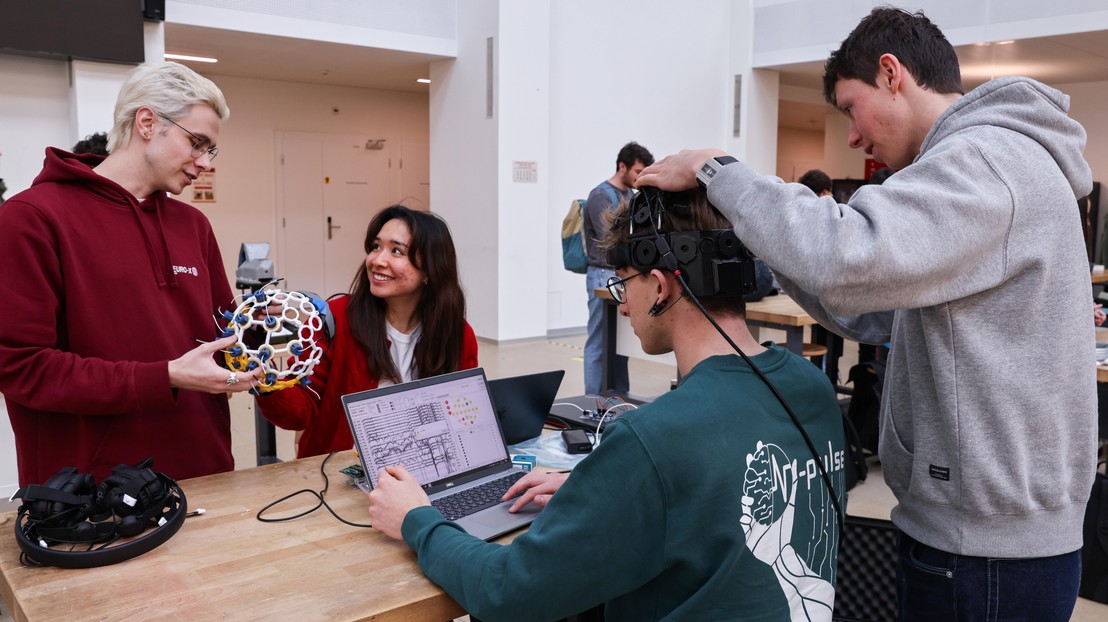
to develop brain-computer interfaces.
2026 EPFL/Alain Herzog - CC-BY-SA 4.0
The idea for N-Pulse came about when the team behind EPFL’s Discovery Learning Labs (DLLs), which oversee student projects, brought in experts including Mahsa Shoaran and Mohammad Ali Shaeri, both from EPFL’s Integrated Neurotechnologies Laboratory at Campus Biotech. “We immediately came on board after seeing how excited the students were about creating brain-computer interfaces,” says Shoaran. “Our research group works directly on these kinds of interfaces, designing both the hardware and software.”
Ali Shaeri, an expert in algorithms and hardware, supervised several student projects under the DLL program, including those by Massonnet and Roman Danylovych. The two students were subsequently joined by Charles Stockman, and the team founded N-Pulse, which became part of the MAKE initiative. N-Pulse now has around 50 members, with Ali Shaeri serving as the lead scientist and main coordinator. “Neural interfaces often require an invasive procedure, and the non-invasive options currently available are quite complicated technically,” says Stockman. He also points out that neurotechnology draws on a number of fields including materials science, electronics, signal processing, mechanical engineering, software programming and artificial intelligence to interpret the brain signals.

the information needed for an effective and personalized prosthesis.
2026 EPFL/Alain Herzog - CC-BY-SA 4.0
One of the biggest challenges of these student projects is designing the assistive devices. What features should a prosthesis have in order to be truly practical? What information is needed to perform the right movements and exert the right amount of pressure? “If a wearer wants to pick up their phone, it’s important that the phone can’t slip between the fingers,” says Massonnet. Miniaturization is also essential: “The headsets we’re using for our research are huge – I doubt anyone would actually want to wear one to control their prosthesis.”
Another key issue relates to the safety of batteries attached to the body. “The devices need to be lightweight because patients with an amputated hand, for example, rarely use their bicep muscles,” says Christophe Hreich, a second-year bachelor’s student in microengineering who’s developing a robotic wrist. “We’re learning by trial and error, and each iteration – I’m now on my fifth one – gets us one step closer to a viable solution.”

2026 EPFL/Alain Herzog - CC-BY-SA 4.0
Given all the aspects involved – design, safety, miniaturization and data analysis – “if the students manage to pull everything together into a coherent system, that will already be a great achievement,” says Ali Shaeri. The students are taking an open-source approach, which is a big advantage. “That means they can experiment freely, design their own equipment and make their technology available to the broader scientific and medical communities,” says Shoaran. In addition, as more people use the open-source data, they will generate even more data, which in turn can be used to improve the algorithms. “This is a general trend we’re seeing in neuro-AI decoding – more systems are being made public, which is leading to more sophisticated and powerful models,” she says.

2026 EPFL/Alain Herzog - CC-BY-SA 4.0
The N-Pulse students are also being advised on questions related to ethics, on testing their systems and on working with potential users. “We need to collect personal data for our devices, so there are a lot of hoops to jump through,” says Massonnet. The students have to map out how these data will be processed, who will be involved and whether the data subjects will be adults or children, for example. Not to mention the slew of regulations: those issued by EPFL, by the cantonal government, by the Campus Biotech ethics committee and by the research group supervising the projects. “Getting all the ethics-related approvals is tedious and stressful, but it’s also a learning experience and gives us a taste of the regulatory framework for the biomedical industry,” says Massonnet.